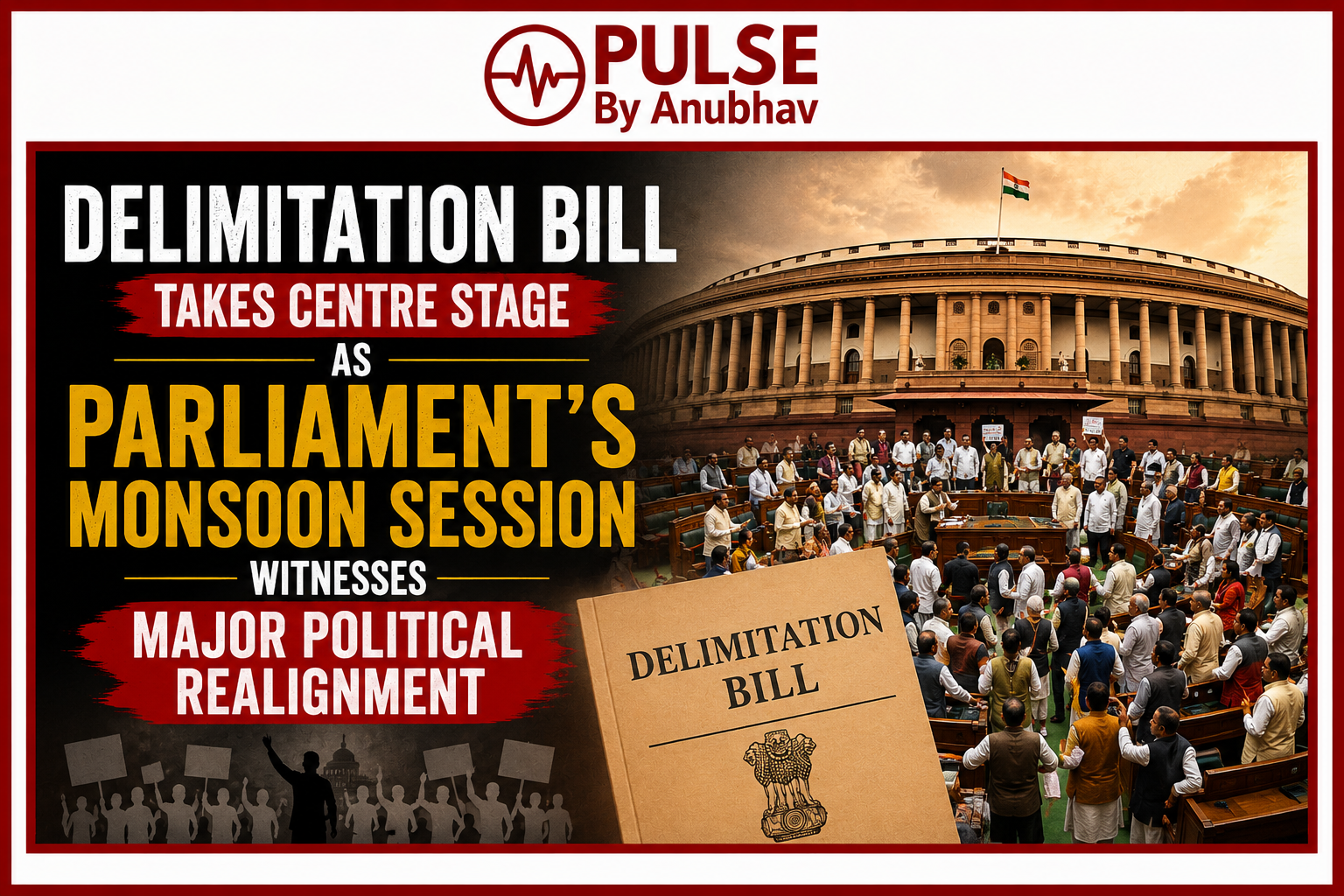
Delimitation Bill dominates Parliament’s Monsoon Session as political alliances shift, youth protests grow, and opposition parties debate the proposed reforms.
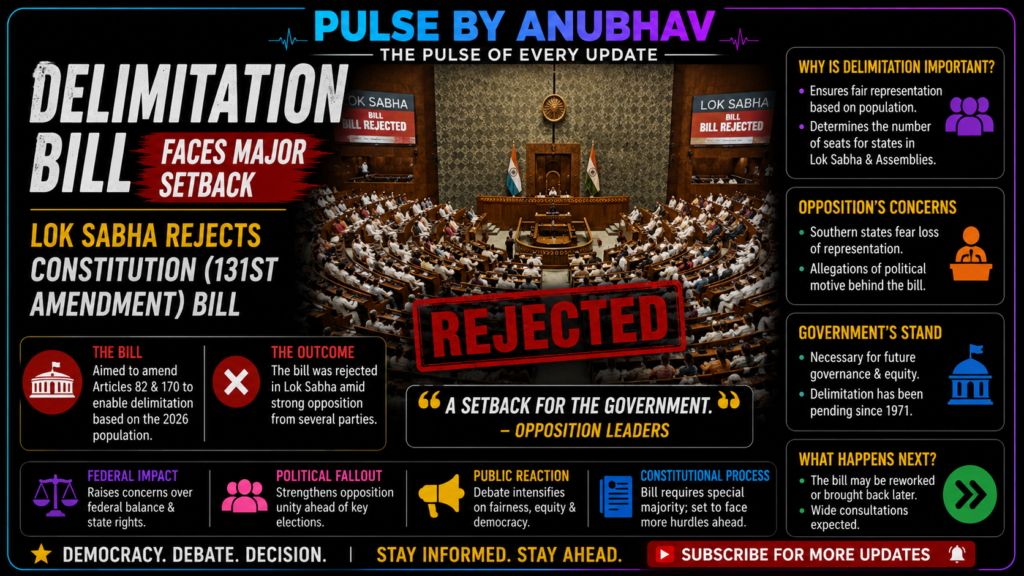
The Delimitation Bill has emerged as the biggest political issue during Parliament’s Monsoon Session, triggering intense debates across party lines. While the BJP seeks wider support for the proposed constitutional amendment, parties like the Samajwadi Party continue to oppose it, and the DMK has hinted at conditional backing if southern states’ interests remain protected. Youth protests over examination reforms have also reshaped the political agenda, making the Delimitation Bill one of the most closely watched developments in Parliament. Pulse by Anubhav will continue bringing verified updates and in-depth coverage of every major political development.
Delimitation Bill Takes Centre Stage as Parliament’s Monsoon Session Witnesses Major Political Realignment
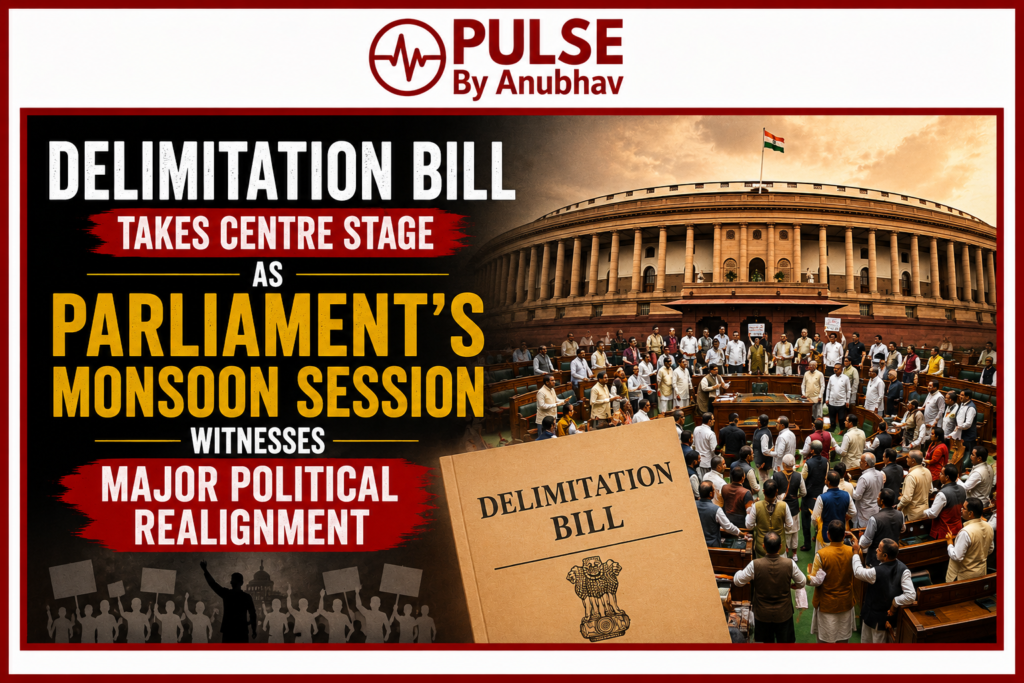
India’s Parliament has entered one of its most politically charged Monsoon Sessions in recent years, with the Delimitation Bill emerging as the biggest point of confrontation between the ruling BJP and opposition parties. While the government was expected to focus on reviving the Constitution (131st Amendment) Bill, massive youth protests over examination paper leaks, shifting political alliances, and fresh negotiations among regional parties have significantly altered the legislative landscape.
The debate is no longer limited to the redistribution of Lok Sabha seats. Instead, it has evolved into a larger political battle involving electoral representation, federal balance, student movements, and coalition politics ahead of future elections.
Youth Protest Changes Parliament’s Political Narrative
The government’s original legislative roadmap faced an unexpected challenge after thousands of students and young protesters marched towards Parliament during the nationwide “Sansad Chalo” campaign. Organised by the Cockroach Janta Party (CJP), the protest demanded stronger action against examination paper leaks and called for the resignation of Union Education Minister Dharmendra Pradhan.
Although police stopped the protesters before they could reach Parliament, the movement quickly became the defining issue of the Monsoon Session. Both the government and opposition were forced to respond as public attention shifted from legislative business to youth concerns.
Prime Minister Narendra Modi later announced stricter legal measures against paper leaks and promised stronger punishment for those involved. The Centre also indicated its willingness to hold discussions with protest leaders while continuing to defend its existing education reforms.
Also Read- Neha Bora: Biography, 23-Day Hunger Strike, AISA Activists & What’s Next After the CJP Protest
BJP’s Strategy Revolves Around the Delimitation Bill
Before the session began, the BJP believed political arithmetic inside Parliament had improved enough to revisit the Delimitation Bill.
Several developments strengthened the government’s confidence:
Changing Numbers in Parliament
Since the previous session:
- Several Trinamool Congress MPs shifted towards the ruling alliance.
- A section of Shiv Sena (UBT) legislators joined the Eknath Shinde-led faction.
- Discussions continued regarding possible political adjustments within the Nationalist Congress Party.
These developments encouraged the BJP to believe that the Constitution (131st Amendment) Bill could receive broader parliamentary support than before.
However, growing public protests and renewed opposition unity complicated those calculations almost immediately.
Why the Delimitation Bill Remains Politically Sensitive
The proposed Delimitation Bill aims to redraw parliamentary constituencies while increasing Lok Sabha seats to accommodate future population changes.
The proposal also connects with the implementation of women’s reservation under the Nari Shakti Vandan Adhiniyam, making it one of the most significant constitutional reforms currently under discussion.
Despite its constitutional importance, the proposal has divided political parties because many southern states fear losing proportional representation if population becomes the primary criterion for seat allocation.
For this reason, every regional party is carefully evaluating the long-term political consequences before declaring its final position.
Samajwadi Party Vows to Block the Delimitation Bill
Among the strongest opponents of the proposal is the Samajwadi Party.
Party leader Dharmendra Yadav reiterated that the party would use its complete parliamentary strength to prevent the Bill from being passed.
According to the Samajwadi Party, the government has failed to justify why the existing democratic framework requires such sweeping constitutional changes. The party also argues that the issue of women’s reservation should not be used to introduce broader changes in constituency boundaries.
With Uttar Pradesh expected to gain additional Lok Sabha seats under any future delimitation exercise, the Samajwadi Party’s opposition carries considerable political significance inside Parliament.
DMK Softens Its Position but Sets Clear Conditions
The Dravida Munnetra Kazhagam (DMK) appears to be adopting a more flexible approach compared to its earlier outright opposition.
Instead of rejecting the proposal completely, party leaders have indicated that they may consider supporting the legislation if certain safeguards are included.
The DMK’s major conditions include:
- Equal percentage increase in Lok Sabha seats for every state.
- No reduction in Tamil Nadu’s existing parliamentary representation.
- Population should not become the only basis for seat allocation.
- Southern states should not lose political influence after delimitation.
Party leaders insist that any future support would depend entirely on the final draft presented in Parliament rather than political alliances.
Also Read- Nandan Nilekani to Lead High-Powered Task Force as PM Modi Unveils Major Exam Reforms
Constitution (131st Amendment) Bill Faces Fresh Uncertainty
The Constitution (131st Amendment) Bill previously failed to secure the mandatory two-thirds majority in the Lok Sabha despite receiving substantial support.
Its defeat demonstrated that constitutional amendments continue to require broad political consensus rather than simple numerical strength.
Although the BJP entered the Monsoon Session hoping to revive the legislation, fresh political developments have once again made its passage uncertain.
The government now faces the challenge of balancing constitutional reforms with increasing public pressure over unrelated but politically influential issues.
Sharad Pawar’s Meeting With PM Modi Fuels Political Speculation
Another major political development came when Nationalist Congress Party (SP) chief Sharad Pawar met Prime Minister Narendra Modi shortly after visiting the CJP protest site at Jantar Mantar.
The timing of the meeting immediately sparked speculation regarding possible political cooperation.
Officially, Pawar stated that the discussion focused on:
- Farmer suicides
- Minimum Support Price (MSP)
- Crop insurance
- Irrigation projects
- Student concerns raised during the ongoing protests
However, political observers also linked the meeting with broader discussions surrounding the Delimitation Bill, especially after reports suggested that the BJP was exploring support from regional parties on key constitutional legislation.
Neither the Prime Minister’s Office nor the NCP (SP) confirmed any political negotiations regarding the proposed Bill.
Parliament Continues to Witness Changing Political Equations
The Monsoon Session has highlighted how quickly parliamentary dynamics can change.
Opposition parties remain divided on several regional issues, yet they have largely united over student concerns. At the same time, regional parties such as the DMK and NCP (SP) are signalling that future support for any major constitutional legislation will depend on policy rather than permanent political alliances.
This evolving political environment makes the fate of the Delimitation Bill increasingly unpredictable.
Final Words
The Delimitation Bill has become much more than a constitutional proposal. It now represents a broader debate over federal representation, electoral fairness, regional balance, and political strategy inside Parliament.
With youth protests influencing legislative priorities, opposition parties recalibrating their positions, and regional players keeping their options open, the coming weeks are expected to determine whether the government can build the consensus required for one of India’s most significant constitutional reforms.
Pulse by Anubhav will continue tracking every major development from Parliament, bringing verified updates, political analysis, and the latest news surrounding the Delimitation Bill as the Monsoon Session progresses.
Also Read- Who Is Pralhad Joshi? Meet India’s New Education Minister, Five-Time MP with RSS Background
1 thought on “Delimitation Bill Faces Major Setback in Parliament as Lok Sabha Rejects Constitution (131st Amendment) Bill”