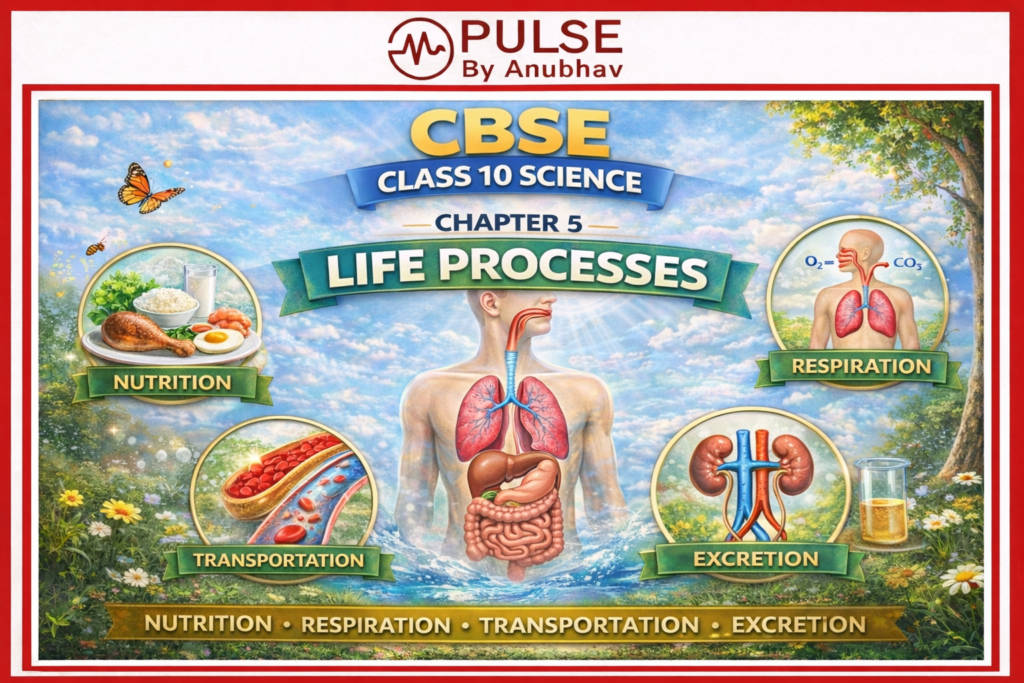
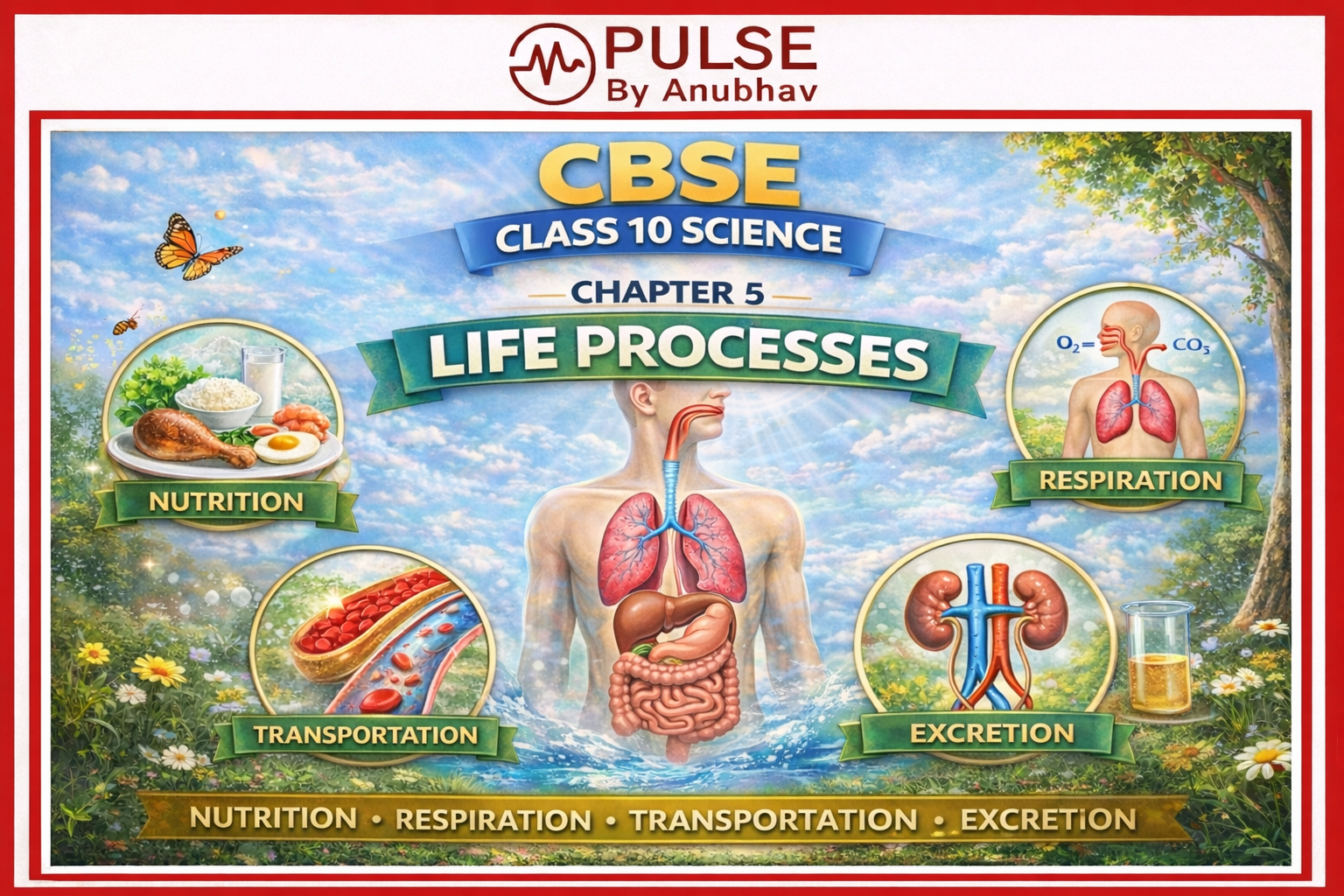
CBSE Class 10 Science Chapter 5 Life Processes

Life Processes is a chapter in your science subject. Radhe Radhe to all my dear children! You all will have to work very hard for your board exams to get good marks. In this post, I will try to cover all the important topics of your 10th-grade science syllabus so that you can understand and remember them.

Life Processes, which is your fifth chapter, falls under the biology section of science. All the information you need to study in this chapter will be found in this post.

Also Read- CBSE Class 10 Science Chapter 4 Carbon and Its Compounds

๐Ÿ‘‰ Skip everything and click here to directly view the Notes PDF

Key Content of Chapter 5 Life Processes

๐Ÿ”น What is Life & Life Processes

  • Living organisms show molecular movements even when no visible movement is seen.
  • Life processes are basic maintenance activities required to keep an organism alive.
  • These include nutrition, respiration, transportation and excretion.
  • Viruses show life only inside a host cell, hence their living status is debated.

๐Ÿ”น 1. Nutrition

Nutrition is the process by which organisms obtain food and utilise it for energy, growth and repair.

(a) Autotrophic Nutrition

  • Found in green plants and some bacteria.
  • Plants make their own food by photosynthesis.
  • Raw materials: Carbon dioxide (air), Water (soil), Sunlight, Chlorophyll.
  • Photosynthesis steps:
    1. Absorption of light by chlorophyll
    2. Conversion of light energy into chemical energy
    3. Reduction of COโ‚‚ into carbohydrates
  • Food is stored as starch in plants.

(b) Heterotrophic Nutrition

  • Organisms depend on others for food.
  • Types:
    • Holozoic โ€“ humans, animals
    • Saprophytic โ€“ fungi
    • Parasitic โ€“ cuscuta, tapeworm

๐Ÿ”น Nutrition in Human Beings

  • Digestion occurs in the alimentary canal.
  • Mouth: Saliva (amylase) digests starch.
  • Stomach: HCl kills germs, pepsin digests proteins.
  • Small intestine: Complete digestion & absorption using bile and pancreatic juice.
  • Villi increase surface area for absorption.
  • Large intestine: Absorbs water, forms faeces.

๐Ÿ”น 2. Respiration

Respiration is the process of releasing energy from food.

Types of Respiration

  • Aerobic respiration: Uses oxygen, produces more energy.
  • Anaerobic respiration: Occurs without oxygen (yeast, muscles during cramps).
  • Cellular respiration: Glucose โ†’ Pyruvate โ†’ Energy (ATP).

Respiration in Humans

  • Organs involved: Nose โ†’ Trachea โ†’ Lungs โ†’ Alveoli.
  • Alveoli: Large surface area, thin walls, rich blood supply.
  • Haemoglobin transports oxygen in blood.

๐Ÿ”น 3. Transportation

(a) Transportation in Humans

  • Transport system includes heart, blood and blood vessels.
  • Heart: Four chambers, double circulation.
  • Blood: Plasma, RBCs, WBCs, platelets.
  • Arteries: Carry blood away from heart.
  • Veins: Bring blood back to heart.
  • Capillaries: Exchange of materials.
  • Lymph: Transports fats and excess fluid.

(b) Transportation in Plants

  • Xylem: Transports water and minerals (root pressure + transpiration pull).
  • Phloem: Transports food by translocation using energy (ATP).
  • Transport is slower due to low energy requirement.

๐Ÿ”น 4. Excretion

(a) Excretion in Humans

  • Organs: Kidneys, ureters, urinary bladder, urethra.
  • Nephron is the functional unit of kidney.
  • Functions:
    • Filtration
    • Reabsorption
    • Urine formation
  • Excess wastes removed as urine.

(b) Excretion in Plants

  • Gases removed through stomata.
  • Wastes stored in vacuoles, gums, resins.
  • Some wastes removed by shedding leaves or into soil.

Also Read- CBSE Class 10 Science Chapter 4 Carbon and Its Compounds

Class 10 Science Chapter 5 Life Processes Notes

CBSE Class 10 Science โ€“ Chapter 5
Life Processes
Complete Class 10 Science Chapter 5 notes, NCERT book PDF aur official Telegram channel ka direct access yahan se milega.

Science Chapter 5 Life Processes MCQs

Q1. Which is NOT a reliable characteristic to identify life?
A. Visible movement
B. Molecular movement
C. Respiration
D. Metabolism
โœ… Correct Answer: Visible movement
Q2. Why are viruses considered at the border of living and non-living?
A. They respire
B. They show activity only inside host cell
C. They grow independently
D. They have tissues
โœ… Correct Answer: They show activity only inside host cell
Q3. Life processes are essential to:
A. Increase size only
B. Maintain living structures
C. Cause movement
D. Produce energy only
โœ… Correct Answer: Maintain living structures
Q4. Which process provides energy required for life activities?
A. Transport
B. Respiration
C. Excretion
D. Diffusion
โœ… Correct Answer: Respiration
Q5. Autotrophs prepare their own food by:
A. Respiration
B. Photosynthesis
C. Fermentation
D. Digestion
โœ… Correct Answer: Photosynthesis
Q6. Which structure increases surface area for absorption in intestine?
A. Alveoli
B. Villi
C. Nephrons
D. Capillaries
โœ… Correct Answer: Villi
Q7. Breakdown of glucose without oxygen is called:
A. Aerobic respiration
B. Anaerobic respiration
C. Transpiration
D. Diffusion
โœ… Correct Answer: Anaerobic respiration
Q8. Oxygen is transported in human blood mainly by:
A. Plasma
B. Haemoglobin
C. Platelets
D. Lymph
โœ… Correct Answer: Haemoglobin
Q9. Which tissue transports food in plants?
A. Xylem
B. Phloem
C. Cambium
D. Cortex
โœ… Correct Answer: Phloem
Q10. The functional unit of kidney is:
A. Alveolus
B. Nephron
C. Villus
D. Capillary
โœ… Correct Answer: Nephron

Also Read- CBSE Class 10 Science Chapter 3 Metals and Non-metals

FAQs About Life Processes

Q1. What are life processes?
Life processes are the basic maintenance activities performed by living organisms to sustain life, such as nutrition, respiration, transport and excretion.
Q2. Why are life processes essential even when an organism is at rest?
Even at rest or during sleep, organisms need energy to maintain body structure, repair cells and carry out vital metabolic activities.
Q3. Why is visible movement not a defining characteristic of life?
Some living organisms may not show visible movement, but molecular movements and metabolic activities continue inside them, which are essential for life.
Q4. What is nutrition?
Nutrition is the process by which organisms obtain food from outside and use it to get energy, grow and repair their body.
Q5. What is the difference between autotrophic and heterotrophic nutrition?
Autotrophs make their own food using sunlight, carbon dioxide and water, while heterotrophs depend on other organisms for food.
Q6. Why is respiration important for living organisms?
Respiration releases energy from food which is required for growth, repair, movement and other life activities.
Q7. Why is diffusion insufficient in multicellular organisms?
In multicellular organisms, many cells are not in direct contact with the environment, so diffusion alone cannot meet their oxygen and nutrient needs.
Q8. What is transportation in living organisms?
Transportation is the process by which food, oxygen, water and wastes are carried from one part of the body to another.
Q9. What is excretion?
Excretion is the process of removing harmful metabolic waste products from the body to maintain internal balance.
Q10. Why are molecular movements necessary for life?
Molecular movements help in repair, maintenance and functioning of cells. Without these movements, organised living structures would break down.
CBSE Class 10 Science โ€“ Chapter Wise Notes

1
Chemical Reactions and Equations
2
Acids, Bases and Salts
3
Metals and Non-metals
4
Carbon and Its Compounds
5
Life Processes
6
Control and Coordination
7
How do Organisms Reproduce?
9
Light โ€“ Reflection and Refraction
10
The Human Eye and the Colorful World
11
Electricity
12
Magnetic Effects of Electric Current
13
Our Environment

Leave a Comment