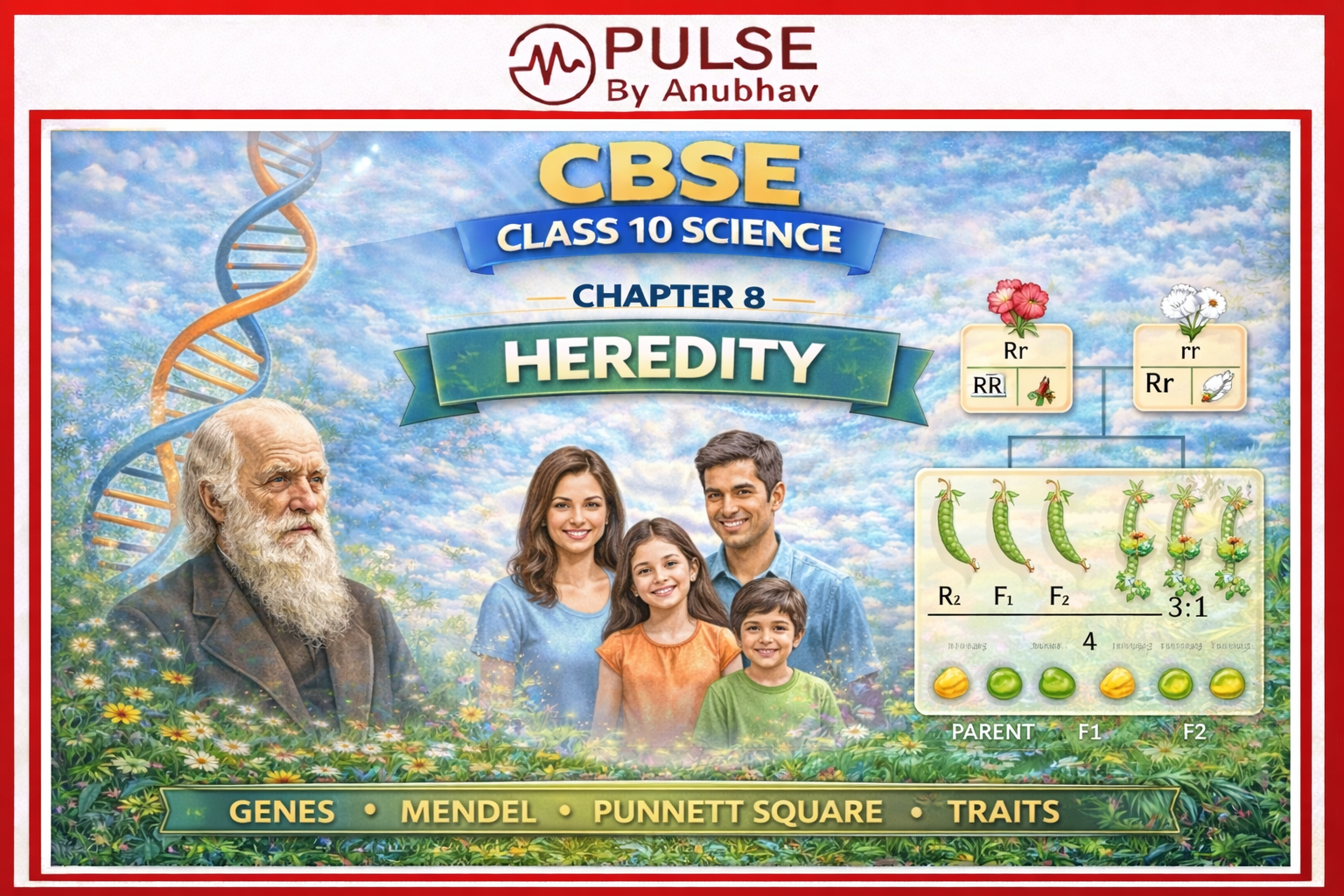
Heredity is a chapter in your science subject. Radhe Radhe to all my dear children! You all will have to work very hard for your board exams to get good marks. In this post, I will try to cover all the important topics of your 10th-grade science syllabus so that you can understand and remember them.
Heredity, which is your eighth chapter, falls under the biology section of science. All the information you need to study in this chapter will be found in this post.
Also Read- CBSE Class 10 Science Chapter 4 Carbon and Its Compounds
👉 Skip everything and click here to directly view the Notes PDFKey Content of Chapter 8 Heredity
🔹 What is Heredity?
- Traits ka parents se offspring me transfer
- Offspring similar bhi hote hain, thode different bhi
🔁 Accumulation of Variation
- Reproduction ke saath variation add hoti jaati hai
- Asexual reproduction → kam variation
- Sexual reproduction → zyada variation
- Variation = survival + evolution ka base
🧬 Why Variation is Important?
- Environment change hota rehta hai
- Kuch variations survival me help karte hain
- Useful variations aage pass hote hain
🧠 Inherited Traits
- Traits = visible characters (height, earlobes, colour)
- Har child me parents ke traits ka mix
- Same species → same basic body design
🌱 Mendel’s Contributions
- Mendel ne pea plants pe experiments kiye
- Traits mix nahi hote, balki alag-alag rehte
- Har trait ke 2 factors (genes) hote hain
👑 Dominant & Recessive Traits
- Dominant → ek copy me hi show ho jaata hai
- Recessive → dono copies honi chahiye
Example:
- Tall (T) → dominant
- Short (t) → recessive
- Tt = Tall
- tt = Short
🔢 Mendel Ratios
- F2 generation:
- Phenotypic ratio → 3 : 1
- Genotypic ratio → 1 : 2 : 1
🔀 Independent Inheritance
- Alag-alag traits independently inherit hote hain
- New combinations bante hain
(tall + wrinkled, short + round)
🧬 How Traits are Expressed?
- Gene → protein → trait
- Gene change → protein change → trait change
- Example: hormone kam → plant short
🧫 Chromosomes & Genes
- Genes chromosomes pe hote hain
- Body cells → 2 gene sets
- Germ cells → 1 gene set
- Fertilisation ke baad → gene number restore
🚻 Sex Determination in Humans
- Female → XX
- Male → XY
- Mother hamesha X deti hai
- Father ka X/Y decide karta hai:
- X → girl
- Y → boy
👉 Sex of child = father decides
Also Read- CBSE Class 10 Science Chapter 4 Carbon and Its Compounds
Class 10 Science Chapter 8 Heredity Notes
CBSE Class 10 Science – Chapter 8
Heredity
Complete Class 10 Science Chapter 8 notes, NCERT book PDF
aur official Telegram channel ka direct access yahan se milega.
Science Chapter 8 Heredity MCQs
Q1. Variations are produced during reproduction due to:
A. Inaccurate DNA copying
B. Respiration
C. Nutrition
D. Excretion
✅ Correct Answer: Inaccurate DNA copying
Q2. Maximum variation is seen in:
A. Sexual reproduction
B. Asexual reproduction
C. Vegetative propagation
D. Binary fission
✅ Correct Answer: Sexual reproduction
Q3. Accumulation of variation helps in:
A. Survival of species
B. Reducing population
C. Stopping evolution
D. Making organisms identical
✅ Correct Answer: Survival of species
Q4. Traits are controlled by:
A. Genes
B. Hormones
C. Enzymes
D. Cells
✅ Correct Answer: Genes
Q5. The scientist who proposed laws of inheritance is:
A. Gregor Mendel
B. Darwin
C. Lamarck
D. Watson
✅ Correct Answer: Gregor Mendel
Q6. A dominant trait is expressed when:
A. At least one dominant allele is present
B. Both alleles are recessive
C. No gene is present
D. Only recessive allele is present
✅ Correct Answer: At least one dominant allele is present
Q7. Recessive trait is expressed only when:
A. Both alleles are recessive
B. One dominant allele is present
C. One recessive allele is present
D. Gene is absent
✅ Correct Answer: Both alleles are recessive
Q8. Independent assortment of traits was shown in:
A. Dihybrid cross
B. Monohybrid cross
C. Asexual reproduction
D. Binary fission
✅ Correct Answer: Dihybrid cross
Q9. Genes are located on:
A. Chromosomes
B. Cytoplasm
C. Ribosomes
D. Cell membrane
✅ Correct Answer: Chromosomes
Q10. Sex of a child in humans is determined by:
A. Father
B. Mother
C. Environment
D. Nutrition
✅ Correct Answer: Father
Also Read- CBSE Class 10 Science Chapter 6 Control and Coordination
FAQs About Heredity
Q1. Why are variations produced during reproduction?
Variations are produced due to inaccuracies during DNA copying. These small
changes make offspring slightly different from their parents.
Q2. In which type of reproduction is maximum variation seen?
Maximum variation is seen in sexual reproduction because genetic material from
two parents combines to form new individuals.
Q3. Why is variation important for survival of species?
Variation helps some individuals survive better in changing environmental
conditions, ensuring continuity of the species.
Q4. What controls the traits in living organisms?
Traits are controlled by genes, which carry hereditary information from parents
to offspring.
Q5. Who proposed the laws of inheritance?
Gregor Mendel proposed the laws of inheritance based on his experiments on
pea plants.
Q6. What is a dominant trait?
A dominant trait is expressed even when only one copy of the dominant gene
is present in an organism.
Q7. When is a recessive trait expressed?
A recessive trait is expressed only when both copies of the gene are recessive.
Q8. What is independent inheritance of traits?
Independent inheritance means that different traits are inherited separately
and can form new combinations in offspring.
Q9. Where are genes located in a cell?
Genes are located on chromosomes inside the nucleus of the cell.
Q10. Who determines the sex of a child in humans?
The father determines the sex of the child. X chromosome leads to a girl,
while Y chromosome leads to a boy.
CBSE Class 10 Science – Chapter Wise Notes
1
Chemical Reactions and Equations
2
Acids, Bases and Salts
3
Metals and Non-metals
4
Carbon and Its Compounds
5
Life Processes
6
Control and Coordination
7
How do Organisms Reproduce?
8
Heredity
9
Light – Reflection and Refraction
10
The Human Eye and the Colorful World
11
Electricity
12
Magnetic Effects of Electric Current
13
Our Environment
4 thoughts on “CBSE Class 10 Science Chapter 8 Heredity”