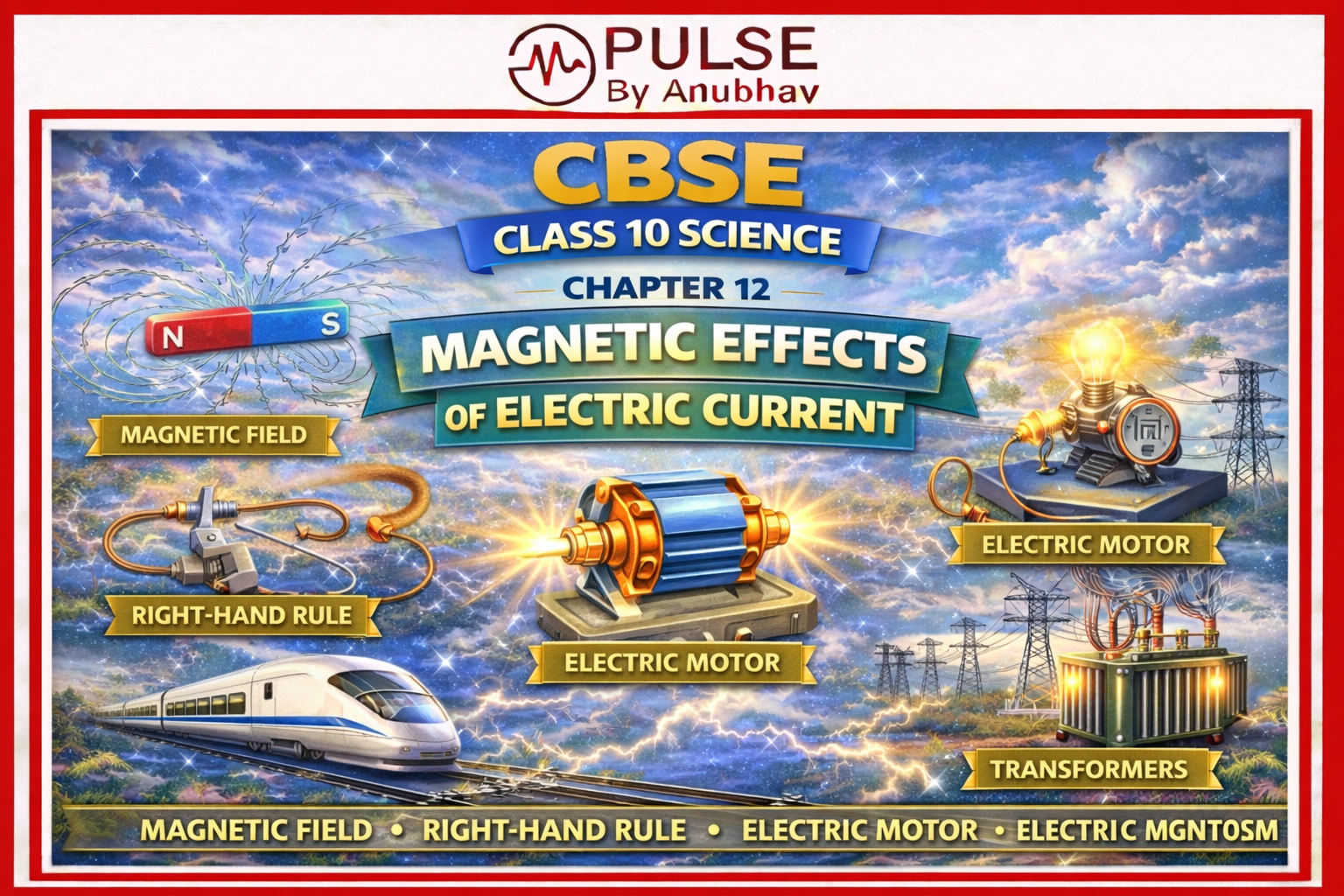
Magnetic Effects of Electric Current is a chapter in your science subject. Radhe Radhe to all my dear children! You all will have to work very hard for your board exams to get good marks. In this post, I will try to cover all the important topics of your 10th-grade science syllabus so that you can understand and remember them.

Magnetic Effects of Electric Current , which is your twelfth chapter, falls under the physics section of science. All the information you need to study in this chapter will be found in this post.
Also Read- CBSE Class 10 Science Chapter 4 Carbon and Its Compounds
👉 Skip everything and click here to directly view the Notes PDFKey Content of Chapter 12 Magnetic Effects of Electric Current
1️⃣ Magnetic Effect of Electric Current
- Electric current sirf heating effect hi nahi, magnetic effect bhi produce karta hai.
- Current-carrying wire magnet ki tarah behave karta hai.
- Compass needle ka deflection proof hai ki current se magnetic field banti hai.
2️⃣ Oersted’s Discovery
- Hans Christian Oersted (1820) ne discover kiya:
- Current-carrying conductor ke paas compass needle deflect hoti hai.
- Isse prove hua ki electricity aur magnetism related hain.
3️⃣ Magnetic Field
- Magnet ke aas-paas ka region jahan magnetic force feel ho → Magnetic Field
- Magnetic field ek vector quantity hai (magnitude + direction).
4️⃣ Magnetic Field Lines
- Field ko represent karne ke liye magnetic field lines use hoti hain.
- Field lines:
- North pole se nikalti hain
- South pole me enter karti hain
- Magnet ke andar South → North jaati hain
- Closed curves hoti hain
Properties:
- Field lines kabhi intersect nahi karti
- Jahan lines zyada close → field zyada strong
- Compass needle field line ke direction me align hoti hai
5️⃣ Magnetic Field due to Current-Carrying Straight Conductor
- Straight wire me current flow → uske around concentric circular field lines banti hain
- Magnetic field:
- Current badhne par ↑
- Distance badhne par ↓
- Current direction reverse → field direction bhi reverse
6️⃣ Right-Hand Thumb Rule
- Right hand ka thumb → current direction
- Ghoome hue fingers → magnetic field direction
- Straight conductor ke around field find karne ke liye use hota hai
7️⃣ Magnetic Field due to Circular Loop
- Circular loop me current flow → center par strong magnetic field
- Center ke paas field lines parallel straight lines jaisi hoti hain
- Turns zyada → field zyada strong
8️⃣ Magnetic Field due to Solenoid
- Solenoid = insulated wire ke bahut saare circular turns cylinder shape me
- Solenoid ka magnetic field:
- Bar magnet jaisa hota hai
- Ek end → North pole
- Dusra end → South pole
- Andar ka field uniform aur strong hota hai
9️⃣ Electromagnet
- Soft iron core + current-carrying solenoid → Electromagnet
- Current band → magnetism bhi band
- Uses:
- Electric bell
- Crane
- Electric motor
🔟 Force on a Current-Carrying Conductor
- Jab current-carrying conductor ko magnetic field me rakha jaye → force lagta hai
- Force depend karta hai:
- Current
- Magnetic field strength
- Length of conductor
- Current ya field reverse → force direction reverse
1️⃣1️⃣ Fleming’s Left-Hand Rule
- Left hand ke:
- First finger → Magnetic field
- Second finger → Current
- Thumb → Force / Motion
- Use: Electric motor, loudspeaker, etc.
1️⃣2️⃣ Domestic Electric Circuits
- Supply: 220 V, 50 Hz (AC)
- Wires:
- Live (Red)
- Neutral (Black)
- Earth (Green)
Earth Wire:
- Safety ke liye
- Leakage current ko ground me bhej deta hai
- Electric shock se bachata hai
1️⃣3️⃣ Fuse and Safety
- Fuse ek safety device hai
- Short circuit / overloading me current ↑
- Fuse wire melt ho kar circuit break kar deta hai
1️⃣4️⃣ Applications in Daily Life
- Electric motor
- Generator
- MRI (medical field)
- Loudspeaker
- Electric bell
- Domestic wiring safety
Also Read- CBSE Class 10 Science Chapter 11 Electricity
Class 10 Science Chapter 12 Magnetic Effects of Electric Current Notes
CBSE Class 10 Science – Chapter 12
Magnetic Effects of Electric Current
Complete Class 10 Science Chapter 12 notes, NCERT book PDF
aur official Telegram channel ka direct access yahan se milega.
Science Chapter 12 Magnetic Effects of Electric Current MCQs
Q1. Magnetic effect of electric current was discovered by:
A. Hans Christian Oersted
B. Michael Faraday
C. James Maxwell
D. Andre Ampere
✅ Correct Answer: Hans Christian Oersted
Q2. A current-carrying conductor produces:
A. Magnetic field
B. Electric charge
C. Chemical energy
D. Sound energy
✅ Correct Answer: Magnetic field
Q3. Magnetic field lines around a straight current-carrying conductor are:
A. Concentric circles
B. Straight lines
C. Radial lines
D. Elliptical
✅ Correct Answer: Concentric circles
Q4. Direction of magnetic field around a straight conductor is given by:
A. Right-hand thumb rule
B. Fleming’s left-hand rule
C. Fleming’s right-hand rule
D. Maxwell’s rule
✅ Correct Answer: Right-hand thumb rule
Q5. Magnetic field inside a current-carrying solenoid is:
A. Uniform
B. Zero
C. Non-uniform
D. Circular
✅ Correct Answer: Uniform
Q6. A solenoid carrying current behaves like:
A. Bar magnet
B. Straight conductor
C. Electric cell
D. Capacitor
✅ Correct Answer: Bar magnet
Q7. The rule used to find direction of force on a current-carrying conductor is:
A. Fleming’s left-hand rule
B. Fleming’s right-hand rule
C. Right-hand thumb rule
D. Corkscrew rule
✅ Correct Answer: Fleming’s left-hand rule
Q8. The force on a current-carrying conductor is maximum when current is:
A. Perpendicular to magnetic field
B. Parallel to magnetic field
C. Zero
D. Very small
✅ Correct Answer: Perpendicular to magnetic field
Q9. Earth wire in domestic circuits is used for:
A. Safety from electric shock
B. Increasing voltage
C. Reducing current
D. Lighting appliances
✅ Correct Answer: Safety from electric shock
Q10. Fuse works on the principle of:
A. Heating effect of electric current
B. Magnetic effect
C. Chemical effect
D. Electric pressure
✅ Correct Answer: Heating effect of electric current
Also Read- CBSE Class 10 Science Chapter 6 Control and Coordination
FAQs About Magnetic Effects of Electric Current
Q1. What is the magnetic effect of electric current?
The phenomenon in which a current-carrying conductor produces a magnetic field
around it is called the magnetic effect of electric current.
Q2. Who discovered the magnetic effect of electric current?
Hans Christian Oersted discovered that a compass needle gets deflected when an
electric current flows through a nearby conductor.
Q3. What are magnetic field lines?
Magnetic field lines are imaginary lines that represent the direction and strength
of a magnetic field. They show the path along which a free north pole would move.
Q4. Why do magnetic field lines never intersect each other?
Magnetic field lines never intersect because at any point the magnetic field has
a unique direction. Intersection would imply two directions at the same point,
which is not possible.
Q5. What is the right-hand thumb rule?
According to the right-hand thumb rule, if the thumb of the right hand points in
the direction of current, then the curled fingers show the direction of the magnetic
field around the conductor.
Q6. What is a solenoid?
A solenoid is a coil of many circular turns of insulated copper wire wrapped
closely in the shape of a cylinder. It produces a strong and uniform magnetic field
when current flows through it.
Q7. What is an electromagnet?
An electromagnet is a temporary magnet produced by passing electric current
through a solenoid having a soft iron core inside it.
Q8. Which rule is used to find the direction of force on a current-carrying conductor?
Fleming’s left-hand rule is used to determine the direction of force acting on a
current-carrying conductor placed in a magnetic field.
Q9. Why are domestic electric appliances connected in parallel?
Domestic appliances are connected in parallel so that each appliance gets the
same voltage and can be operated independently without affecting others.
Q10. What is the function of a fuse in an electric circuit?
A fuse protects electrical appliances and circuits from damage due to overloading
or short-circuiting by melting and breaking the circuit when excessive current flows.
CBSE Class 10 Science – Chapter Wise Notes
1
Chemical Reactions and Equations
2
Acids, Bases and Salts
3
Metals and Non-metals
4
Carbon and Its Compounds
5
Life Processes
6
Control and Coordination
7
How do Organisms Reproduce?
8
Heredity
9
Light – Reflection and Refraction
10
The Human Eye and the Colorful World
11
Electricity
12
Magnetic Effects of Electric Current
13
Our Environment
2 thoughts on “CBSE Class 10 Science Chapter 12 Magnetic Effects of Electric Current”