Radhe Radhe, B.Pharm students! In this post, you will find the notes for your 6th semester Pharmaceutical Medicinal Chemistry – III subject . Here you will find notes, books, previous year questions (PYQs), and important question-answers related to your pharmacy course Syllabus. You will also find GPAT updates here and exam tips. Here You will find pharmacy-related vacancies, so stay calm and connected with Pulse by Anubhav. Join Our Telegram Channel As Well As Bookmark Our Site For Latest Update.
As you may have realized, pursuing a B.Pharm degree is not easy. Many people initially choose it as just one option, but later they discover how much studying is involved. Your B.Pharm course is divided into 8 semesters. In which the sixth semester, you have to study a total number of 6 subjects, of which all are compulsory. You won’t have to study any additional subjects in this semester.
The pharmacy field is a very important medical field. Here, pharmacists not only dispense medication to patients but also educate them about the medicines. In the pharmaceutical industry, these same pharmacists manufacture the medicines and conduct research on them.
The link to download notes for all units is given below. If you want to download the PDF without reading the post, you can download the PDF by clicking on the link given below. You can also join our Telegram channel for future updates.
Also Read- Fatima Sana Shaikh Age, Biography, Viral Boxing Look & Vijay Varma Relationship Rumors
The Subjects in the 6th semester of B.Pharm are:
- 🧪 Medicinal Chemistry – III
- 💊 Pharmacology – III
- 🌿 Herbal Drug Technology
- 🧪 Biopharmaceutics & Pharmacokinetics
- 🧫 Pharmaceutical Biotechnology
- ✅ Pharmaceutical Quality Assurance
Pharmaceutical Medicinal Chemistry – III is a very complex subject and is very difficult to remember. You will have to study this carefully as it involves a lot of structures. You will have to keep revising your Pharmaceutical Medicinal Chemistry 2nd and 1st.
B.Pharm 6th Semester Medicinal Chemistry – III Syllabus
Before downloading the notes, please take a look at the Medicinal Chemistry – III syllabus to understand what topics are covered.
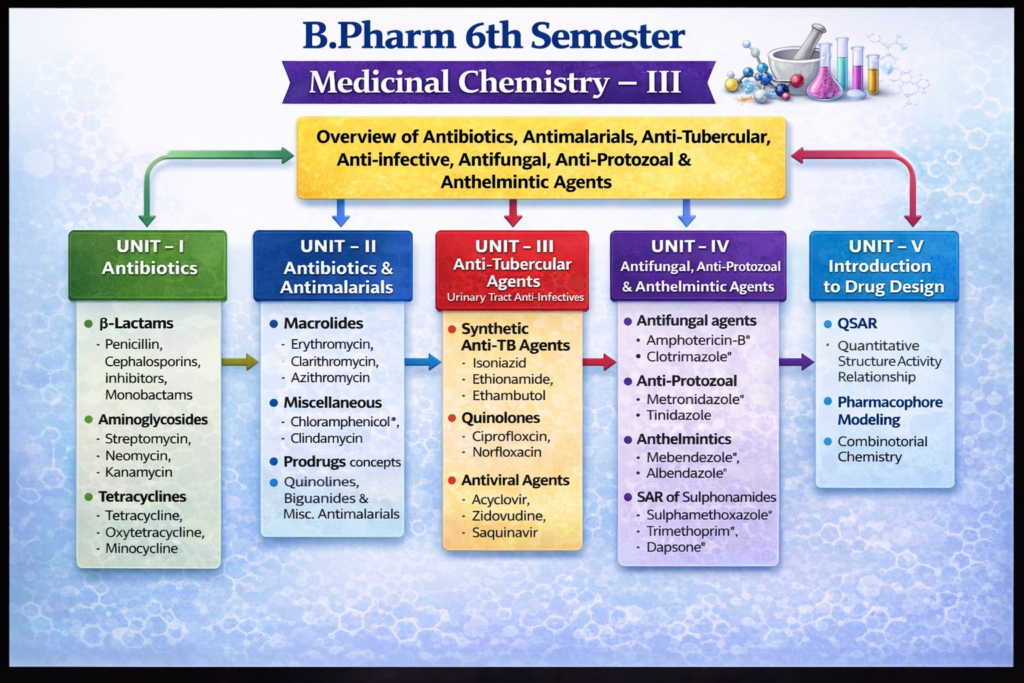
UNIT – I
Antibiotics
General Topics (Applicable to all classes):
- Historical background
- Nomenclature
- Stereochemistry
- Structure Activity Relationship (SAR)
- Chemical degradation
- Classification
- Important products
1. β-Lactam Antibiotics
- Penicillin
- Cephalosporins
- β-Lactamase inhibitors
- Monobactams
2. Aminoglycosides
- Streptomycin
- Neomycin
- Kanamycin
3. Tetracyclines
- Tetracycline
- Oxytetracycline
- Chlortetracycline
- Minocycline
- Doxycycline
UNIT – II
Antibiotics
General Topics:
- Historical background
- Nomenclature
- Stereochemistry
- SAR
- Chemical degradation
- Classification
- Important products
1. Macrolides
- Erythromycin
- Clarithromycin
- Azithromycin
2. Miscellaneous Antibiotics
- Chloramphenicol*
- Clindamycin
3. Prodrugs
- Basic concepts
- Applications in prodrug design
Antimalarials
Etiology of Malaria
1. Quinolines (with SAR)
- Quinine sulphate
- Chloroquine*
- Amodiaquine
- Primaquine phosphate
- Pamaquine*
- Quinacrine hydrochloride
- Mefloquine
2. Biguanides & Dihydrotriazines
- Cycloguanil pamoate
- Proguanil
3. Miscellaneous
- Pyrimethamine
- Artesunate
- Artemether
- Atovaquone
UNIT – III
Anti-Tubercular Agents
1. Synthetic Anti-TB Agents
- Isoniazid*
- Ethionamide
- Ethambutol
- Pyrazinamide
- Para-aminosalicylic acid*
2. Anti-TB Antibiotics
- Rifampicin
- Rifabutin
- Cycloserine
- Streptomycin
- Capreomycin sulphate
Urinary Tract Anti-infective Agents
Quinolones (with SAR)
- Nalidixic acid
- Norfloxacin
- Enoxacin
- Ciprofloxacin*
- Ofloxacin
- Lomefloxacin
- Sparfloxacin
- Gatifloxacin
- Moxifloxacin
Miscellaneous
- Furazolidone
- Nitrofurantoin*
- Methenamine
Antiviral Agents
- Amantadine hydrochloride
- Rimantadine hydrochloride
- Idoxuridine
- Trifluridine
- Acyclovir*
- Ganciclovir
- Zidovudine
- Didanosine
- Zalcitabine
- Lamivudine
- Loviride
- Delavirdine
- Ribavirin
- Saquinavir
- Indinavir
- Ritonavir
UNIT – IV
Antifungal Agents
1. Antifungal Antibiotics
- Amphotericin-B
- Nystatin
- Natamycin
- Griseofulvin
2. Synthetic Antifungal Agents
- Clotrimazole
- Econazole
- Butoconazole
- Oxiconazole
- Tioconazole
- Miconazole*
- Ketoconazole
- Terconazole
- Itraconazole
- Fluconazole
- Naftifine hydrochloride
- Tolnaftate*
Anti-Protozoal Agents
- Metronidazole*
- Tinidazole
- Ornidazole
- Diloxanide
- Iodoquinol
- Pentamidine isethionate
- Atovaquone
- Eflornithine
Anthelmintics
- Diethylcarbamazine citrate*
- Thiabendazole
- Mebendazole*
- Albendazole
- Niclosamide
- Oxamniquine
- Praziquantel
- Ivermectin
Sulphonamides & Sulfones
1. Sulphonamides
- Historical development
- Chemistry
- Classification
- SAR
Drugs:
- Sulphamethizole
- Sulfisoxazole
- Sulphamethizine
- Sulfacetamide*
- Sulphapyridine
- Sulfamethoxazole*
- Sulphadiazine
- Mafenide acetate
- Sulfasalazine
2. Folate Reductase Inhibitors
- Trimethoprim*
- Cotrimoxazole
3. Sulfones
- Dapsone*
UNIT – V
Introduction to Drug Design
- Various approaches in drug design
QSAR (Quantitative Structure Activity Relationship)
- Partition coefficient
- Hammett’s electronic parameter
- Taft’s steric parameter
- Hansch analysis
Pharmacophore Modeling
- Concept
- Docking techniques
Combinatorial Chemistry
- Concept
- Applications
- Solid phase synthesis
- Solution phase synthesis
Also Read- B.Pharm 5th Semester Pharmaceutical Pharmacognosy and Phytochemistry 2 Notes
B.Pharm 6th Semester Medicinal Chemistry – III Notes PDF
🧪 Download B.Pharm 6th Semester – Medicinal Chemistry III Notes (AV Syllabus | Unit-wise | Flowchart PDF)
⚡ Medicinal Chemistry III notes are prepared in simple, exam-oriented flowchart format specially for AKTU / AV 6th Semester students – easy revision & maximum scoring.
🚀 Join Pulse Pharma Notes Telegram Channel 📘 Download Complete Medicinal Chemistry III Flowchart Notes (PDF)Also Read:- B.Pharm 5th Semester Pharmaceutical Jurisprudence Notes
B.Pharm 6th Semester Medicinal Chemistry – 3 Book PDF
Books are very important; you should definitely check out the books according to your syllabus. During your pharmacy studies, books from Nirali Prakashan and PV Sindhu are very helpful. You can download the PDFs from the link below.
- Pharmaceutical Medicinal Chemistry – III Nirali Prakashan Full Book PDF:- PDF
- Pharmaceutical Medicinal Chemistry – III Chemistry PV Sindhu Full Book PDF:- PDF
- Pharmaceutical Medicinal Chemistry – III Chemistry Thakur Publication Full Book PDF:- PDF
- Pharmaceutical Medicinal Chemistry – III Chemistry The Point Publication Full Book PDF: PDF
❓ Pharmaceutical Medicinal Chemistry – 3– FAQs (B.Pharm 6th Semester)
❓ Medicinal Chemistry – III FAQs (B.Pharm 6th Semester )
What is Medicinal Chemistry – III in B.Pharm 6th Semester?
Medicinal Chemistry – III focuses on anti-infective agents including antibiotics, antimalarials, anti-tubercular drugs, antivirals, antifungals, sulfonamides and basic concepts of drug design as per AV syllabus.
What topics are covered in UNIT-I?
UNIT-I includes β-lactam antibiotics (Penicillins, Cephalosporins, β-lactamase inhibitors), Aminoglycosides, and Tetracyclines along with their SAR, classification, chemical degradation and important products.
What is included in UNIT-II?
UNIT-II covers Macrolides, Miscellaneous antibiotics, Prodrugs concept and detailed study of Antimalarial agents including Quinolines, Biguanides and Artemisinin derivatives.
What does UNIT-III contain?
UNIT-III includes Anti-tubercular agents (Isoniazid, Rifampicin, etc.), Urinary tract anti-infective agents (Fluoroquinolones), and Antiviral drugs such as Acyclovir, Zidovudine, and Protease inhibitors.
Which drugs are studied in UNIT-IV?
UNIT-IV covers Antifungal agents (Azoles, Amphotericin-B), Anti-protozoal drugs (Metronidazole), Anthelmintics (Albendazole, Mebendazole), Sulfonamides, Sulfones and Folate reductase inhibitors.
What is taught in UNIT-V?
UNIT-V focuses on Introduction to Drug Design including QSAR, Hammett and Taft parameters, Hansch analysis, Pharmacophore modeling, Docking techniques and Combinatorial chemistry.
Why is Medicinal Chemistry – III important for exams?
This subject carries high scoring potential in B.Pharm 6th semester. Understanding SAR, mechanisms of action, classification and important examples helps in writing structured and diagram-based answers.
How to prepare Medicinal Chemistry – III for AV exams?
Focus on SAR tables, mechanisms, classification flowcharts and important starred drugs. Writing answers in structured headings and flowchart format improves scoring in AV exams.
B.Pharm 6th Semester Notes
| Subject Name | Notes Link |
|---|---|
| 🧪 Medicinal Chemistry – III | View Notes |
| 💊 Pharmacology – III | View Notes |
| 🌿 Herbal Drug Technology | View Notes |
| 🧪 Biopharmaceutics & Pharmacokinetics | View Notes |
| 🧫 Pharmaceutical Biotechnology | View Notes |
| ✅ Pharmaceutical Quality Assurance | View Notes |
7 thoughts on “B.Pharm 6th Semester Medicinal Chemistry – III Notes”