Radhe Radhe, B.Pharm students! In this post, you will find the notes for your 1st semester Pharmaceutical Inorganic Chemistry subject . Here you will find notes, books, previous year questions (PYQs), and important question-answers related to your pharmacy course. You will also find GPAT updates here. Bookmark our site for future updates. You will find updated B.Pharm syllabus notes here.
As you may have realized, pursuing a B.Pharm degree is not easy. Many people initially choose it as just one option, but later they discover how much studying is involved. Your B.Pharm course is divided into 8 semesters. In the first semester, you have to study a total of 6 subjects, of which 4 are compulsory. Those who passed their intermediate exams with Biology have to study Remedial Mathematics, and those who passed with Mathematics have to study Remedial Biology.
B.Pharm is a professional course, and if you understand it carefully, it’s a very important part of the medical field. From manufacturing medicines to dispensing them, all of that is our responsibility. Pharmacists don’t just give patients medicine; they also explain how to take it, what its benefits are, and what the potential side effects are.
Pharmaceutical Inorganic Chemistry is a very important subject, and you can even pursue a PhD in it in the future. There are many research options in chemistry, and you have a higher chance of getting a high-paying job in this field.
The link to download notes for all units is given below. If you want to download the PDF without reading the post, you can download the PDF by clicking on the link given below. You can also join our Telegram channel for future updates.
The Subjects in the 1st semester of B.Pharm are:
- Human Anatomy and Physiology- I
- Pharmaceutical Analysis
- Pharmaceutical Inorganic Chemistry
- Pharmaceutics I
- Communication Skills
- Remedial Mathematics
- Remedial Biology
Also Read:- Pharmaceutic Notes
B.Pharm 1st Semester Pharmaceutical Inorganic Chemistry Syllabus
Before downloading the notes, please take a look at the Pharmaceutical Analysis syllabus to understand what topics are covered.
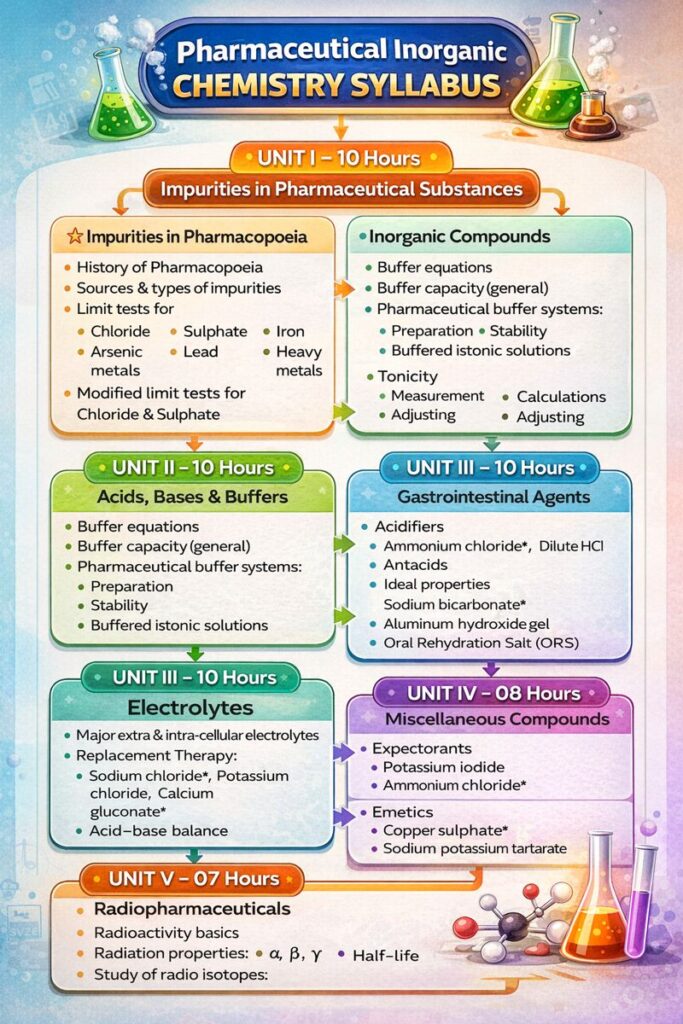
UNIT I
Impurities in Pharmaceutical Substances
- History of Pharmacopoeia
- Sources of impurities
- Types of impurities
- Principles involved in Limit Tests for:
- Chloride
- Sulphate
- Iron
- Arsenic
- Lead
- Heavy metals
- Modified limit test for:
- Chloride
- Sulphate
Inorganic Compounds
- General methods of preparation
- Assay of compounds marked with asterisk (*)
- Properties & medicinal uses of inorganic compounds from various classes
UNIT II
Acids, Bases & Buffers
- Buffer equations
- Buffer capacity (general concept)
- Pharmaceutical buffer systems:
- Preparation
- Stability
- Buffered isotonic solutions
- Tonicity:
- Measurement of tonicity
- Calculations
- Methods of adjusting isotonicity
Electrolytes
- Major extra & intracellular electrolytes
- Functions of major physiological ions
- Electrolytes used in Replacement Therapy:
- Sodium chloride*
- Potassium chloride
- Calcium gluconate*
- Oral Rehydration Salt (ORS)
- Physiological acid–base balance
Dental Products
- Dentifrices
- Role of fluoride in dental caries treatment
- Desensitizing agents
- Inorganic dental compounds:
- Calcium carbonate
- Sodium fluoride
- Zinc eugenol cement
UNIT III
Gastrointestinal Agents
Acidifiers
- Ammonium chloride*
- Dilute HCl (Dil. HCl)
Antacids
- Ideal properties of antacids
- Combinations of antacids
- Examples:
- Sodium bicarbonate*
- Aluminum hydroxide gel
- Magnesium hydroxide mixture
Cathartics
- Magnesium sulphate
- Sodium orthophosphate
Adsorbents
- Kaolin
- Bentonite
Antimicrobials
- Mechanism of action
- Classification
- Examples:
- Potassium permanganate
- Boric acid
- Hydrogen peroxide*
- Chlorinated lime*
- Iodine & its preparations
- Chlorinated lime*
UNIT IV
Miscellaneous Compounds
Expectorants
- Potassium iodide
- Ammonium chloride*
Emetics
- Copper sulphate*
- Sodium potassium tartarate
Haematinics
- Ferrous sulphate*
- Ferrous gluconate
- Ferrous gluconate
Poison & Antidotes
- Sodium thiosulphate*
- Activated charcoal
- Sodium nitrite
- Activated charcoal
- Sodium nitrite
Astringents
- Zinc sulphate
- Potash alum (Potash Alum)
UNIT V
Radiopharmaceuticals
- Radioactivity basics
- Measurement of radioactivity
- Properties of radiations:
- α (Alpha)
- β (Beta)
- γ (Gamma)
- Half-life
- Study of radio isotopes:
- Sodium iodide (I-131)
- Storage conditions
- Precautions while handling radioactive substances
- Pharmaceutical applications of radioactive compounds
B.Pharm 1st Semester Pharmaceutical Inorganic Chemistry Notes PDF
📘 Download B.Pharm 1st Semester – Pharmaceutical Inorganic Chemistry Notes (Unit-wise)
📲 All Inorganic Chemistry notes available on Telegram for fast & free access.
Also Read:- Pharmaceutical Analysis Notes
B.Pharm 1st Semester Pharmaceutical Inorganic Chemistry Book PDF
Books are very important; you should definitely check out the books according to your syllabus. During your pharmacy studies, books from Nirali Prakashan and PV Sindhu are very helpful. You can download the PDFs from the link below.
- Pharmaceutical Inorganic Chemistry Nirali Prakashan Full Book PDF:- PDF
- Pharmaceutical Inorganic Chemistry PV Sindhu Full Book PDF:- PDF
- Pharmaceutical Inorganic Chemistry Thakur Publication Full Book PDF:- PDF
B.Pharm 1st Semester Notes
| Subject Name | Notes Link |
|---|---|
| Human Anatomy and Physiology- I Notes | View Notes |
| Pharmaceutical Analysis Notes | View Notes |
| Pharmaceutical Inorganic Chemistry Notes | View Notes |
| Pharmaceutics I Notes | View Notes |
| Communication Skills Notes | View Notes |
| Remedial Mathematics Notes | View Notes |
| Remedial Biology Notes | View Notes |
5 thoughts on “B.Pharm 1st Semester Pharmaceutical Inorganic Chemistry Notes”