Radhe Radhe, B.Pharm students! In this post, you will find the notes for your 1st semester Pharmaceutical Inorganic and Analytical Chemistry subject . Here you will find notes, books, previous year questions (PYQs), and important question-answers related to your pharmacy course Updated syllabus. You will also find GPAT updates here. Follow our Telegram link; you will find all the semester notes and book PDFs there.
As you may have already understood, pursuing a B.Pharm degree is not as easy as it looks. Many students choose this course as just an option after 12th, but later they realize how much deep study, practical knowledge, and professional understanding it actually requires.
B.Pharm is a 4-year professional course divided into 8 semesters. At this stage, as students progress towards the 7th semester, the subjects become more advanced and focus more on pharmaceutical technology, clinical knowledge, drug development, research, and practical applications.
This clearly shows that pharmacy is now moving towards technology + research-driven healthcare, where scientific knowledge, data analysis, modern technologies, and evidence-based practices are becoming increasingly important for research and drug development.
B.Pharm and D.Pharm Notes PDF (All Semester) – Complete Study Material & Syllabus
Why B.Pharm is Important in Healthcare
B.Pharm is not only about medicines — it is one of the most important courses in the healthcare sector. This course helps students understand how medicines are prepared, tested, formulated, distributed, and used safely for patients.
A pharmacist plays a major role in the medical field. They help doctors and patients by providing the correct medicines and proper guidance related to drug usage. A pharmacist also explains:
- How to take medicines properly
- Benefits and uses of medicines
- Possible side effects
- Safe dosage and precautions
Today, the pharmacy profession is growing rapidly because healthcare industries, hospitals, research labs, and pharmaceutical companies all require skilled pharmacy professionals.
If you study B.Pharm seriously, you can build a strong career in:
- Pharmaceutical industries
- Hospitals and clinical settings
- Drug research and development
- Medical coding & pharmacovigilance
- Government healthcare sectors
At Pulse by Anubhav, we always try to provide updated B.Pharm notes, syllabus PDFs, PYQs, important questions, and study materials to help pharmacy students throughout their academic journey.
Why B.Pharm is Important in Healthcare
B.Pharm is not only about medicines — it is one of the most important courses in the healthcare sector. This course helps students understand how medicines are prepared, tested, distributed, and used safely for patients.
A pharmacist plays a major role in the medical field. They help doctors and patients by providing the correct medicines and proper guidance related to drug usage. A pharmacist also explains:
- How to take medicines properly
- Benefits of medicines
- Possible side effects
- Safe dosage and precautions
Today, the pharmacy profession is growing rapidly because healthcare industries, hospitals, research labs, and pharmaceutical companies all require skilled pharmacy professionals.
If you study B.Pharm seriously, you can build a strong career in:
- Pharmaceutical industries
- Hospitals and clinics
- Drug research centers
- Medical coding & pharmacovigilance
- Government healthcare sectors
At Pulse by Anubhav, we always try to provide updated B.Pharm notes, syllabus PDFs, PYQs, and study materials to help pharmacy students in their academic journey.
Updated Subjects in B.Pharm 1st Semester (As per New PCI Syllabus)
Here is the latest subject list for B.Pharm 1st Semester including theory and practical subjects.
Theory Subjects
- BP101T – Basics of Python Programming for Pharmaceutical Sciences
- BP102T – General Pharmacy
- BP103T – Healthcare Psychology and Communication Skills
- BP104T – Human Anatomy, Physiology and Pathophysiology I
- BP105T – Introduction to Pharmacognosy
- BP106T – Pharmaceutical Inorganic and Analytical Chemistry
Practical Subjects
- BP107P – General Pharmacy Practical
- BP108P – Healthcare Psychology and Communication Skills Practical
- BP109P – Human Anatomy, Physiology and Pathophysiology I Practical
- BP110P – Introduction to Pharmacognosy Practical
- BP111P – Pharmaceutical Inorganic and Analytical Chemistry Practical
Prepare for your B.Pharm Pharmaceutical Inorganic & Analytical Chemistry exam with easy, unit-wise and exam-focused quick notes. Revise important concepts, definitions, reactions, analytical methods, inorganic compounds, radiopharmaceuticals, haematinics, poisons and antidotes in less time.
Basics of Python Programming for Pharmaceutical Sciences Notes Link
B.Pharm 1st Semester Pharmaceutical Inorganic and Analytical Chemistry Science Syllabus
Before downloading the notes, please take a look at the Pharmaceutical Inorganic and Analytical Chemistry syllabus to understand what topics are covered.
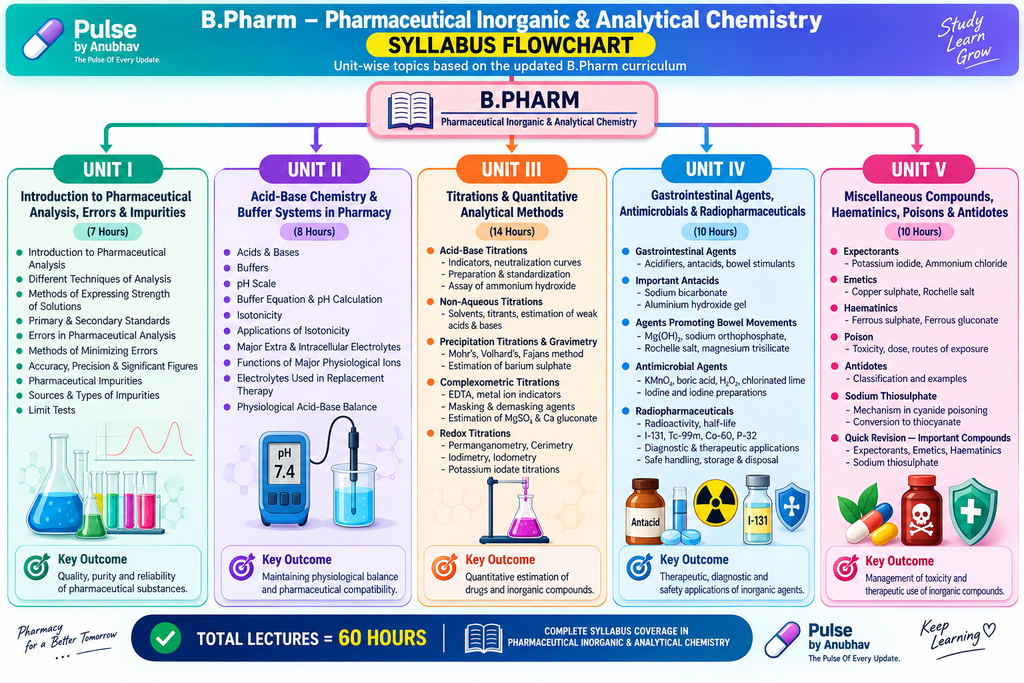
💊 B.Pharm — Pharmaceutical Inorganic & Analytical Chemistry
Complete unit-wise syllabus based on the updated B.Pharm curriculum. The subject covers pharmaceutical analysis, errors and impurities, acid-base chemistry, titrations, gravimetric and complexometric analysis, redox titrations, pharmaceutical inorganic compounds, radiopharmaceuticals and antidotes.
🔬 Unit I — Introduction to Pharmaceutical Analysis, Errors & Impurities
1. Introduction to Pharmaceutical Analysis
- Definition of Pharmaceutical Analysis
- Importance of Pharmaceutical Analysis
- Scope of Pharmaceutical Analysis
- Applications in Pharmaceutical Sciences
- Qualitative Analysis
- Quantitative Analysis
- Role of Analysis in Drug Quality Control
2. Different Techniques of Analysis
- Classical Methods of Analysis
- Volumetric Analysis
- Gravimetric Analysis
- Instrumental Methods of Analysis
- Importance of Analytical Techniques
- Selection of Analytical Method
3. Methods of Expressing Strength of Solutions
- Percentage Strength
- Percentage w/v
- Percentage w/w
- Percentage v/v
- Molarity
- Normality
- Molality
- Parts Per Million (ppm)
- Parts Per Billion (ppb)
4. Primary & Secondary Standards
- Definition of Standard Substance
- Primary Standard
- Characteristics of Primary Standard
- Examples of Primary Standards
- Secondary Standard
- Characteristics of Secondary Standard
- Examples of Secondary Standards
- Difference Between Primary and Secondary Standards
5. Errors in Pharmaceutical Analysis
- Definition of Analytical Error
- Sources of Errors
- Systematic Errors
- Random Errors
- Gross Errors
- Instrumental Errors
- Personal Errors
- Method Errors
- Environmental Errors
6. Methods of Minimizing Errors
- Calibration of Instruments
- Standardization of Apparatus
- Blank Determination
- Replicate Analysis
- Proper Sampling
- Controlled Experimental Conditions
- Use of Standard Procedures
7. Accuracy, Precision & Significant Figures
- Definition of Accuracy
- Definition of Precision
- Difference Between Accuracy and Precision
- Absolute Error
- Relative Error
- Percentage Error
- Significant Figures
- Rules for Significant Figures
- Rounding Off of Analytical Results
8. Pharmaceutical Impurities
- Definition of Impurity
- Types of Impurities
- Organic Impurities
- Inorganic Impurities
- Residual Solvents
- Contents of Impurities
- Regulatory Importance of Impurity Control
- Importance of Purity Testing
9. Sources & Types of Impurities in Pharmaceuticals
- Raw Materials
- Manufacturing Processes
- Reagents and Solvents
- Equipment and Containers
- Storage Conditions
- Environmental Contamination
- Decomposition of Drugs
- Cross-Contamination
10. Limit Tests
- Definition of Limit Test
- Principle of Limit Tests
- Limit Test for Chloride
- Limit Test for Sulphate
- Limit Test for Iron
- Limit Test for Arsenic
- Limit Test for Lead
- Limit Test for Heavy Metals
- Modified Limit Test for Chloride
- Modified Limit Test for Sulphate
⏱ Duration: 7 Hours
⚗️ Unit II — Acid-Base Chemistry & Buffer Systems in Pharmacy
1. Acids & Bases
- Definition of Acids
- Definition of Bases
- Properties of Acids
- Properties of Bases
- Strong Acids and Weak Acids
- Strong Bases and Weak Bases
- Importance of Acid-Base Chemistry in Pharmacy
2. Buffers
- Definition of Buffer
- Types of Buffer Solutions
- Acidic Buffer
- Basic Buffer
- Composition of Buffer Solutions
- Buffer Action
- Importance of Buffers in Pharmacy
- Pharmaceutical Applications of Buffers
3. pH Scale
- Definition of pH
- pH Scale
- Acidic pH
- Neutral pH
- Alkaline pH
- Importance of pH in Pharmaceutical Preparations
- Measurement of pH
4. Buffer Equation & pH Calculation
- Henderson-Hasselbalch Equation
- Buffer Equation for Acidic Buffer
- Buffer Equation for Basic Buffer
- Calculation of pH of Buffer Solutions
- Factors Affecting Buffer pH
- Buffer Capacity
5. Isotonicity
- Definition of Isotonicity
- Isotonic Solutions
- Hypotonic Solutions
- Hypertonic Solutions
- Importance of Isotonicity
- Methods of Adjusting Isotonicity
6. Applications of Isotonicity
- Isotonicity in IV Fluids
- Isotonicity in Ophthalmic Solutions
- Physiological Compatibility
- Effect of Osmotic Pressure
- Importance in Patient Safety
7. Major Extra & Intracellular Electrolytes
- Definition of Electrolytes
- Extracellular Electrolytes
- Intracellular Electrolytes
- Sodium Ion
- Potassium Ion
- Calcium Ion
- Magnesium Ion
- Chloride Ion
- Bicarbonate Ion
- Phosphate Ions
8. Functions of Major Physiological Ions
- Role of Sodium
- Role of Potassium
- Role of Calcium
- Role of Magnesium
- Role of Chloride
- Role of Bicarbonate
- Role of Phosphate
- Electrolyte Balance
9. Electrolytes Used in Replacement Therapy
- Sodium Chloride
- Potassium Chloride
- Calcium Chloride
- Oral Rehydration Salt (ORS)
- Composition of ORS
- Mechanism of Oral Rehydration
- Applications of Electrolyte Replacement Therapy
10. Physiological Acid-Base Balance
- Definition of Acid-Base Balance
- Normal Body pH Regulation
- Buffer Systems in the Body
- Bicarbonate Buffer System
- Phosphate Buffer System
- Protein Buffer System
- Role of Lungs
- Role of Kidneys
- Basic Concept of Acidosis
- Basic Concept of Alkalosis
⏱ Duration: 8 Hours
🧪 Unit III — Titrations & Quantitative Analytical Methods
Part A — Acid-Base Titrations
- Definition of Acid-Base Titration
- Principle of Neutralization
- Theories of Acid-Base Indicators
- Ostwald Theory
- Quinonoid Theory
- Classification of Acid-Base Titrations
- Strong Acid–Strong Base Titration
- Weak Acid–Strong Base Titration
- Strong Acid–Weak Base Titration
- Very Weak Acid and Base Titrations
Preparation & Standardization of Titrants
- Preparation of Hydrochloric Acid
- Standardization of Hydrochloric Acid
- Preparation of Sodium Hydroxide
- Standardization of Sodium Hydroxide
- Primary Standard Substances
- Secondary Standard Solutions
Neutralization Curves
- Definition of Neutralization Curve
- Strong Acid–Strong Base Curve
- Weak Acid–Strong Base Curve
- Strong Acid–Weak Base Curve
- Equivalence Point
- Endpoint
- Indicator Selection
Assay of Ammonium Hydroxide
- Principle of Assay
- Reaction Involved
- Role of Standard Acid
- Indicator Selection
- Endpoint Detection
- Calculation of Assay
Part B — Non-Aqueous Titrations
- Definition of Non-Aqueous Titration
- Need for Non-Aqueous Titration
- Types of Non-Aqueous Solvents
- Protogenic Solvents
- Protophilic Solvents
- Amphiprotic Solvents
- Aprotic Solvents
- Acidimetric Titration
- Alkalimetric Titration
Preparation & Standardization of Non-Aqueous Titrants
- Acidic Titrants
- Basic Titrants
- Standardization of Acidic Titrants
- Standardization of Basic Titrants
- Choice of Solvent
- Choice of Indicator
Estimation of Weakly Acidic & Basic Substances
- Weakly Acidic Substances
- Weakly Basic Substances
- Use of Non-Aqueous Solvents
- Estimation Using Non-Aqueous Titrants
- Estimation of Sodium Benzoate
Part C — Precipitation Titrations & Gravimetry
- Definition of Precipitation Titration
- Principle of Precipitation Titration
- Formation of Insoluble Precipitate
- Gravimetric Analysis
- Principle of Gravimetric Analysis
- Steps Involved in Gravimetry
- Precipitation
- Digestion
- Filtration
- Washing
- Drying / Ignition
- Weighing
- Calculation of Result
Methods of Precipitation Titration
- Mohr’s Method
- Principle of Mohr’s Method
- Indicator Used
- Volhard’s Method
- Principle of Volhard’s Method
- Modified Volhard’s Method
- Fajans Method
- Adsorption Indicators
- Comparison of Precipitation Methods
Estimation of Barium Sulphate by Gravimetry
- Principle
- Precipitation of Barium Sulphate
- Digestion of Precipitate
- Filtration and Washing
- Drying / Ignition
- Weighing of Precipitate
- Gravimetric Calculation
Part D — Complexometric Titrations
- Definition of Complexometric Titration
- Principle of Complex Formation
- Classification of Complexometric Titrations
- Direct Titration
- Back Titration
- Replacement / Displacement Titration
- Indirect Titration
Metal Ion Indicators
- Definition of Metal Ion Indicator
- Eriochrome Black T
- Murexide
- Xylenol Orange
- Indicator-Metal Complex
- Endpoint Detection
Masking & Demasking Reagents
- Definition of Masking
- Masking Agents
- Purpose of Masking
- Definition of Demasking
- Demasking Agents
- Applications in Complexometric Analysis
Disodium EDTA
- Structure and Properties of EDTA
- Disodium EDTA
- Preparation of Disodium EDTA Solution
- Standardization of Disodium EDTA
- Metal-EDTA Complex Formation
- 1:1 Metal Ion–EDTA Complex
Estimation of Magnesium Sulphate & Calcium Gluconate
- Estimation of Magnesium Sulphate
- Principle and Reaction
- Buffer and Indicator
- Estimation of Calcium Gluconate
- Principle and Reaction
- Role of Metal Ion Indicator
- Endpoint Detection
Part E — Redox Titrations
- Concept of Oxidation
- Concept of Reduction
- Oxidizing Agents
- Reducing Agents
- Electron Transfer Reactions
- Permanganometry
- Cerimetry
- Iodimetry
- Iodometry
- Potassium Iodate Titrations
⏱ Duration: 14 Hours
🧴 Unit IV — Gastrointestinal Agents, Antimicrobials & Radiopharmaceuticals
1. Gastrointestinal Agents
- Definition of Gastrointestinal Agents
- Classification of Gastrointestinal Agents
- Acidifiers
- Antacids
- Agents Promoting Bowel Movements
- Pharmaceutical Applications
2. Acidifiers
- Sodium Acid Phosphate
- Properties of Sodium Acid Phosphate
- Pharmaceutical Uses
- Dilute Hydrochloric Acid
- Uses of Dilute Hydrochloric Acid
- Role as Gastric Acidifier
3. Antacids
- Definition of Antacids
- Ideal Properties of Antacids
- Systemic Antacids
- Non-Systemic Antacids
- Mechanism of Acid Neutralization
- Combinations of Antacids
Important Antacids
- Sodium Bicarbonate
- Formula and Properties
- Mechanism of Action
- Neutralization Reaction
- Pharmaceutical Uses
- Aluminium Hydroxide Gel
- Properties of Aluminium Hydroxide
- Mechanism of Action
- Neutralization Reaction
- Pharmaceutical Uses
4. Agents Promoting Bowel Movements
- Magnesium Hydroxide
- Properties and Uses
- Sodium Orthophosphate
- Osmotic Action
- Sodium Potassium Tartrate
- Rochelle Salt
- Magnesium Trisilicate
- Pharmaceutical Applications
5. Antimicrobial Agents
- Definition of Antimicrobial Agents
- Classification of Antimicrobials
- Mechanism of Antimicrobial Action
- Oxidation
- Protein Denaturation
- Cell Membrane Damage
- Enzyme Inactivation
- Halogenation / Oxidation
Important Inorganic Antimicrobials
- Potassium Permanganate
- Oxidizing Action of Potassium Permanganate
- Boric Acid
- Antimicrobial Properties of Boric Acid
- Hydrogen Peroxide
- Decomposition of Hydrogen Peroxide
- Oxidizing Antimicrobial Action
- Chlorinated Lime
- Available Chlorine
- Disinfectant Action
- Iodine
- Antimicrobial Action of Iodine
- Iodine Preparations
- Povidone-Iodine
- Tincture of Iodine
6. Radiopharmaceuticals
- Definition of Radiopharmaceuticals
- Basics of Radioactivity
- Radioactive Decay
- Alpha Radiation
- Beta Radiation
- Gamma Radiation
- Half-Life
- Radioactivity and Becquerel
- Diagnostic Applications
- Therapeutic Applications
Important Radioisotopes
- Sodium Iodide I-131
- Thyroid Diagnosis and Therapy
- Technetium-99m
- Diagnostic Imaging Applications
- Cobalt-60
- Radiotherapy Applications
- Phosphorus-32
- Therapeutic and Research Applications
7. Safe Handling, Storage & Disposal
- Radiation Safety Principles
- Safe Handling of Radioactive Materials
- Time-Distance-Shielding Principle
- Personal Protective Measures
- Labelling of Radioactive Materials
- Shielded Storage
- Controlled Access
- Radioactive Waste Segregation
- Safe Disposal Procedures
- Regulatory Safety Requirements
⏱ Duration: 10 Hours
🧪 Unit V — Miscellaneous Compounds, Haematinics, Poisons & Antidotes
1. Expectorants
- Definition of Expectorants
- Mechanism of Action of Expectorants
- Potassium Iodide
- Formula and Properties
- Mechanism as an Expectorant
- Pharmaceutical Uses
- Ammonium Chloride
- Formula and Properties
- Mechanism as an Expectorant
- Pharmaceutical Uses
2. Emetics
- Definition of Emetics
- Copper Sulphate
- Formula and Properties
- Mechanism of Emetic Action
- Sodium Potassium Tartrate
- Rochelle Salt
- Historical Emetic Use
- Safety Considerations
3. Haematinics
- Definition of Haematinics
- Role in Haemoglobin Formation
- Ferrous Sulphate
- Formula and Properties
- Mechanism of Action
- Uses in Iron Deficiency
- Ferrous Gluconate
- Formula and Properties
- Mechanism of Action
- Pharmaceutical Uses
- Common Adverse Effects of Oral Iron
4. Poison
- Definition of Poison
- General Concept of Toxicity
- Factors Affecting Toxic Effects
- Dose and Toxicity
- Routes of Exposure
5. Antidotes
- Definition of Antidote
- Purpose of Antidotes
- Classification of Antidotes
- Physical Antidotes
- Chemical Antidotes
- Physiological / Pharmacological Antidotes
- Examples of Different Antidote Classes
6. Sodium Thiosulphate
- Formula of Sodium Thiosulphate
- Properties of Sodium Thiosulphate
- Classification as Chemical Antidote
- Mechanism in Cyanide Poisoning
- Conversion of Cyanide to Thiocyanate
- Pharmaceutical and Antidotal Applications
- Clinical Importance
7. Quick Revision — Important Compounds
- Potassium Iodide — Expectorant
- Ammonium Chloride — Expectorant
- Copper Sulphate — Historical Emetic
- Sodium Potassium Tartrate — Historical Emetic
- Ferrous Sulphate — Haematinic
- Ferrous Gluconate — Haematinic
- Sodium Thiosulphate — Chemical Antidote
Also Read- Who Is Krystle D’Souza? All About The Traitors 2 Contestant, Career, Family & Personal Life
B.Pharm 1st Semester Pharmaceutical Inorganic and Analytical Chemistry Notes PDF
Also Read:- Pharmaceutical Analysis Notes
B.Pharm 1st Semester Pharmaceutical Inorganic and Analytical Chemistry Book PDF
Books are very important; you should definitely check out the books according to your syllabus. During your pharmacy studies, books from Nirali Prakashan and PV Sindhu are very helpful. You can download the PDFs from the link below.
- Pharmaceutical Inorganic and Analytical Chemistry Nirali Prakashan Full Book PDF:- PDF
- Pharmaceutical Inorganic and Analytical Chemistry PV Sindhu Full Book PDF:- PDF
Also read- Rashmeet Kaur Wiki, Height, Age, Relationships & Music Career | Pulse by Anubhav
1 thought on “B.Pharm 1st Semester Pharmaceutical Inorganic and Analytical Chemistry Notes PDF, Updated Syllabus & Books”