Radhe Radhe, B.Pharm students! In this post, you will find the notes for your 2nd semester Pharmaceutical Organic Chemistry I subject . Here you will find notes, books, previous year questions (PYQs), and important question-answers related to your pharmacy course. You will also find GPAT updates here. You will find pharmacy-related vacancies here, so stay calm and connected with Pulse by Anubhav. Join Our Telegram Channel As Well As Bookmark Our Site For Latest Update.
As you may have realized, pursuing a B.Pharm degree is not easy. Many people initially choose it as just one option, but later they discover how much studying is involved. Your B.Pharm course is divided into 8 semesters. In the second semester, you have to study a total of 6 subjects, of which 4 are compulsory. This semester you will be studying Computer Applications and Environmental Science. You will be taught this as an additional subject and you have to give it as a non-university paper.
The pharmacy field is a very important medical field. Here, pharmacists not only dispense medication to patients but also educate them about the medicines. In the pharmaceutical industry, these same pharmacists manufacture the medicines and conduct research on them.
Pharmaceutical Organic Chemistry I is an important part of pharmacy chemistry. In this course, you will learn how different chemicals react and how they can be used effectively. Chemistry will be very useful to you in the industry, so study diligently and with focus.
The link to download notes for all units is given below. If you want to download the PDF without reading the post, you can download the PDF by clicking on the link given below. You can also join our Telegram channel for future updates.
Also Read- Do you experience bleeding from your nose? Know what epistaxis is.
The Subjects in the 2nd semester of B.Pharm are:
- Human Anatomy and Physiology II
- Pharmaceutical Organic Chemistry I
- Pathophysiology
- Biochemistry
- Computer Applications
- Environmental Science
B.Pharm 2nd Semester Pharmaceutical Organic Chemistry I Syllabus
Before downloading the notes, please take a look at the Pharmaceutical Organic Chemistry I syllabus to understand what topics are covered.
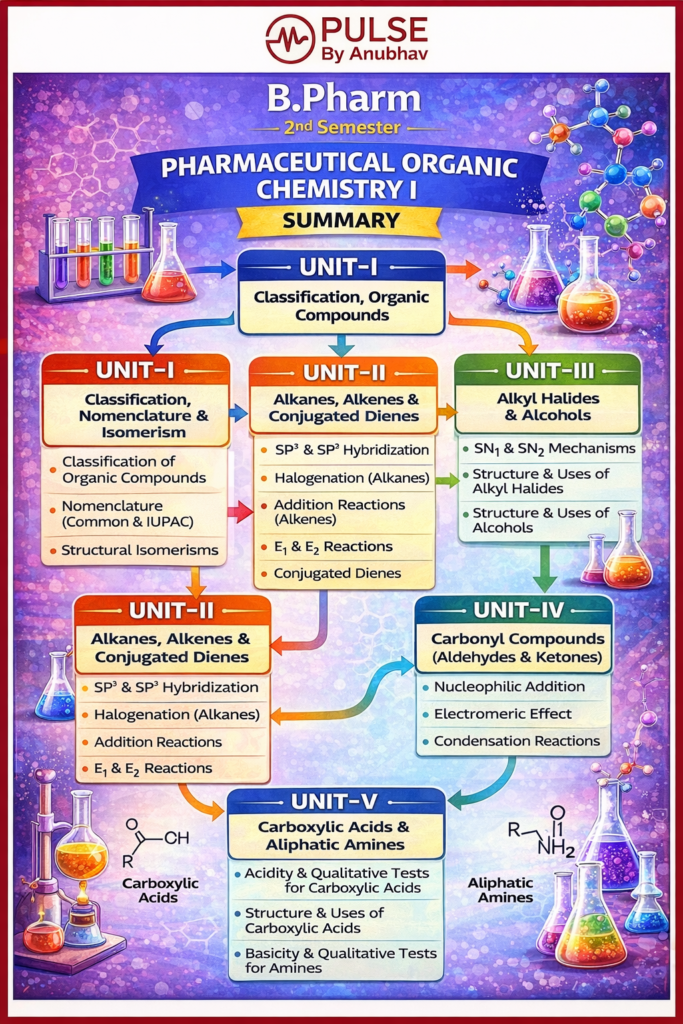
UNIT-I — Classification, Nomenclature & Isomerism
1. Classification of Organic Compounds
- Based on structure:
Aliphatic (open chain), Alicyclic, Aromatic, Heterocyclic - Based on functional group:
Hydrocarbons, Alcohols, Aldehydes, Ketones, Carboxylic acids, Amines, etc. - Based on bonding:
Saturated, Unsaturated - Based on carbon skeleton:
Straight chain, Branched chain, Cyclic
2. Nomenclature Systems
- Common (Trivial) system
- IUPAC system
Rules applicable up to 10 carbon open chain and carbocyclic compounds
3. Isomerism
- Structural Isomerism
- Chain isomerism
- Position isomerism
- Functional group isomerism
- Metamerism
- Tautomerism
- Stereoisomerism (for reference):
Geometrical & Optical (covered later in syllabus)
UNIT-II — Alkanes, Alkenes & Conjugated Dienes
A. Alkanes
- Hybridization: SP³
- Reaction: Halogenation (Free radical substitution)
- Uses: Paraffins (fuel, lubricants, wax, solvent, petroleum industry)
B. Alkenes
- Hybridization: SP²
- Stability: More substituted alkenes are more stable
- Reactions:
- Ozonolysis
- Electrophilic addition
- Markovnikov orientation (H adds to carbon with more H)
- Free radical addition
- Anti-Markovnikov orientation (Peroxide effect)
Elimination Reactions
- E₁ Reaction
- First-order kinetics
- Occurs via carbocation formation
- Rearrangement possible
- E₂ Reaction
- Second-order kinetics
- No rearrangement
- Favors strong base
- Saytzeff’s Rule: More substituted alkene is major product
- Factors affecting E₁/E₂
- Base strength
- Solvent
- Temperature
- Nature of leaving group
- Alkyl halide structure
C. Conjugated Dienes
- Stability: Resonance stabilized
- Reactions:
- Diels–Alder (cycloaddition)
- Electrophilic addition
- Free radical addition
- Allylic rearrangement
UNIT-III — Alkyl Halides & Alcohols
1. Nucleophilic Substitution (SN1 & SN2)
| SN1 | SN2 |
|---|---|
| 1st order kinetics | 2nd order kinetics |
| Carbocation intermediate | No intermediate |
| Rearrangement possible | No rearrangement |
| Racemization occurs | Inversion of configuration |
- Order of reactivity:
SN1 → 3° > 2° > 1°
SN2 → 1° > 2° > 3° - Factors affecting SN1/SN2
- Solvent polarity
- Base/Nucleophile strength
- Leaving group ability
- Steric hindrance
- Temperature
2. Important Compounds — Structure & Uses
- Ethyl chloride → Local anesthetic, refrigerant
- Chloroform → Solvent, anesthetic (historical use)
- Trichloroethylene / Tetrachloroethylene → Industrial solvent, dry cleaning
- Dichloromethane / Tetrachloromethane → Solvent, fire extinguisher
- Iodoform → Antiseptic
3. Alcohols
- Qualitative tests:
Lucas test, Oxidation test, Ester test, Iodoform test (for ethanol/acetone type) - Structure & Uses
- Ethyl alcohol → Solvent, antiseptic, beverage, fuel additive
- Methyl alcohol → Solvent, antifreeze, industrial use
- Chlorobutanol → Preservative, sedative
- Cetostearyl alcohol → Cosmetics, ointment base
- Benzyl alcohol → Perfumes, solvent, antiseptic
- Glycerol / Propylene glycol → Moisturizer, solvent, pharmaceutical vehicle
UNIT-IV — Carbonyl Compounds (Aldehydes & Ketones)
1. Effects & Mechanism
- Nucleophilic addition
- Electromeric effect (+E / −E)
2. Reactions
- Aldol condensation
- Crossed aldol condensation
- Cannizzaro reaction (for non-α-H aldehydes)
- Crossed Cannizzaro
- Benzoin condensation
- Perkin condensation
3. Qualitative tests
- 2,4-DNPH test, Tollens test, Fehling/Benedict test, Schiff’s test, etc.
4. Structure & Uses
- Formaldehyde → Disinfectant, preservative
- Paraldehyde → Sedative, hypnotic
- Acetone → Solvent, pharmaceutical use
- Chloral hydrate → Sedative
- Hexamine → Urinary antiseptic
- Benzaldehyde, Vanillin, Cinnamaldehyde → Flavoring & fragrance agents
UNIT-V — Carboxylic Acids & Aliphatic Amines
A. Carboxylic Acids
- Acidity & Inductive effect
- Electron-withdrawing groups ↑ acidity
- Electron-donating groups ↓ acidity
- Qualitative tests:
Litmus, sodium bicarbonate test, ester/amide tests
Structure & Uses
- Acetic acid → Solvent, vinegar, pharmaceutical use
- Lactic, Tartaric, Citric acids → Food & medicinal uses
- Succinic, Oxalic, Salicylic, Benzoic acids → Industrial & pharmaceutical uses
- Methyl salicylate, Acetyl salicylic acid → Analgesic, anti-inflammatory
B. Aliphatic Amines
- Basicity
- 2° > 1° > 3° (in gas phase)
- Affected by substituents & resonance
- Qualitative tests:
Carbylamine test, nitrous acid test, etc.
Structure & Uses
- Ethanolamine, Ethylenediamine → Pharmaceutical intermediates
- Amphetamine → CNS stimulant (medical use & regulatory importance)
Also Read- How to get admission in D.Pharm? Know everything about Diploma in Pharmacy.
B.Pharm 2nd Semester Pharmaceutical Organic Chemistry I Notes PDF
📘 Download B.Pharm 2nd Semester – Pharmaceutical Organic Chemistry I Notes (PDF / Unit-wise)
📲 All notes available in flowchart format for fast revision.
🚀 Join Pulse Pharma Notes Telegram Channel 🧪 Download Organic Chemistry Notes PackageAlso Read:- B.Pharm 2nd Semester Human Anatomy and Physiology II Notes
B.Pharm 2nd Semester Pharmaceutical Organic Chemistry I Book PDF
Books are very important; you should definitely check out the books according to your syllabus. During your pharmacy studies, books from Nirali Prakashan and PV Sindhu are very helpful. You can download the PDFs from the link below.
- Pharmaceutical Organic Chemistry I Nirali Prakashan Full Book PDF:- PDF
- Pharmaceutical Organic Chemistry I Chemistry PV Sindhu Full Book PDF:- PDF
- Pharmaceutical Organic Chemistry I Chemistry Thakur Publication Full Book PDF:- PDF
- Pharmaceutical Organic Chemistry I Chemistry The Point Publication Full Book PDF: PDF
FAQs About Pharmaceutical Organic Chemistry I
❓ Frequently Asked Questions (Pharmaceutical Organic Chemistry I Notes)
B.Pharm 2nd Semester Notes
| Subject Name | Notes Link |
|---|---|
| Human Anatomy and Physiology II Notes | View Notes |
| Pharmaceutical Organic Chemistry I Notes | View Notes |
| Pathophysiology Notes | View Notes |
| Biochemistry Notes | View Notes |
| Computer Applications in Pharmacy Notes | View Notes |
| Environmental Science Notes | View Notes |
1 thought on “B.Pharm 2nd Semester Pharmaceutical Organic Chemistry I Notes”