Radhe Radhe, B.Pharm students! In this post, you will find the notes for your 3rd semester Pharmaceutical Engineering subject . Here you will find notes, books, previous year questions (PYQs), and important question-answers related to your pharmacy course. You will also find GPAT updates here. You will find pharmacy-related vacancies here, so stay calm and connected with Pulse by Anubhav. Join Our Telegram Channel As Well As Bookmark Our Site For Latest Stuff.
As you may have realized, pursuing a B.Pharm degree is not easy. Many people initially choose it as just one option, but later they discover how much studying is involved. Your B.Pharm course is divided into 8 semesters. In the third semester, you have to study a total of 4 subjects, of which all are compulsory. You won’t have to study any additional subjects this semester. You will meet new friends in this semester. There will be lateral entry for D.Pharma students in your class in this semester.
The pharmacy field is a very important medical field. Here, pharmacists not only dispense medication to patients but also educate them about the medicines. In the pharmaceutical industry, these same pharmacists manufacture the medicines and conduct research on them.
The link to download notes for all units is given below. If you want to download the PDF without reading the post, you can download the PDF by clicking on the link given below. You can also join our Telegram channel for future updates.
Also Read- From Taskaree’s ‘Priya’ to Bollywood: Zoya Afroz’s bold avatar is surprising everyone.
The Subjects in the 3rd semester of B.Pharm are:
- Pharmaceutical Organic Chemistry -2
- Pharmaceutical Microbiology
- Physical Pharmaceutics -1
- Pharmaceutical Engineering
The Pharmaceutical Engineering course that you are being taught in the 3rd semester is very important from an industry perspective. In this course, you will learn how to operate equipment and how to handle particles in large machines.
B.Pharm 3rd Semester Pharmaceutical Engineering Syllabus
Before downloading the notes, please take a look at the Pharmaceutical Engineering syllabus to understand what topics are covered.
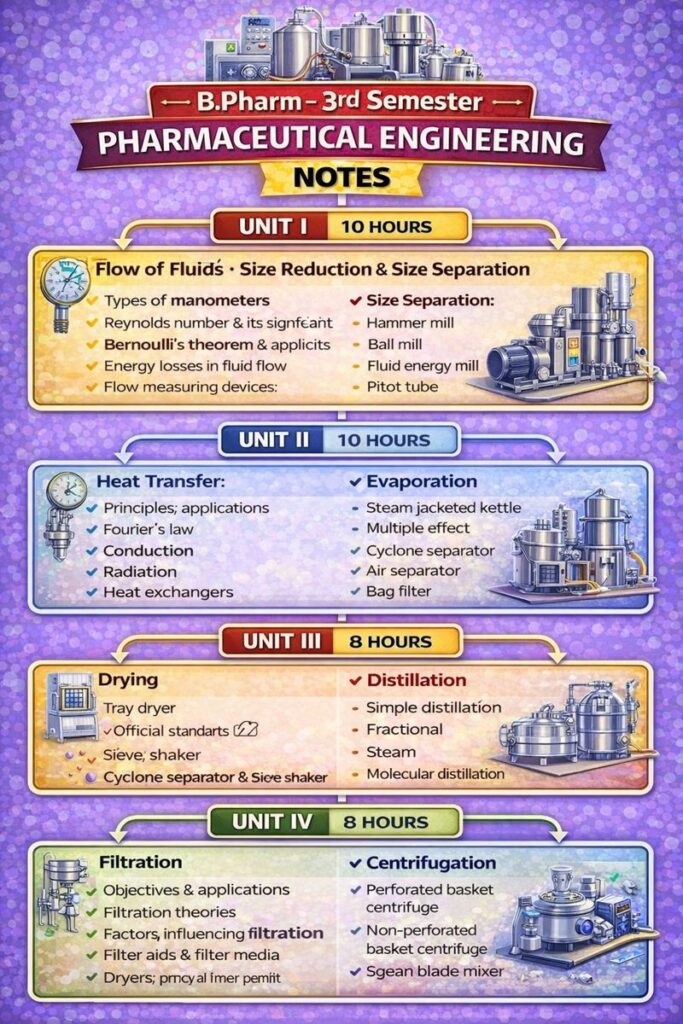
UNIT I – Flow of Fluids, Size Reduction & Size Separation
Flow of Fluids
- Types of manometers
- Reynolds number and its significance
- Bernoulli’s theorem and its applications
- Energy losses in fluid flow
- Flow measuring devices:
- Orifice meter
- Venturimeter
- Pitot tube
- Rotometer
Size Reduction
- Objectives of size reduction
- Mechanisms and laws governing size reduction
- Factors affecting size reduction
- Size reduction equipment – principle, construction, working, uses, merits & demerits:
- Hammer mill
- Ball mill
- Fluid energy mill
- Edge runner mill
- End runner mill
Size Separation
- Objectives, applications and mechanism of size separation
- Official standards of powders
- Sieves and principles of size separation
- Size separation equipment – principle, construction, working, uses, merits & demerits:
- Sieve shaker
- Cyclone separator
- Air separator
- Bag filter
- Elutriation tank
UNIT II – Heat Transfer, Evaporation & Distillation
Heat Transfer
- Objectives and applications
- Mechanisms of heat transfer
- Fourier’s law
- Heat transfer by:
- Conduction
- Convection
- Radiation
- Heat interchangers and heat exchangers
Evaporation
- Objectives and applications
- Factors influencing evaporation
- Difference between evaporation and other heat processes
- Evaporators – principle, construction, working, uses, merits & demerits:
- Steam jacketed kettle
- Horizontal tube evaporator
- Climbing film evaporator
- Forced circulation evaporator
- Multiple effect evaporator
- Economy of multiple effect evaporator
Distillation
- Principles and methodology of:
- Simple distillation
- Flash distillation
- Fractional distillation
- Distillation under reduced pressure
- Steam distillation
- Molecular distillation
UNIT III – Drying & Mixing
Drying
- Objectives, applications and mechanism of drying
- Equilibrium moisture content – measurement & applications
- Rate of drying curve
- Dryers – principle, construction, working, uses, merits & demerits:
- Tray dryer
- Drum dryer
- Spray dryer
- Fluidized bed dryer
- Vacuum dryer
- Freeze dryer
Mixing
- Objectives, applications and factors affecting mixing
- Difference between solid, liquid and semisolid mixing
- Mechanism of:
- Solid mixing
- Liquid mixing
- Semisolid mixing
- Mixers – principle, construction, working, uses, merits & demerits:
- Double cone blender
- Twin shell blender
- Ribbon blender
- Sigma blade mixer
- Planetary mixer
- Propellers
- Turbines
- Paddles
- Silverson emulsifier
UNIT IV – Filtration & Centrifugation
Filtration
- Objectives and applications
- Filtration theories
- Factors influencing filtration
- Filter aids and filter media
- Filters – principle, construction, working, uses, merits & demerits:
- Plate and frame filter
- Filter leaf
- Rotary drum filter
- Meta filter
- Cartridge filter
- Membrane filters
- Seitz filter
Centrifugation
- Objectives, principles and applications
- Centrifuges – principle, construction, working, uses, merits & demerits:
- Perforated basket centrifuge
- Non-perforated basket centrifuge
- Semi-continuous centrifuge
- Super centrifuge
UNIT V – Materials of Construction & Material Handling
- Materials used in pharmaceutical plant construction
- Factors affecting selection of materials for pharmaceutical plants
- Corrosion:
- Theories of corrosion
- Types of corrosion
- Prevention of corrosion
- Materials of construction:
- Ferrous metals
- Non-ferrous metals
- Inorganic non-metals
- Organic non-metals
- Basics of material handling systems
Also Read- Understanding Virginity and Its Connection to Rape Cases
B.Pharm 3rd Semester Pharmaceutical Engineering Notes PDF
⚙️ Download B.Pharm 3rd Semester – Pharmaceutical Engineering Notes (Unit-wise | Flowchart PDF)
⚡ All Pharmaceutical Engineering notes are prepared in **easy flowchart format** for quick revision, concept clarity & university exams.
🚀 Join Pulse Pharma Notes Telegram Channel 📘 Download Complete Pharmaceutical Engineering Flowchart NotesAlso Read:- B.Pharm 3rd Semester Pharmaceutical Microbiology Notes
B.Pharm 3rd Semester Pharmaceutical Engineering Book PDF
Books are very important; you should definitely check out the books according to your syllabus. During your pharmacy studies, books from Nirali Prakashan and PV Sindhu are very helpful. You can download the PDFs from the link below.
- Pharmaceutical Engineering Nirali Prakashan Full Book PDF:- PDF
- Pharmaceutical Engineering Chemistry PV Sindhu Full Book PDF:- PDF
- Pharmaceutical Engineering Chemistry Thakur Publication Full Book PDF:- PDF
- Pharmaceutical Engineering Chemistry The Point Publication Full Book PDF: PDF
❓ Pharmaceutical Engineering – Frequently Asked Questions (B.Pharm)
What is Pharmaceutical Engineering in B.Pharm?
Pharmaceutical Engineering deals with the application of engineering principles to pharmaceutical manufacturing processes such as fluid flow, heat transfer, drying, mixing, filtration, centrifugation and plant design.
Which unit of Pharmaceutical Engineering is most important for exams?
UNIT I (Flow of Fluids, Size Reduction & Size Separation) and UNIT II (Heat Transfer, Evaporation & Distillation) are most frequently asked in university examinations.
Why is Reynolds number important in fluid flow?
Reynolds number helps in predicting the nature of fluid flow (laminar or turbulent), which is essential for designing pharmaceutical equipment like pipelines, pumps and flow meters.
What is the purpose of size reduction in pharmaceuticals?
Size reduction increases surface area, improves dissolution rate, enhances uniformity of mixing and improves bioavailability of drugs.
Why are evaporators and distillation units important?
Evaporation is used for concentration of solutions, while distillation is used for purification and separation of liquids in pharmaceutical manufacturing.
What is the significance of drying in pharmaceutical processes?
Drying removes moisture to improve stability, shelf life and flow properties of pharmaceutical products such as powders and granules.
Why are filtration and centrifugation used in pharma industries?
Filtration and centrifugation are separation techniques used to remove solids from liquids, clarify solutions and recover products during manufacturing.
Why is corrosion study important in pharmaceutical plants?
Corrosion can contaminate products and damage equipment. Studying corrosion helps in selecting suitable construction materials and increasing plant safety and product quality.
B.Pharm 3rd Semester Notes
| Subject Name | Notes Link |
|---|---|
| Pharmaceutical Organic Chemistry – II Notes | View Notes |
| Pharmaceutical Microbiology Notes | View Notes |
| Physical Pharmaceutics – I Notes | View Notes |
| Pharmaceutical Engineering Notes | View Notes |
1 thought on “B.Pharm 3rd Semester Pharmaceutical Engineering Notes”