Radhe Radhe, B.Pharm students! In this post, you will find the notes for your 4th semester Pharmaceutical Pharmacognosy and Phytochemistry 1 subject . Here you will find notes, books, previous year questions (PYQs), and important question-answers related to your pharmacy course Syllabus. You will also find GPAT updates here. Here You will find pharmacy-related vacancies, so stay calm and connected with Pulse by Anubhav. Join Our Telegram Channel As Well As Bookmark Our Site For Latest Stuff.
As you may have realized, pursuing a B.Pharm degree is not easy. Many people initially choose it as just one option, but later they discover how much studying is involved. Your B.Pharm course is divided into 8 semesters. In the fourth semester, you have to study a total number of 5 subjects, of which all are compulsory. You won’t have to study any additional subjects in this semester.
The pharmacy field is a very important medical field. Here, pharmacists not only dispense medication to patients but also educate them about the medicines. In the pharmaceutical industry, these same pharmacists manufacture the medicines and conduct research on them.
The link to download notes for all units is given below. If you want to download the PDF without reading the post, you can download the PDF by clicking on the link given below. You can also join our Telegram channel for future updates.
Also Read- You Look Fine… But Are You Suffering From Anemia?
The Subjects in the 4th semester of B.Pharm are:
- Pharmaceutical Organic Chemistry – 3
- Physical Pharmaceutics – 2
- Medicinal Chemistry – 1
- Pharmacology – 1
- Pharmacognosy and Phytochemistry – 1
In Pharmacognosy and Phytochemistry 1, you will be taught about crude drugs. This is a very important subject that is taught to every student pursuing a medical degree. It is also taught in courses like B.A.M.S, M.B.B.S, and B.H.M.S.
B.Pharm 4th Semester Pharmacognosy and Phytochemistry 1 Syllabus
Before downloading the notes, please take a look at the Pharmacognosy and Phytochemistry 1 syllabus to understand what topics are covered.
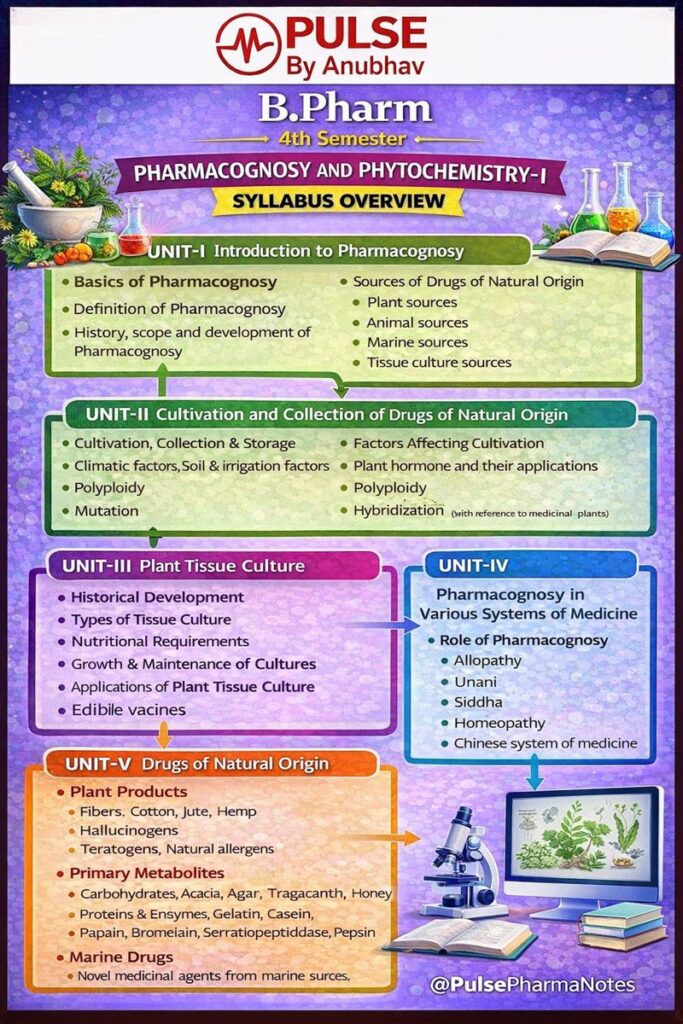
UNIT – I
Introduction to Pharmacognosy
a. Basics of Pharmacognosy
- Definition of Pharmacognosy
- History, scope and development of Pharmacognosy
b. Sources of Drugs of Natural Origin
- Plant sources
- Animal sources
- Marine sources
- Tissue culture sources
c. Organized & Unorganized Drugs
- Organized drugs
- Unorganized drugs:
- Dried latex
- Dried juices
- Dried extracts
- Gums and mucilages
- Oleoresins
- Oleo-gum-resins
d. Classification of Drugs
- Alphabetical classification
- Morphological classification
- Taxonomical classification
- Chemical classification
- Pharmacological classification
- Chemo-taxonomical classification
- Sero-taxonomical classification
e. Quality Control of Drugs of Natural Origin
- Adulteration of drugs of natural origin
- Evaluation methods:
- Organoleptic evaluation
- Microscopic evaluation
- Physical evaluation
- Chemical evaluation
- Biological evaluation
f. Quantitative Microscopy
- Lycopodium spore method
- Leaf constants
- Camera lucida
- Diagrams of microscopic objects to scale using camera lucida
UNIT – II
Cultivation and Collection of Drugs of Natural Origin
a. Cultivation, Collection & Storage
- Cultivation of medicinal plants
- Collection of crude drugs
- Processing of drugs of natural origin
- Storage of crude drugs
b. Factors Affecting Cultivation
- Climatic factors
- Soil and irrigation factors
c. Plant Improvement Techniques
- Plant hormones and their applications
- Polyploidy
- Mutation
- Hybridization (with reference to medicinal plants)
d. Conservation of Medicinal Plants
UNIT – III
Plant Tissue Culture
- Historical development of plant tissue culture
- Types of tissue culture
- Nutritional requirements
- Growth and maintenance of cultures
Applications of Plant Tissue Culture
- Applications in Pharmacognosy
- Edible vaccines
UNIT – IV
Pharmacognosy in Various Systems of Medicine
a. Role of Pharmacognosy
- Role in allopathy
- Role in traditional systems of medicine:
- Ayurveda
- Unani
- Siddha
- Homeopathy
- Chinese system of medicine
b. Secondary Metabolites
- Definition
- Classification
- Properties
- Identification tests for:
- Alkaloids
- Glycosides
- Flavonoids
- Tannins
- Volatile oils
- Resins
UNIT – V
Drugs of Natural Origin
a. Plant Products
- Fibers:
- Cotton
- Jute
- Hemp
- Hallucinogens
- Teratogens
- Natural allergens
b. Primary Metabolites
General introduction and detailed study with respect to:
- Chemistry
- Sources
- Preparation
- Evaluation
- Preservation
- Storage
- Therapeutic uses
- Commercial utility as pharmaceutical aids and/or medicines
Carbohydrates
- Acacia
- Agar
- Tragacanth
- Honey
Proteins & Enzymes
- Gelatin
- Casein
- Proteolytic enzymes:
- Papain
- Bromelain
- Serratiopeptidase
- Urokinase
- Streptokinase
- Pepsin
Lipids
- Waxes
- Fats
- Fixed oils:
- Castor oil
- Chaulmoogra oil
- Wool fat
- Bees wax
c. Marine Drugs
- Novel medicinal agents from marine sources
Also Read- What is an expectorant? Learn when to take which type expectorant.
B.Pharm 4th Semester Pharmacognosy and Phytochemistry 1 Notes PDF
🌿 Download B.Pharm 4th Semester – Pharmacognosy & Phytochemistry-I Notes (Unit-wise | Flowchart PDF)
⚡ Pharmacognosy & Phytochemistry-I notes are prepared in simple, exam-oriented flowchart format for quick revision, concept clarity & university exams.
🚀 Join Pulse Pharma Notes Telegram Channel 📘 Download Complete Pharmacognosy & Phytochemistry-I Flowchart NotesAlso Read:- B.Pharm 4th Semester Pharmaceutical Pharmacology 1 Notes
B.Pharm 4th Semester Pharmacognosy and Phytochemistry 1 Book PDF
Books are very important; you should definitely check out the books according to your syllabus. During your pharmacy studies, books from Nirali Prakashan and PV Sindhu are very helpful. You can download the PDFs from the link below.
- Pharmaceutical Pharmacognosy and Phytochemistry 1 Nirali Prakashan Full Book PDF:- PDF
- Pharmaceutical Pharmacognosy and Phytochemistry 1 Chemistry PV Sindhu Full Book PDF:- PDF
- Pharmaceutical Pharmacognosy and Phytochemistry 1 Chemistry Thakur Publication Full Book PDF:- PDF
- Pharmaceutical Pharmacognosy and Phytochemistry 1 Chemistry The Point Publication Full Book PDF: PDF
❓ Pharmacognosy & Phytochemistry-I – FAQs (B.Pharm 4th Semester)
What is Pharmacognosy & Phytochemistry-I?
Pharmacognosy & Phytochemistry-I deals with drugs obtained from natural sources such as plants, animals and marine organisms, including their identification, evaluation, constituents and uses.
Which topics are covered in Unit-I of Pharmacognosy?
Unit-I includes introduction to pharmacognosy, sources of drugs, organized and unorganized drugs, classification of crude drugs, quality control and quantitative microscopy.
What are organized and unorganized drugs?
Organized drugs retain cellular structure like leaves and roots, whereas unorganized drugs include dried latex, gums, mucilages, resins and extracts without cellular organization.
Why is quality control important in Pharmacognosy?
Quality control ensures identity, purity and strength of crude drugs and helps in detecting adulteration using organoleptic, microscopic, chemical and biological methods.
What is studied under cultivation and collection of medicinal plants?
It includes cultivation, collection, processing, storage of crude drugs, factors affecting cultivation, plant hormones, hybridization and conservation of medicinal plants.
What is plant tissue culture and its importance?
Plant tissue culture is the in-vitro growth of plant cells or tissues. It is important for rapid multiplication, production of secondary metabolites and development of edible vaccines.
What are secondary metabolites?
Secondary metabolites are organic compounds like alkaloids, glycosides, flavonoids, tannins, volatile oils and resins which are responsible for therapeutic activity of natural drugs.
Which systems of medicine are covered in this subject?
Pharmacognosy covers the role of crude drugs in allopathy and traditional systems such as Ayurveda, Unani, Siddha, Homeopathy and Chinese system of medicine.
What are primary metabolites studied in Unit-V?
Primary metabolites include carbohydrates, proteins, enzymes and lipids which are studied with respect to source, chemistry, preparation, uses and pharmaceutical applications.
How to score well in Pharmacognosy & Phytochemistry-I exams?
Focus on definitions, classification tables, flowcharts, diagrams, sources, chemical constituents and therapeutic uses of crude drugs for high scoring answers.
B.Pharm 4th Semester Notes
| Subject Name | Notes Link |
|---|---|
| Pharmaceutical Organic Chemistry – III Notes | View Notes |
| Pharmaceutical Physical Pharmaceutics – II Notes | View Notes |
| Pharmaceutical Medicinal Chemistry – I Notes | View Notes |
| Pharmaceutical Pharmacology – I Notes | View Notes |
| Pharmacognosy and Phytochemistry – I Notes | View Notes |
4 thoughts on “B.Pharm 4th Semester Pharmacognosy and Phytochemistry 1 Notes”