Radhe Radhe, B.Pharm students! In this post, you will find the notes for your 5th semester Pharmaceutical Medicinal Chemistry 2 subject . Here you will find notes, books, previous year questions (PYQs), and important question-answers related to your pharmacy course Syllabus. You will also find GPAT updates here and exam tips. Here You will find pharmacy-related vacancies, so stay calm and connected with Pulse by Anubhav. Join Our Telegram Channel As Well As Bookmark Our Site For Latest Update.
As you may have realized, pursuing a B.Pharm degree is not easy. Many people initially choose it as just one option, but later they discover how much studying is involved. Your B.Pharm course is divided into 8 semesters. In which the fifth semester, you have to study a total number of 5 subjects, of which all are compulsory. You won’t have to study any additional subjects in this semester.
The pharmacy field is a very important medical field. Here, pharmacists not only dispense medication to patients but also educate them about the medicines. In the pharmaceutical industry, these same pharmacists manufacture the medicines and conduct research on them.
The link to download notes for all units is given below. If you want to download the PDF without reading the post, you can download the PDF by clicking on the link given below. You can also join our Telegram channel for future updates.
Also Read- B.Pharm 4th Semester Pharmacognosy and Phytochemistry 1 Notes
The Subjects in the 5th semester of B.Pharm are:
- Medicinal Chemistry-2
- Industrial Pharmacy-1
- Pharmaceutical Pharmacology-2
- Pharmacognosy and Phytochemistry-2
- Pharmaceutical Jurisprudence
Medicinal Chemistry 2 is a very important subject that you will study in the 5th semester, which is at the beginning of your third year. You will have to memorize many Structure-Activity Relationships (SARs) in this course. You will find many such structures and reactions here which you may have read earlier.
B.Pharm 5th Semester Medicinal Chemistry 2 Syllabus
Before downloading the notes, please take a look at the Medicinal Chemistry-2 syllabus to understand what topics are covered.
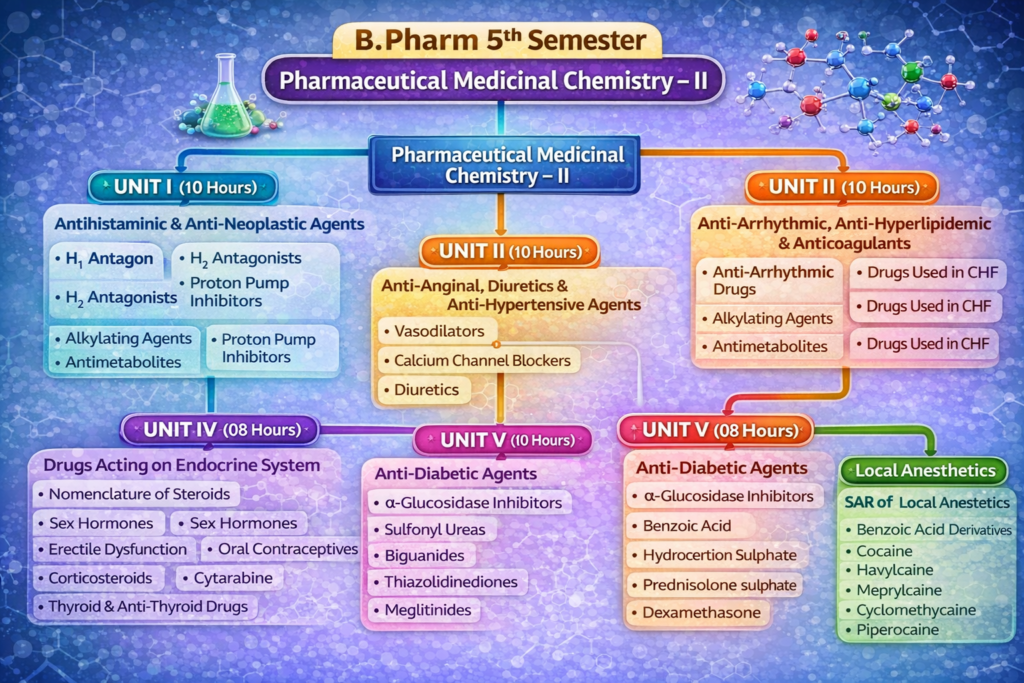
UNIT – I
Antihistaminic Agents
- Histamine: Receptors & distribution in human body
H₁ – Antagonists
- Diphenhydramine HCl*
- Dimenhydrinate
- Doxylamine succinate
- Clemastine fumarate
- Diphenylpyraline HCl
- Tripelenamine HCl
- Chlorcyclizine HCl
- Meclizine HCl
- Buclizine HCl
- Chlorpheniramine maleate
- Triprolidine HCl*
- Phenindamine tartrate
- Promethazine HCl*
- Trimeprazine tartrate
- Cyproheptadine HCl
- Azatadine maleate
- Astemizole
- Loratadine
- Cetirizine
- Levocetirizine
- Cromolyn sodium
H₂ – Antagonists
- Cimetidine*
- Famotidine
- Ranitidine
Gastric Proton Pump Inhibitors
- Omeprazole
- Lansoprazole
- Rabeprazole
- Pantoprazole
Anti-Neoplastic Agents
Alkylating Agents
- Mechlorethamine*
- Cyclophosphamide
- Melphalan
- Chlorambucil
- Busulfan
- Thiotepa
Antimetabolites
- Mercaptopurine*
- Thioguanine
- Fluorouracil
- Floxuridine
- Cytarabine
- Methotrexate*
- Azathioprine
Antibiotics
- Dactinomycin
- Daunorubicin
- Doxorubicin
- Bleomycin
Plant Products
- Etoposide
- Vinblastine sulphate
- Vincristine sulphate
Miscellaneous
- Cisplatin
- Mitotane
UNIT – II
Anti-Anginal Drugs
Vasodilators
- Amyl nitrite
- Nitroglycerin*
- Pentaerythritol tetranitrate
- Isosorbide dinitrate*
- Dipyridamole
Calcium Channel Blockers
- Verapamil
- Bepridil HCl
- Diltiazem HCl
- Nifedipine
- Amlodipine
- Felodipine
- Nicardipine
- Nimodipine
Diuretics
Carbonic Anhydrase Inhibitors
- Acetazolamide*
- Methazolamide
- Dichlorphenamide
Thiazides
- Chlorthiazide*
- Hydrochlorothiazide
- Cyclothiazide
- Hydroflumethiazide
Loop Diuretics
- Furosemide*
- Bumetanide
- Ethacrynic acid
Potassium Sparing Diuretics
- Spironolactone
- Triamterene
- Amiloride
Osmotic Diuretics
- Mannitol
Anti-Hypertensive Agents
- Timolol
- Captopril
- Lisinopril
- Enalapril
- Benazepril HCl
- Quinapril HCl
- Methyldopate HCl*
- Clonidine HCl
- Guanethidine monosulphate
- Guanabenz acetate
- Sodium nitroprusside
- Diazoxide
- Minoxidil
- Reserpine
- Hydralazine HCl
UNIT – III
Anti-Arrhythmic Drugs
- Quinidine sulphate
- Procainamide HCl
- Disopyramide phosphate*
- Phenytoin sodium
- Lidocaine HCl
- Tocainide HCl
- Mexiletine HCl
- Lorcainide HCl
- Amiodarone
- Sotalol
Anti-Hyperlipidemic Agents
- Clofibrate
- Lovastatin
- Cholestyramine
- Cholestipol
Coagulants & Anticoagulants
- Menadione
- Acetomenadione
- Warfarin*
- Anisindione
- Clopidogrel
Drugs Used in Congestive Heart Failure
- Digoxin
- Digitoxin
- Nesiritide
- Bosentan
- Tezosentan
UNIT – IV
Drugs Acting on Endocrine System
- Nomenclature, stereochemistry & metabolism of steroids
Sex Hormones
- Testosterone
- Nandrolone
- Progesterone
- Oestriol
- Oestradiol
- Oestrone
- Diethylstilbestrol
Drugs for Erectile Dysfunction
- Sildenafil
- Tadalafil
Oral Contraceptives
- Mifepristone
- Norgestrel
- Levonorgestrel
Corticosteroids
- Cortisone
- Hydrocortisone
- Prednisolone
- Dexamethasone
- Betamethasone
Thyroid & Anti-Thyroid Drugs
- L-Thyroxine
- L-Thyronine
- Propylthiouracil
- Methimazole
UNIT – V
Antidiabetic Agents
Insulin
- Insulin & its preparations
Sulfonyl Ureas
- Tolbutamide*
- Chlorpropamide
- Glipizide
- Glimepiride
Biguanides
- Metformin
Thiazolidinediones
- Pioglitazone
- Rosiglitazone
Meglitinides
- Repaglinide
- Nateglinide
α-Glucosidase Inhibitors
- Acarbose
- Voglibose
Local Anesthetics
SAR of Local Anesthetics
Benzoic Acid Derivatives
- Cocaine
- Hexylcaine
- Meprylcaine
- Cyclomethycaine
- Piperocaine
Amino Benzoic Acid Derivatives
- Benzocaine*
- Butamben
- Procaine*
- Butacaine
- Propoxycaine
- Tetracaine
- Benoxinate
Anilide (Lidocaine) Derivatives
- Lignocaine
- Mepivacaine
- Prilocaine
- Etidocaine
Miscellaneous
- Phenacaine
- Diperodon
- Dibucaine*
Also Read- Hair Fall Alert: Why do we lose hair and how to stop it?
B.Pharm 5th Semester Medicinal Chemistry 2 Notes PDF
🧪 Download B.Pharm 5th Semester – Pharmaceutical Medicinal Chemistry-II Notes (Unit-wise | Flowchart PDF)
⚡ Pharmaceutical Medicinal Chemistry-II notes are prepared in simple, exam-oriented flowchart format for quick revision, concept clarity & university exams.
🚀 Join Pulse Pharma Notes Telegram Channel 📘 Download Complete PMC-II Flowchart Notes (PDF)Also Read:- What are antihistamines? How it works, best medicine and precautions
B.Pharm 5th Semester Medicinal Chemistry 2 Book PDF
Books are very important; you should definitely check out the books according to your syllabus. During your pharmacy studies, books from Nirali Prakashan and PV Sindhu are very helpful. You can download the PDFs from the link below.
- Pharmaceutical Medicinal Chemistry 2 Nirali Prakashan Full Book PDF:- PDF
- Pharmaceutical Medicinal Chemistry 2 Chemistry PV Sindhu Full Book PDF:- PDF
- Pharmaceutical Medicinal Chemistry 2 Chemistry Thakur Publication Full Book PDF:- PDF
- Pharmaceutical Medicinal Chemistry 2 Chemistry The Point Publication Full Book PDF: PDF
❓ Pharmaceutical Medicinal Chemistry-II – FAQs (B.Pharm 5th Semester)
What is Pharmaceutical Medicinal Chemistry-II?
Pharmaceutical Medicinal Chemistry-II deals with chemical structure, synthesis, mechanism of action, SAR and therapeutic applications of drugs acting on different body systems.
Which topics are covered in Unit-I of PMC-II?
Unit-I includes antihistaminic agents, H1 and H2 antagonists, proton pump inhibitors and anti-neoplastic agents such as alkylating agents, antimetabolites and anticancer antibiotics.
What is the importance of SAR in Medicinal Chemistry?
Structure Activity Relationship (SAR) helps in understanding how chemical structure affects biological activity and is useful in designing safer and more potent drugs.
Which cardiovascular drugs are studied in Unit-II?
Unit-II covers anti-anginal drugs, vasodilators, calcium channel blockers, diuretics and anti-hypertensive agents with their chemistry and pharmacological actions.
What drugs are included in Unit-III?
Unit-III includes anti-arrhythmic drugs, anti-hyperlipidemic agents, coagulants, anticoagulants and drugs used in congestive heart failure.
What is studied under endocrine system drugs?
Unit-IV covers nomenclature, stereochemistry and metabolism of steroids, sex hormones, oral contraceptives, corticosteroids, thyroid and anti-thyroid drugs.
Which antidiabetic agents are included in PMC-II?
Unit-V includes insulin preparations, sulfonyl ureas, biguanides, thiazolidinediones, meglitinides and alpha-glucosidase inhibitors.
What is covered under Local Anesthetics?
Local anesthetics include SAR, benzoic acid derivatives, amino-benzoic acid derivatives, lignocaine derivatives and miscellaneous local anesthetic agents.
How to prepare PMC-II for university exams?
Focus on chemical structures, synthesis, SAR, mechanism of action, classification tables and flowcharts for writing high-scoring, exam-oriented answers.
B.Pharm 5th Semester Notes
| Subject Name | Notes Link |
|---|---|
| Pharmaceutical Medicinal Chemistry – II Notes | View Notes |
| Pharmaceutical Industrial Pharmacy – I Notes | View Notes |
| Pharmaceutical Pharmacology – II Notes | View Notes |
| Pharmacognosy and Phytochemistry – II Notes | View Notes |
| Pharmaceutical Jurisprudence Notes | View Notes |
3 thoughts on “B.Pharm 5th Semester Pharmaceutical Medicinal Chemistry 2 Notes”