Chemical Reactions and Equations is a chapter in your science subject. Radhe Radhe to all my dear children! You all will have to work very hard for your board exams to get good marks. In this post, I will try to cover all the important topics of your 10th-grade science syllabus so that you can understand and remember them.
Chemical Reactions and Equations, which is your first chapter, falls under the chemistry section of science. All the information you need to study in this chapter will be found in this post.
👉 Skip everything and click here to directly view the Notes PDF
Jab ek ya zyada substances chemical change se naye substances banate hain Daily life examples:Milk → curd Iron rusting Grapes fermentation Cooking & digestion of food Respiration ➡️ In sab me new substance banta hai → chemical reaction
Chemical reaction ke signs:
Change in colour Change in state Evolution of gas Change in temperature Formation of precipitate Reaction ko words ya symbols me likhna Reactants → Products LHS = reactants RHS = products Example (word):
Example (symbol):
Skeletal equation : atoms equal nahiBalanced equation : har element ke atoms LHS = RHS➡️ Law of Conservation of Mass
Mass create ya destroy nahi hota Atoms count karo Coefficients change karo (formula nahi) Hit-and-trial method Smallest whole number use karo (s) → solid (l) → liquid (g) → gas (aq) → aqueous ➡️ Kabhi-kabhi reaction conditions bhi likhte hain (heat, light, catalyst)
2 ya zyada reactants → 1 product Example: Mostly exothermic 1 compound → 2 ya zyada products Energy required (heat / light / electricity) Types:
Thermal decomposition Photochemical decomposition Electrolytic decomposition Zyada reactive element, kam reactive ko replace karta hai Example: Ions exchange hote hain Example: ➡️ Agar insoluble solid bane → Precipitation reaction
Exothermic → heat releaseEndothermic → heat absorbOxidation :Gain of oxygen Loss of hydrogen Reduction :Loss of oxygen Gain of hydrogen ➡️ Dono saath hote hain → Redox reaction
Metals ka slow damage due to air & moisture Example:Rusting of iron Green layer on copper Black coating on silver ➡️ Heavy economic loss
Also Read- B.Pharm 5th Semester Pharmaceutical Pharmacognosy and Phytochemistry 2 Notes
CBSE Class 10 Science – Chapter 1
Chemical Reactions and Equations
Complete Class 10 Science Chapter 1 notes, NCERT book PDF
aur official Telegram channel ka direct access yahan se milega.
Q1. Milk turning sour in summer is due to:
A. Physical change
B. Chemical reaction
C. Evaporation
D. Melting
✅ Correct Answer: Chemical reaction
Q2. Rusting of iron is an example of:
A. Physical change
B. Chemical change
C. Temporary change
D. Reversible change
✅ Correct Answer: Chemical change
Q3. Digestion of food is:
A. Physical process
B. Chemical reaction
C. Mechanical change
D. Reversible change
✅ Correct Answer: Chemical reaction
Q4. Burning of magnesium ribbon forms:
A. Magnesium hydroxide
B. Magnesium oxide
C. Magnesium carbonate
D. Magnesium sulphate
✅ Correct Answer: Magnesium oxide
Q5. Which indicates a chemical reaction?
A. Change in size
B. Evolution of gas
C. Movement
D. Shape change
✅ Correct Answer: Evolution of gas
Q6. Reactants are written on:
A. Left-hand side
B. Right-hand side
C. Above arrow
D. Below arrow
✅ Correct Answer: Left-hand side
Q7. Mg + O₂ → MgO is a:
A. Word equation
B. Skeletal equation
C. Ionic equation
D. Balanced equation
✅ Correct Answer: Skeletal equation
Q8. Balanced equations follow law of:
A. Energy conservation
B. Mass conservation
C. Motion
D. Pressure
✅ Correct Answer: Conservation of mass
Q9. Method used for balancing equations:
A. Hit and trial
B. Chain method
C. Ratio method
D. Cross method
✅ Correct Answer: Hit and trial
Q10. (aq) represents:
A. Solid
B. Gas
C. Aqueous solution
D. Liquid
✅ Correct Answer: Aqueous solution
Q11. CaO + H₂O → Ca(OH)₂ is:
A. Combination reaction
B. Decomposition
C. Displacement
D. Neutralisation
✅ Correct Answer: Combination reaction
Q12. Reaction releasing heat is:
A. Endothermic
B. Exothermic
C. Neutral
D. Slow
✅ Correct Answer: Exothermic
Q13. Respiration is:
A. Exothermic reaction
B. Endothermic
C. Physical change
D. Neutral
✅ Correct Answer: Exothermic reaction
Q14. FeSO₄ on heating shows:
A. Combination
B. Decomposition
C. Displacement
D. Neutralisation
✅ Correct Answer: Decomposition reaction
Q15. Decomposition by heat is called:
A. Photo decomposition
B. Thermal decomposition
C. Electrolysis
D. Combination
✅ Correct Answer: Thermal decomposition
Q16. AgCl turns grey in sunlight due to:
A. Combination
B. Photochemical decomposition
C. Neutralisation
D. Displacement
✅ Correct Answer: Photochemical decomposition
Q17. Iron nail in CuSO₄ shows:
A. Combination
B. Displacement reaction
C. Decomposition
D. Neutralisation
✅ Correct Answer: Displacement reaction
Q18. BaSO₄ formed in double displacement is:
A. Precipitate
B. Gas
C. Liquid
D. Solution
✅ Correct Answer: Precipitate
Q19. Oxidation means:
A. Gain of oxygen
B. Gain of hydrogen
C. Loss of energy
D. Loss of mass
✅ Correct Answer: Gain of oxygen
Q20. Rusting is an example of:
A. Reduction
B. Oxidation
C. Neutralisation
D. Decomposition
✅ Correct Answer: Oxidation
Also Read- B.Pharm 5th Semester Pharmaceutical Jurisprudence Notes
Q1. What happens when milk is left at room temperature during summers?
Milk turns sour due to a chemical reaction caused by bacterial activity,
leading to the formation of lactic acid.
Q2. Why does an iron nail rust when exposed to humid air?
Rusting occurs due to a chemical reaction between iron, oxygen and moisture,
forming iron oxide.
Q3. Which observation indicates that a chemical reaction has taken place?
Evolution of gas, change in colour, change in temperature or change in state
indicates a chemical reaction.
Q4. What is formed when magnesium ribbon is burnt in air?
Magnesium oxide is formed as a white powder when magnesium ribbon burns in air.
Q5. Why should chemical equations be balanced?
Chemical equations are balanced to satisfy the law of conservation of mass,
ensuring equal number of atoms on both sides.
1
Chemical Reactions and Equations
4
Carbon and Its Compounds
6
Control and Coordination
7
How do Organisms Reproduce?
9
Light – Reflection and Refraction
10
The Human Eye and the Colorful World
12
Magnetic Effects of Electric Current
Related 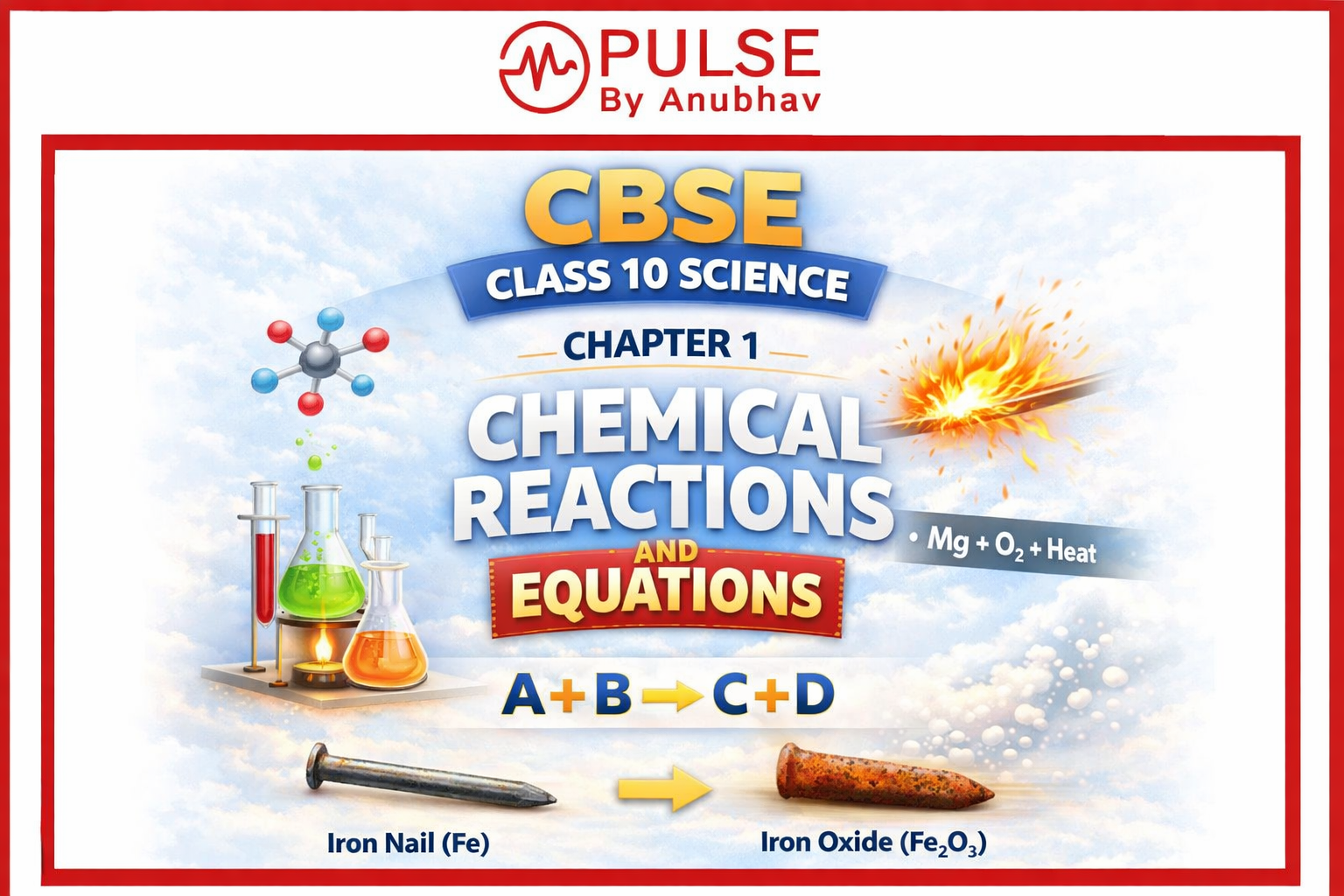
11 thoughts on “CBSE Class 10 Science Chapter 1 Chemical Reactions and Equations”