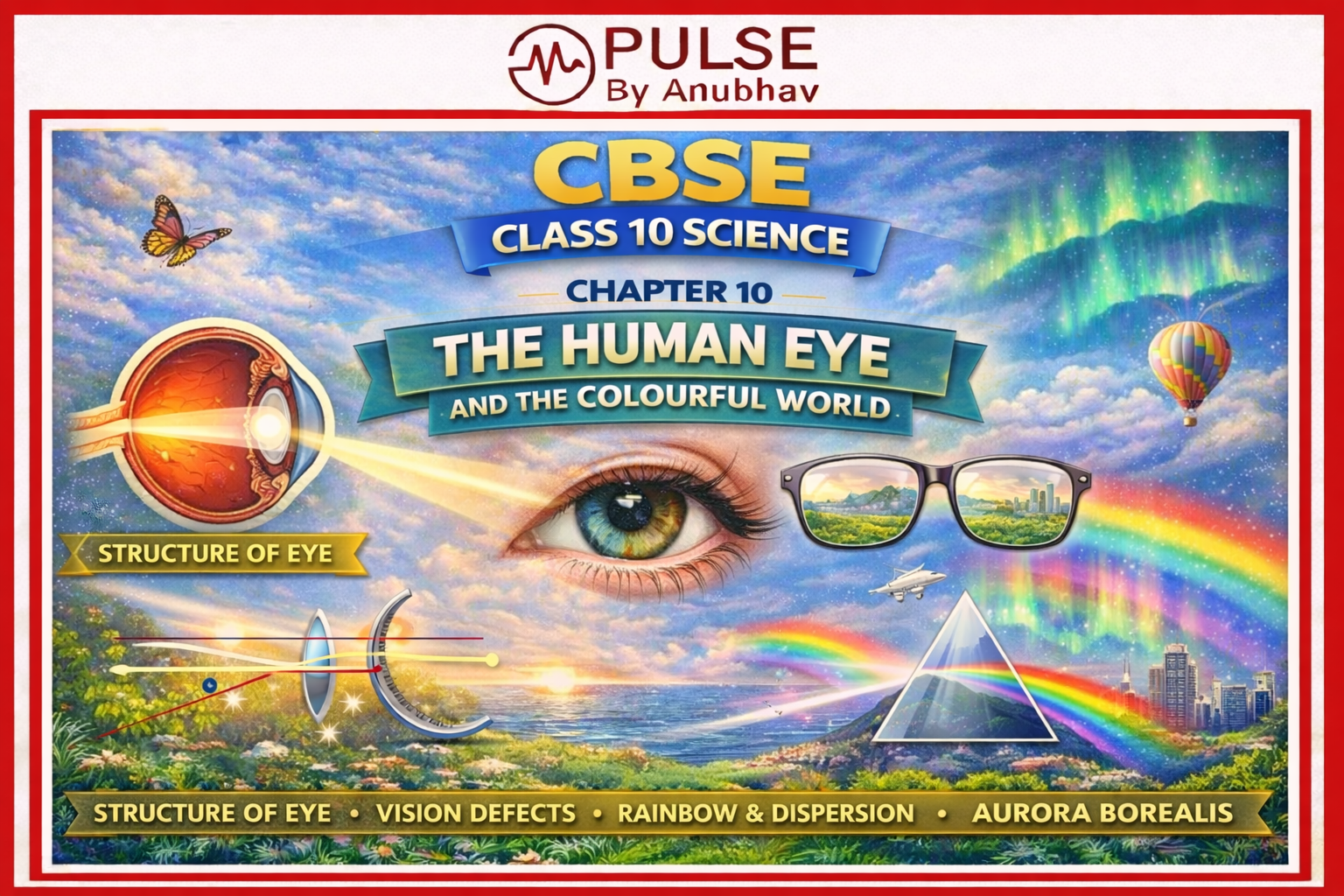
The Human Eye and the Colorful World is a chapter in your science subject. Radhe Radhe to all my dear children! You all will have to work very hard for your board exams to get good marks. In this post, I will try to cover all the important topics of your 10th-grade science syllabus so that you can understand and remember them.
The Human Eye and the Colorful World, which is your tenth chapter, falls under the physics section of science. All the information you need to study in this chapter will be found in this post.
Also Read- CBSE Class 10 Science Chapter 9 Light – Reflection and Refraction
👉 Skip everything and click here to directly view the Notes PDFKey Content of Chapter 10 The Human Eye and the Colorful World
👁️ 1. The Human Eye
- Human eye is a sense organ that helps us see objects and colours.
- It works like a camera.
- Light enters the eye through cornea.
- The eye lens focuses light on the retina.
- Retina has light-sensitive cells that convert light into electrical signals.
- These signals are sent to the brain through the optic nerve.
- Brain interprets these signals and forms the image.
👁️🗨️ 2. Power of Accommodation
- The eye lens can change its focal length.
- This ability is called power of accommodation.
- Ciliary muscles control the curvature of the eye lens.
- For distant objects → lens becomes thin → focal length increases.
- For nearby objects → lens becomes thick → focal length decreases.
- Near point of normal eye = 25 cm.
- Far point of normal eye = infinity.
⚠️ 3. Defects of Vision and Their Correction
(a) Myopia (Near-sightedness)
- Person sees near objects clearly, but distant objects blurred.
- Image forms in front of retina.
- Causes:
- Excessive curvature of eye lens
- Elongation of eyeball
- Corrected using a concave lens.
(b) Hypermetropia (Far-sightedness)
- Person sees distant objects clearly, but near objects blurred.
- Image forms behind the retina.
- Causes:
- Long focal length of eye lens
- Short eyeball
- Corrected using a convex lens.
(c) Presbyopia
- Occurs due to ageing.
- Power of accommodation decreases.
- Near point shifts away.
- Corrected using bifocal lenses:
- Upper part → concave lens (distant vision)
- Lower part → convex lens (near vision)
🔺 4. Refraction of Light Through a Prism
- A prism has two triangular bases and three rectangular faces.
- Light bends at both refracting surfaces.
- Emergent ray is not parallel to incident ray.
- The angle between incident and emergent ray is called angle of deviation.
🌈 5. Dispersion of White Light
- White light splits into seven colours (VIBGYOR).
- This phenomenon is called dispersion.
- Violet bends the most, red bends the least.
- The band of colours formed is called spectrum.
- Newton proved that sunlight is made of seven colours.
🌧️ 6. Formation of Rainbow
- Rainbow is formed due to:
- Refraction of sunlight
- Dispersion
- Total internal reflection inside water droplets
- Water droplets act like tiny prisms.
- Rainbow is always seen opposite to the Sun.
🌬️ 7. Atmospheric Refraction
- Refraction of light by layers of atmosphere.
- Causes:
- Twinkling of stars
- Advance sunrise
- Delayed sunset
- Sun is visible 2 minutes earlier at sunrise and 2 minutes later at sunset.
✨ 8. Twinkling of Stars
- Stars appear to twinkle due to atmospheric refraction.
- Stars are very far and act as point sources.
- Changing refractive index of air bends light continuously.
🪐 9. Why Planets Do Not Twinkle?
- Planets are closer to Earth.
- They appear as extended sources.
- Fluctuations in light cancel out.
🌌 10. Scattering of Light
- Scattering occurs due to tiny particles in the atmosphere.
- Tyndall effect: scattering of light by colloidal particles.
🔵 11. Why is the Sky Blue?
- Air molecules scatter shorter wavelength (blue light) more.
- Blue light reaches our eyes → sky appears blue.
- In absence of atmosphere, sky would look dark.
🔴 12. Why Sun Appears Red at Sunrise and Sunset?
- Sunlight travels longer path through atmosphere.
- Blue light is scattered away.
- Only red light reaches the eye.
🚦 13. Why Danger Signals are Red?
- Red light has longest wavelength.
- Least scattered by fog or smoke.
- Visible from long distances.
Also Read- CBSE Class 10 Science Chapter 4 Carbon and Its Compounds
Class 10 Science Chapter 10 The Human Eye and the Colorful World Notes
CBSE Class 10 Science – Chapter 10
The Human Eye and the Colorful World
Complete Class 10 Science Chapter 10 notes, NCERT book PDF
aur official Telegram channel ka direct access yahan se milega.
Science Chapter 10 The Human Eye and the Colorful World MCQs
Q1. The human eye forms the image of an object on:
A. Retina
B. Cornea
C. Iris
D. Pupil
✅ Correct Answer: Retina
Q2. The ability of the eye to adjust its focal length is called:
A. Power of accommodation
B. Refraction
C. Dispersion
D. Scattering
✅ Correct Answer: Power of accommodation
Q3. The least distance of distinct vision for a normal eye is:
A. 25 cm
B. 2.5 cm
C. 50 cm
D. Infinity
✅ Correct Answer: 25 cm
Q4. Myopia is corrected using:
A. Concave lens
B. Convex lens
C. Cylindrical lens
D. Plane glass
✅ Correct Answer: Concave lens
Q5. Hypermetropia is also known as:
A. Far-sightedness
B. Near-sightedness
C. Colour blindness
D. Cataract
✅ Correct Answer: Far-sightedness
Q6. Presbyopia occurs due to:
A. Ageing
B. Infection
C. Injury
D. Pollution
✅ Correct Answer: Ageing
Q7. Splitting of white light into its component colours is called:
A. Dispersion
B. Reflection
C. Refraction
D. Scattering
✅ Correct Answer: Dispersion
Q8. The colour of the sky appears blue due to:
A. Scattering of light
B. Reflection
C. Dispersion
D. Refraction
✅ Correct Answer: Scattering of light
Q9. Twinkling of stars is due to:
A. Atmospheric refraction
B. Scattering
C. Dispersion
D. Reflection
✅ Correct Answer: Atmospheric refraction
Q10. Danger signals are red in colour because red light:
A. Is least scattered
B. Has shortest wavelength
C. Is highly refracted
D. Travels slowest
✅ Correct Answer: Is least scattered
Also Read- CBSE Class 10 Science Chapter 6 Control and Coordination
FAQs About The Human Eye and the Colorful World
Q1. What is heredity?
Heredity is the transfer of traits from parents to their offspring through genes.
Q2. What are genes?
Genes are units of heredity present on chromosomes that control the traits of an organism.
Q3. Who is known as the father of genetics?
Gregor Mendel is known as the father of genetics due to his experiments on pea plants.
Q4. What is a dominant trait?
A dominant trait is a trait that appears in the offspring even when only one dominant gene is present.
Q5. What is a recessive trait?
A recessive trait is expressed only when both the genes for that trait are recessive.
Q6. What is Mendel’s law of segregation?
It states that the two alleles of a trait separate during gamete formation and reunite during fertilisation.
Q7. What is Mendel’s law of independent assortment?
It states that different pairs of traits are inherited independently of each other.
Q8. What is variation?
Variation refers to differences in traits among individuals of the same species.
Q9. Why are variations important?
Variations help organisms survive changing environmental conditions and lead to evolution.
Q10. How is the sex of a child determined in humans?
The sex of a child is determined by the father. X chromosome produces a girl (XX) and Y chromosome produces a boy (XY).
CBSE Class 10 Science – Chapter Wise Notes
1
Chemical Reactions and Equations
2
Acids, Bases and Salts
3
Metals and Non-metals
4
Carbon and Its Compounds
5
Life Processes
6
Control and Coordination
7
How do Organisms Reproduce?
8
Heredity
9
Light – Reflection and Refraction
10
The Human Eye and the Colorful World
11
Electricity
12
Magnetic Effects of Electric Current
13
Our Environment