Acids, Bases and Salts is a chapter in your science subject. Radhe Radhe to all my dear children! You all will have to work very hard for your board exams to get good marks. In this post, I will try to cover all the important topics of your 10th-grade science syllabus so that you can understand and remember them.
Acids, Bases and Salts, which is your second chapter, falls under the chemistry section of science. All the information you need to study in this chapter will be found in this post.
👉 Skip everything and click here to directly view the Notes PDF
1️⃣ Acids, Bases & Neutralisation
Also Read- B.Pharm 5th Semester Pharmaceutical Pharmacognosy and Phytochemistry 2 Notes
CBSE Class 10 Science – Chapter 2
Acids, Bases and Salts
Complete Class 10 Science Chapter 2 notes, NCERT book PDF
aur official Telegram channel ka direct access yahan se milega.
Q1. Which substance is used as a remedy for acidity after overeating?
A. Lemon juice
B. Vinegar
C. Baking soda solution
D. Salt water
✅ Correct Answer: Baking soda solution
Q2. Acids change the colour of blue litmus to:
A. Red
B. Green
C. Yellow
D. Purple
✅ Correct Answer: Red
Q3. Which of the following is a natural indicator?
A. Litmus
B. Phenolphthalein
C. Methyl orange
D. Universal indicator
✅ Correct Answer: Litmus
Q4. Onion, vanilla and clove are examples of:
A. Natural indicators
B. Olfactory indicators
C. Synthetic indicators
D. Acidic indicators
✅ Correct Answer: Olfactory indicators
Q5. Which gas is evolved when an acid reacts with a metal?
A. Hydrogen
B. Oxygen
C. Carbon dioxide
D. Nitrogen
✅ Correct Answer: Hydrogen
Q6. Acid + Metal → ?
A. Base + Water
B. Salt + Hydrogen
C. Salt + Oxygen
D. Acid + Base
✅ Correct Answer: Salt + Hydrogen
Q7. Which ion is responsible for acidic nature?
A. H⁺
B. OH⁻
C. Na⁺
D. Cl⁻
✅ Correct Answer: H⁺
Q8. Bases that dissolve in water are called:
A. Alkalis
B. Acids
C. Salts
D. Oxides
✅ Correct Answer: Alkalis
Q9. pH value of a neutral solution is:
A. 0
B. 7
C. 14
D. 5
✅ Correct Answer: 7
Q10. Baking soda is chemically known as:
A. Sodium hydrogencarbonate
B. Sodium carbonate
C. Calcium carbonate
D. Sodium chloride
✅ Correct Answer: Sodium hydrogencarbonate
Also Read- CBSE Class 10 Science Chapter 1 Chemical Reactions and Equations
Q1. Why is baking soda solution used as a remedy for acidity?
Baking soda is basic in nature and neutralises excess acid present
in the stomach, providing relief from acidity.
Q2. How do acids and bases neutralise each other?
Acids and bases cancel each other’s effect by forming salt and water.
This reaction is called a neutralisation reaction.
Q3. What happens to blue litmus paper in an acidic solution?
Blue litmus paper turns red in the presence of an acid.
Q4. Name two natural indicators used to test acids and bases.
Litmus and turmeric are natural indicators used to identify acids and bases.
Q5. Why does a curry stain turn reddish-brown when soap is applied?
Soap is basic in nature. Turmeric present in curry changes colour
in basic medium, turning the stain reddish-brown.
Q6. What are olfactory indicators?
Olfactory indicators are substances whose smell changes in acidic
or basic medium, such as onion, vanilla and clove.
Q7. What is observed when zinc reacts with dilute sulphuric acid?
Hydrogen gas is evolved, which burns with a pop sound, and a salt
is formed.
Q8. Why do acids show acidic behaviour only in aqueous solution?
Acids produce hydrogen ions (H⁺ or H₃O⁺) only in the presence of water,
which are responsible for acidic behaviour.
Q9. What is the pH value of a neutral solution?
The pH value of a neutral solution is 7.
Q10. Why should acids be added to water during dilution?
Adding acid to water prevents splashing and excessive heating,
making the dilution process safe.
1
Chemical Reactions and Equations
4
Carbon and Its Compounds
6
Control and Coordination
7
How do Organisms Reproduce?
9
Light – Reflection and Refraction
10
The Human Eye and the Colorful World
12
Magnetic Effects of Electric Current
Related 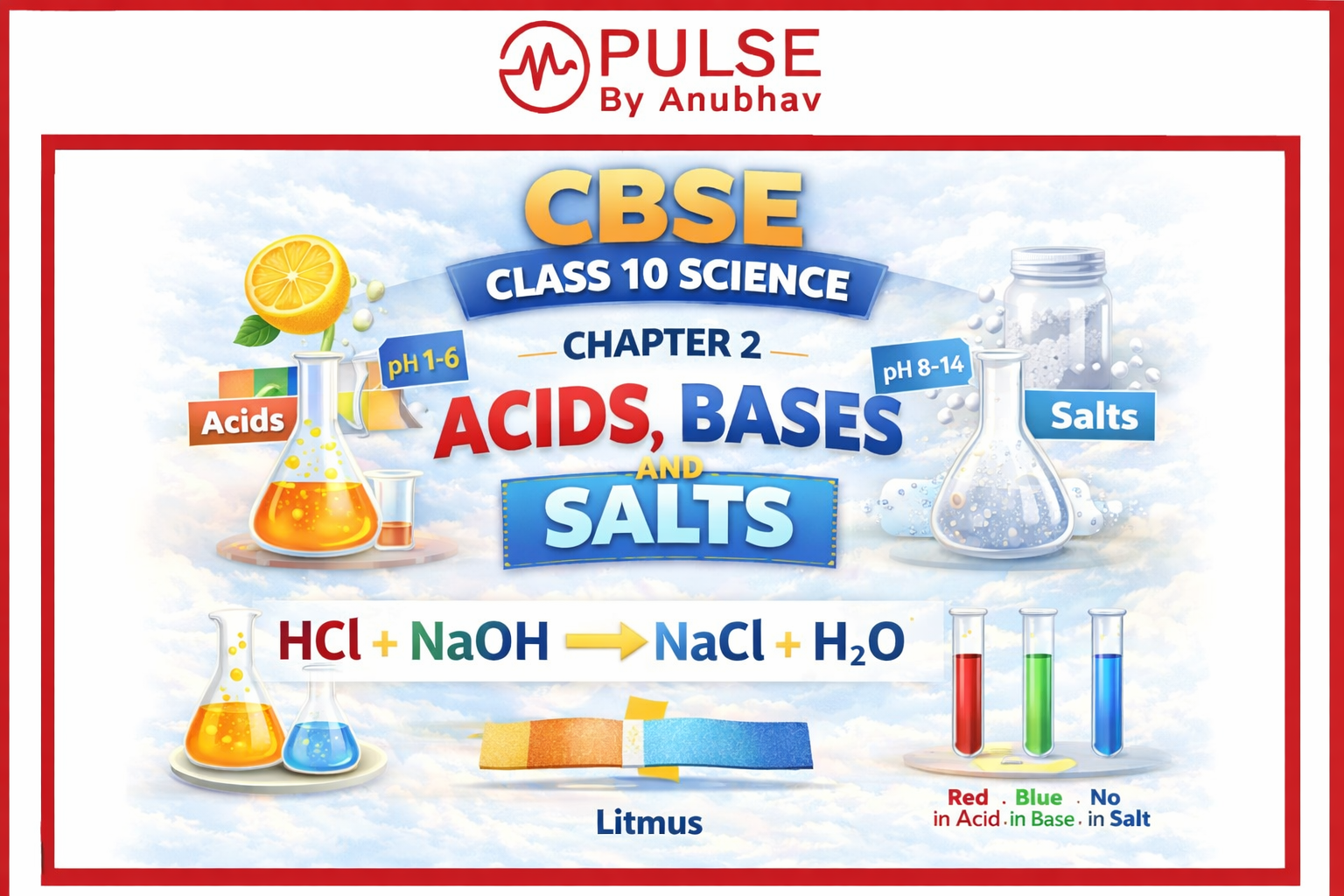
5 thoughts on “CBSE Class 10 Science Chapter 2 Acids, Bases and Salts”