Carbon and Its Compounds is a chapter in your science subject. Radhe Radhe to all my dear children! You all will have to work very hard for your board exams to get good marks. In this post, I will try to cover all the important topics of your 10th-grade science syllabus so that you can understand and remember them.
Carbon and Its Compounds, which is your fourth chapter, falls under the chemistry section of science. All the information you need to study in this chapter will be found in this post.
Q1. Why does carbon form covalent bonds instead of ionic bonds?
Carbon has four valence electrons. It cannot easily lose or gain four electrons,
so it shares electrons with other atoms to complete its octet, forming covalent bonds.
Q2. Why do carbon compounds have low melting and boiling points?
Carbon compounds have weak intermolecular forces of attraction,
which results in low melting and boiling points compared to ionic compounds.
Q3. What is meant by catenation?
Catenation is the property of carbon to form long chains, branched chains
or rings by bonding with other carbon atoms through single, double or triple bonds.
Q4. What are saturated and unsaturated hydrocarbons?
Saturated hydrocarbons contain only single bonds between carbon atoms,
while unsaturated hydrocarbons contain one or more double or triple bonds.
Q5. What are homologous series?
A homologous series is a group of carbon compounds having the same functional group
and similar chemical properties, where successive members differ by a –CH₂ unit.
Q6. Why do diamond and graphite have different properties?
Diamond and graphite differ due to different arrangements of carbon atoms.
Diamond has a rigid 3D structure, while graphite has layered hexagonal structures.
Q7. Why does graphite conduct electricity?
In graphite, each carbon atom is bonded to three others, leaving one free electron
which can move freely and conduct electricity.
Q8. What is ethanol and mention one of its uses?
Ethanol is an alcohol (C₂H₅OH). It is used as a solvent in medicines
and as a fuel additive because it burns cleanly.
Q9. What is ethanoic acid commonly known as?
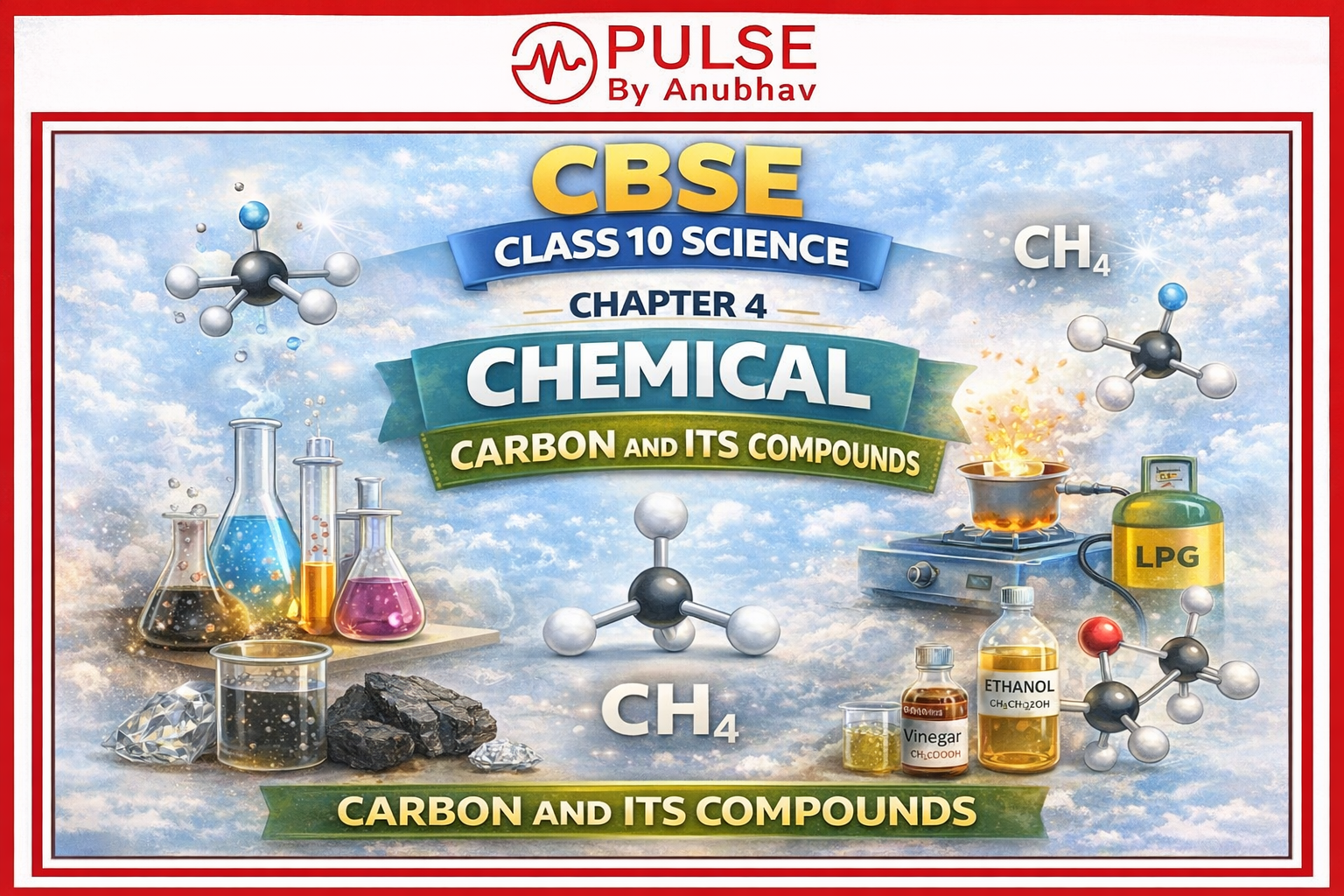
Ethanoic acid is commonly known as acetic acid.
A 5–8% solution of ethanoic acid in water is called vinegar.
Q10. How do soaps clean oily dirt?
Soap molecules form micelles in water. The hydrophobic end traps oily dirt,
while the hydrophilic end dissolves in water, allowing dirt to be washed away.
10 thoughts on “CBSE Class 10 Science Chapter 4 Carbon and Its Compounds”