Control and Coordination is a chapter in your science subject. Radhe Radhe to all my dear children! You all will have to work very hard for your board exams to get good marks. In this post, I will try to cover all the important topics of your 10th-grade science syllabus so that you can understand and remember them.
Control and Coordination , which is your sixth chapter, falls under the biology section of science. All the information you need to study in this chapter will be found in this post.
Also Read- CBSE Class 10 Science Chapter 4 Carbon and Its Compounds
👉 Skip everything and click here to directly view the Notes PDF
Body activities ko regulate karna Stimulus ka sahi response dena Neuron → dendrite (receive), axon (carry), synapse (gap)Reflex action → fast, automatic, spinal cord seBrain parts :Forebrain → thinking Midbrain → involuntary actions Cerebellum → balance & posture Medulla → heartbeat, breathing Receptor → Sensory neuron → Spinal cord → Motor neuron → Muscle
2 movements :Immediate (no growth) → Mimosa Growth based → tropism Phototropism → light Geotropism → gravity Hydrotropism → water Chemotropism → chemicals Auxin → growth, bending Gibberellin → stem growth Cytokinin → cell division Abscisic acid → growth stop Chemical messengers Blood ke through kaam Thyroxin → metabolism Insulin → blood sugar Adrenaline → emergency Growth hormone → height Testosterone / Oestrogen → puberty Hormone zyada → secretion kam Hormone kam → secretion zyada Also Read- CBSE Class 10 Science Chapter 4 Carbon and Its Compounds
CBSE Class 10 Science – Chapter 6
Control and Coordination
Complete Class 10 Science Chapter 6 notes, NCERT book PDF
aur official Telegram channel ka direct access yahan se milega.
Q1. Control and coordination in animals is mainly done by:
A. Nervous system and hormones
B. Digestive system
C. Respiratory system
D. Circulatory system
✅ Correct Answer: Nervous system and hormones
Q2. Which part of neuron receives the impulse?
A. Dendrite
B. Axon
C. Cell body
D. Synapse
✅ Correct Answer: Dendrite
Q3. The gap between two neurons is called:
A. Axon
B. Synapse
C. Dendrite
D. Nerve
✅ Correct Answer: Synapse
Q4. Reflex action is controlled by:
A. Forebrain
B. Spinal cord
C. Cerebellum
D. Medulla
✅ Correct Answer: Spinal cord
Q5. Which part of brain maintains posture and balance?
A. Forebrain
B. Cerebellum
C. Medulla
D. Midbrain
✅ Correct Answer: Cerebellum
Q6. Folding of leaves in Mimosa pudica is due to:
A. Change in water content of cells
B. Cell division
C. Cell elongation
D. Hormone secretion
✅ Correct Answer: Change in water content of cells
Q7. Bending of shoot towards light is called:
A. Phototropism
B. Geotropism
C. Hydrotropism
D. Chemotropism
✅ Correct Answer: Phototropism
Q8. Which hormone helps in cell elongation in plants?
A. Auxin
B. Cytokinin
C. Gibberellin
D. Abscisic acid
✅ Correct Answer: Auxin
Q9. Which hormone prepares body for emergency?
A. Adrenaline
B. Insulin
C. Thyroxin
D. Growth hormone
✅ Correct Answer: Adrenaline
Q10. Insulin hormone is secreted by:
A. Liver
B. Pancreas
C. Thyroid
D. Adrenal gland
✅ Correct Answer: Pancreas
Also Read- CBSE Class 10 Science Chapter 3 Metals and Non-metals
Q1. What is control and coordination in living organisms?
Control and coordination refer to the ability of an organism to regulate its body
activities and respond properly to changes in the environment.
Q2. Which systems control and coordinate activities in animals?
In animals, control and coordination are carried out by the nervous system
and the endocrine (hormonal) system.
Q3. What is a reflex action?
A reflex action is a fast, automatic and involuntary response to a stimulus,
controlled mainly by the spinal cord.
Q4. What is a reflex arc?
A reflex arc is the pathway followed by a nerve impulse during a reflex action,
from receptor to effector.
Q5. Which part of the brain controls balance and posture?
The cerebellum controls balance, posture and precision of voluntary movements.
Q6. How do plants respond to stimuli without a nervous system?
Plants respond to stimuli using chemical coordination through plant hormones
and by changes in growth or water content of cells.
Q7. What is phototropism?
Phototropism is the directional growth of a plant part in response to light,
such as bending of shoots towards light.
Q8. Which hormone is responsible for bending of plants towards light?
Auxin hormone is responsible for cell elongation and bending of plants
towards light.
Q9. What is the role of adrenaline in humans?
Adrenaline prepares the body for emergency situations by increasing heart rate,
breathing rate and blood supply to muscles.
Q10. Why is insulin important for our body?
Insulin regulates blood sugar level in the body. Its deficiency leads to diabetes.
1
Chemical Reactions and Equations
4
Carbon and Its Compounds
6
Control and Coordination
7
How do Organisms Reproduce?
9
Light – Reflection and Refraction
10
The Human Eye and the Colorful World
12
Magnetic Effects of Electric Current
Related 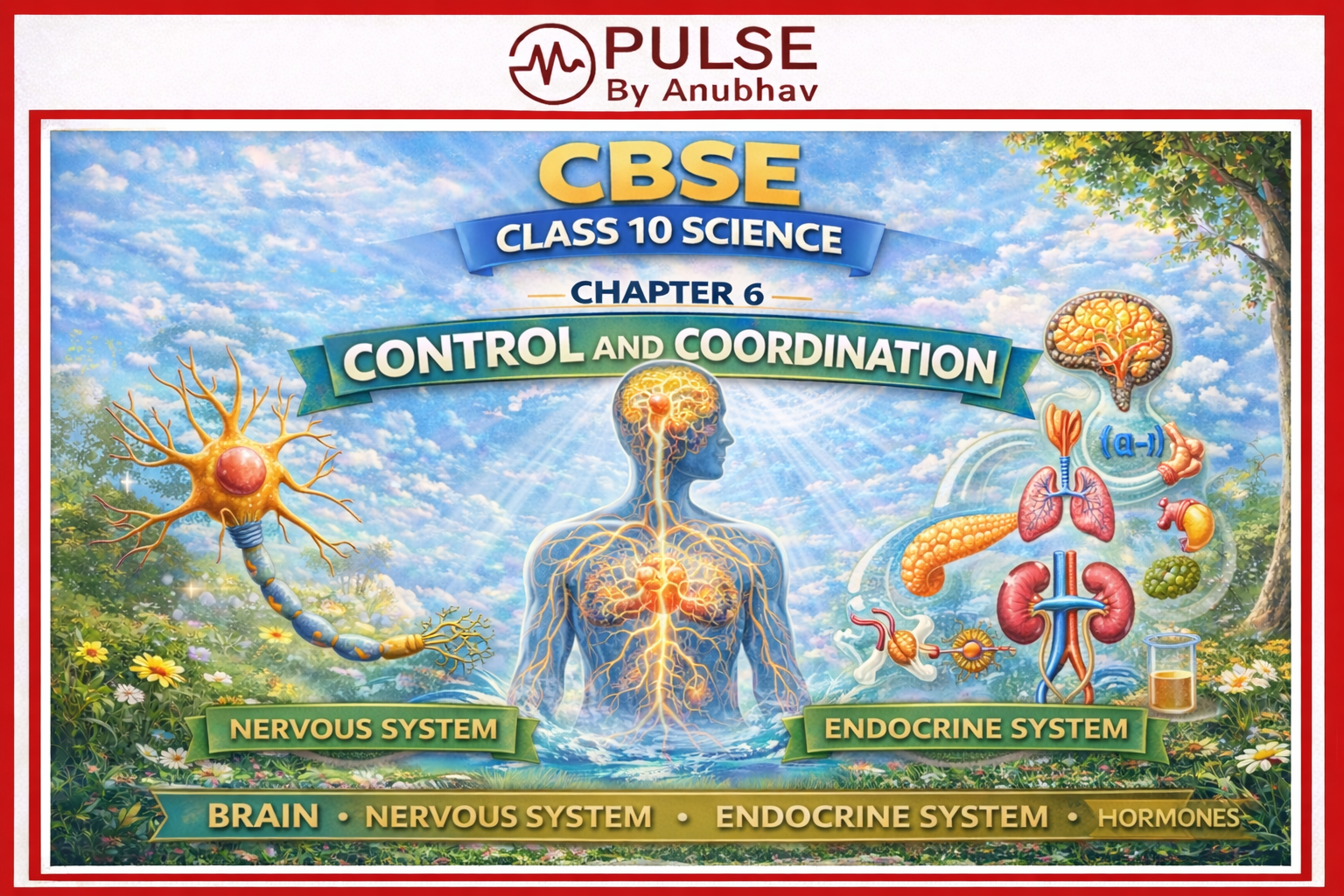
6 thoughts on “CBSE Class 10 Science Chapter 6 Control and Coordination”