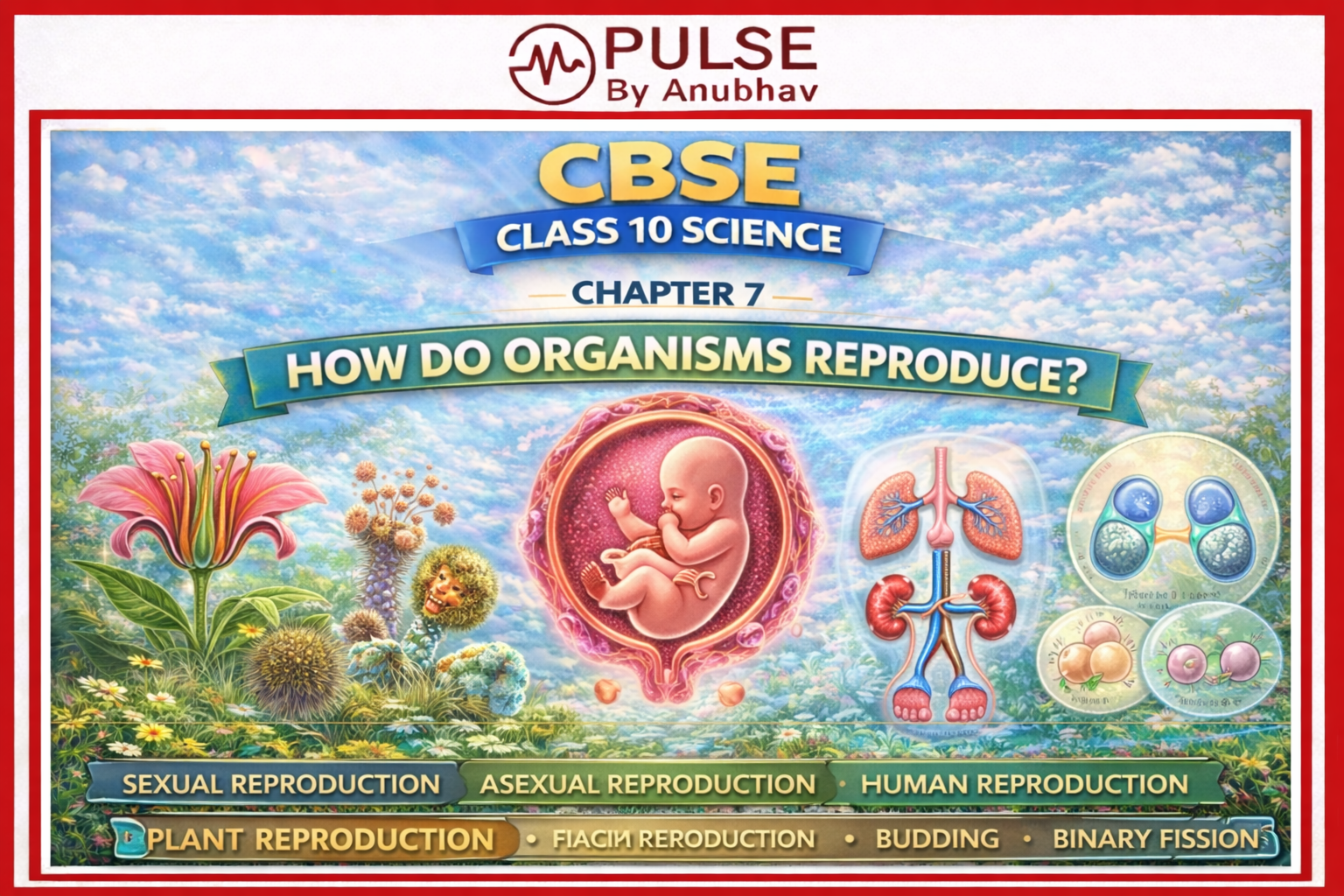
How do Organisms Reproduce is a chapter in your science subject. Radhe Radhe to all my dear children! You all will have to work very hard for your board exams to get good marks. In this post, I will try to cover all the important topics of your 10th-grade science syllabus so that you can understand and remember them.

How do Organisms Reproduce, which is your seventh chapter, falls under the biology section of science. All the information you need to study in this chapter will be found in this post.
Also Read- CBSE Class 10 Science Chapter 4 Carbon and Its Compounds
👉 Skip everything and click here to directly view the Notes PDFKey Content of Chapter 7 How do Organisms Reproduce
🔹 Why do organisms reproduce?
- Individual ke liye zaroori nahi
- Species ko continue karne ke liye zaroori
- Same species ke naye organisms bante hain
🧬 DNA Copying & Variation
- Reproduction me DNA copy banti hai
- Copy perfect nahi hoti → variation
- Variation se species survive karti hai
- Variation = basis of evolution
🌱 Asexual Reproduction
- Single parent
- No fusion of gametes
- Fast process
- Less variation
Types:
- Binary fission – Amoeba
- Multiple fission – Plasmodium
- Budding – Yeast, Hydra
- Fragmentation – Spirogyra
- Regeneration – Planaria, Hydra
- Vegetative propagation – Potato, Bryophyllum
- Spore formation – Rhizopus
🌿 Vegetative Propagation (Plants)
- New plant from root/stem/leaf
- Plants same as parent
- Early flowering
- Used in agriculture
🌼 Sexual Reproduction
- Two parents
- Fusion of male & female gametes
- More variation
- Slow but better survival
🌸 Sexual Reproduction in Plants
- Flower = reproductive organ
- Stamen → pollen (male)
- Pistil → ovary, ovule (female)
Processes:
- Pollination – pollen transfer
- Fertilisation – fusion of gametes
- Ovule → seed
- Ovary → fruit
👦👧 Sexual Reproduction in Humans
Puberty
- Body changes
- Sexual maturity
- Caused by hormones
👨 Male Reproductive System
- Testes → sperms + testosterone
- Vas deferens → sperm transport
- Prostate & seminal vesicle → nutrition
- Penis → sperm transfer
👩 Female Reproductive System
- Ovaries → eggs
- Fallopian tube → fertilisation
- Uterus → embryo development
- Vagina → birth canal
🤰 Fertilisation & Development
- Fertilisation → fallopian tube
- Embryo → uterus
- Placenta → nutrition
- Pregnancy → ~9 months
🩸 Menstruation
- Egg not fertilised
- Uterus lining breaks
- Monthly cycle (2–8 days)
🛡️ Reproductive Health
- STDs: AIDS, gonorrhoea, syphilis
- Condoms prevent STDs
- Contraception avoids pregnancy
Contraceptive Methods:
- Condom
- Oral pills
- Copper-T
- Surgical methods
Also Read- CBSE Class 10 Science Chapter 4 Carbon and Its Compounds
Class 10 Science Chapter 7 How do Organisms Reproduce Notes
CBSE Class 10 Science – Chapter 7
How do Organisms Reproduce
Complete Class 10 Science Chapter 7 notes, NCERT book PDF
aur official Telegram channel ka direct access yahan se milega.
Science Chapter 7 How do Organisms Reproduce MCQs
Q1. Why is reproduction important?
A. It ensures continuity of species
B. It helps in respiration
C. It provides energy
D. It removes waste
✅ Correct Answer: It ensures continuity of species
Q2. Which molecule carries hereditary information?
A. DNA
B. Protein
C. Lipid
D. Enzyme
✅ Correct Answer: DNA
Q3. Variation during reproduction is important because it:
A. Helps species survive changing environment
B. Stops reproduction
C. Reduces population
D. Makes organisms identical
✅ Correct Answer: Helps species survive changing environment
Q4. Binary fission occurs in:
A. Amoeba
B. Hydra
C. Spirogyra
D. Human
✅ Correct Answer: Amoeba
Q5. Multiple fission is seen in:
A. Plasmodium
B. Yeast
C. Amoeba
D. Hydra
✅ Correct Answer: Plasmodium
Q6. Budding is a mode of reproduction in:
A. Yeast
B. Plasmodium
C. Amoeba
D. Human
✅ Correct Answer: Yeast
Q7. Regeneration is commonly seen in:
A. Planaria
B. Dog
C. Human
D. Cow
✅ Correct Answer: Planaria
Q8. Transfer of pollen from anther to stigma is called:
A. Pollination
B. Fertilisation
C. Germination
D. Reproduction
✅ Correct Answer: Pollination
Q9. Fertilisation in human beings occurs in:
A. Fallopian tube
B. Uterus
C. Vagina
D. Ovary
✅ Correct Answer: Fallopian tube
Q10. Which method of contraception also protects from STDs?
A. Condom
B. Copper-T
C. Oral pills
D. Tubectomy
✅ Correct Answer: Condom
Also Read- CBSE Class 10 Science Chapter 6 Control and Coordination
FAQs About How do Organisms Reproduce
Q1. Why do organisms reproduce?
Organisms reproduce to ensure continuity of their species. Reproduction is not
essential for survival of an individual, but it is necessary for survival of the species.
Q2. Do organisms create exact copies of themselves?
No, organisms do not create exact copies. During DNA copying, small variations
occur which make the offspring slightly different from parents.
Q3. What is the role of DNA in reproduction?
DNA carries information for body design and characteristics. DNA copying ensures
transfer of parental features to the next generation.
Q4. Why is variation important for a species?
Variation helps a species survive changing environmental conditions. Some
individuals may adapt better and continue the species.
Q5. What is asexual reproduction?
Asexual reproduction is a mode of reproduction in which a single parent produces
new individuals without fusion of gametes.
Q6. What is binary fission?
Binary fission is an asexual reproduction method in which one organism divides
into two identical individuals, as seen in Amoeba.
Q7. How does spore formation help organisms?
Spores have thick protective walls that help organisms survive unfavourable
conditions and germinate when conditions become favourable.
Q8. What is sexual reproduction?
Sexual reproduction involves two parents and fusion of male and female gametes,
resulting in greater variation among offspring.
Q9. What is pollination?
Pollination is the transfer of pollen grains from the anther to the stigma of a flower,
which is necessary for fertilisation.
Q10. How does the embryo get nourishment in humans?
The embryo gets nourishment from the mother’s blood through a special structure
called placenta, which supplies oxygen and nutrients.
CBSE Class 10 Science – Chapter Wise Notes
1
Chemical Reactions and Equations
2
Acids, Bases and Salts
3
Metals and Non-metals
4
Carbon and Its Compounds
5
Life Processes
6
Control and Coordination
7
How do Organisms Reproduce?
8
Heredity
9
Light – Reflection and Refraction
10
The Human Eye and the Colorful World
11
Electricity
12
Magnetic Effects of Electric Current
13
Our Environment