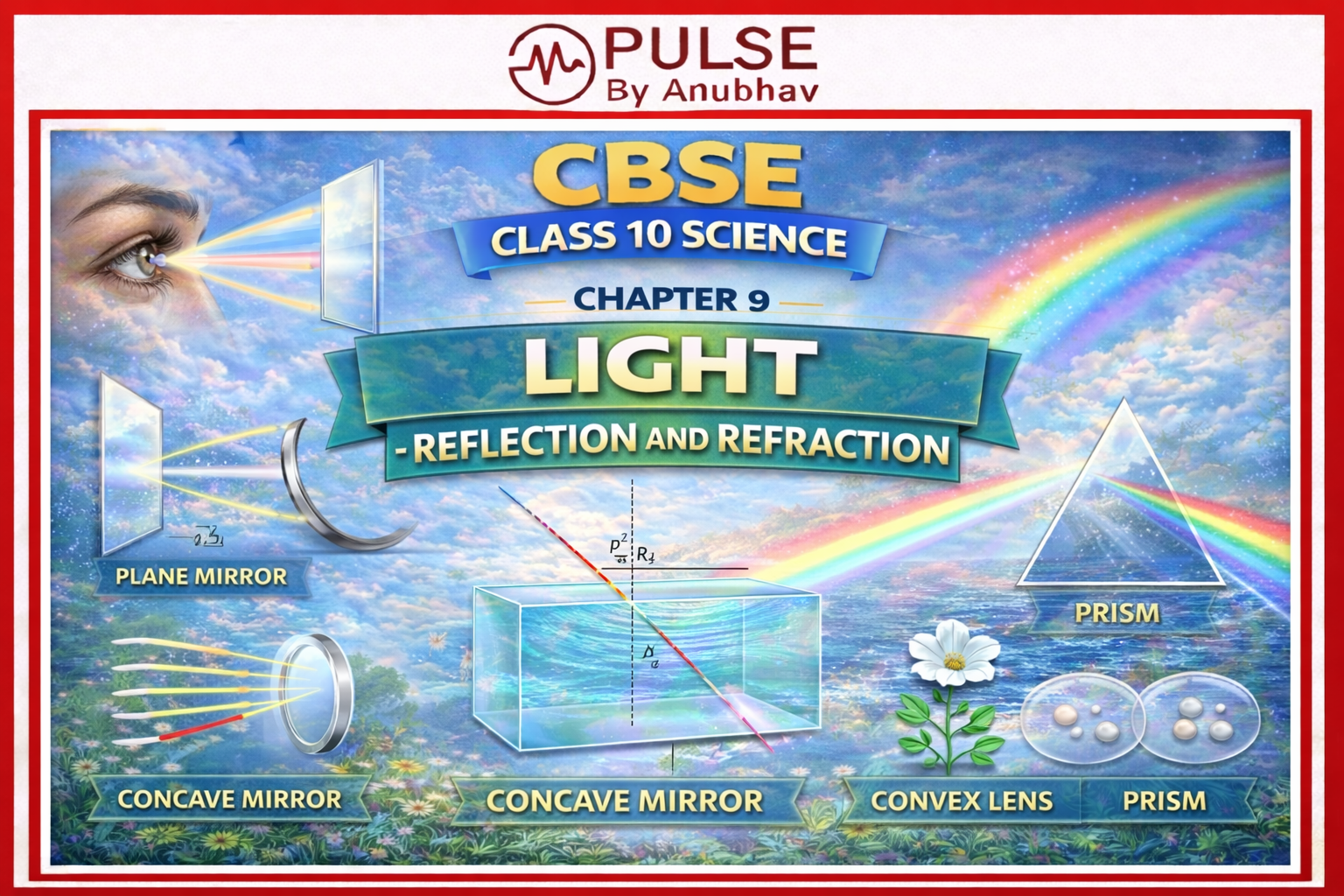
Light – Reflection and Refraction is a chapter in your science subject. Radhe Radhe to all my dear children! You all will have to work very hard for your board exams to get good marks. In this post, I will try to cover all the important topics of your 10th-grade science syllabus so that you can understand and remember them.

Light – Reflection and Refraction , which is your ninth chapter, falls under the physics section of science. All the information you need to study in this chapter will be found in this post.
Also Read- CBSE Class 10 Science Chapter 4 Carbon and Its Compounds
👉 Skip everything and click here to directly view the Notes PDFKey Content of Chapter 9 Light – Reflection and Refraction
1️⃣ What is Light?
- Light is a form of energy that enables us to see objects.
- We see objects when light falls on them and gets reflected into our eyes.
- Light generally travels in straight lines, called rays of light.
2️⃣ Reflection of Light
🔹 Reflection
Reflection is the bouncing back of light when it strikes a polished surface like a mirror.
🔹 Laws of Reflection
- Angle of incidence = Angle of reflection
- Incident ray, reflected ray and normal lie in the same plane
3️⃣ Plane Mirror – Image Characteristics
- Image is virtual and erect
- Image size = object size
- Image distance = object distance
- Image is laterally inverted
4️⃣ Spherical Mirrors
🔹 Types
- Concave Mirror – reflecting surface curves inward
- Convex Mirror – reflecting surface curves outward
🔹 Important Terms (Spherical Mirrors)
- Pole (P): Centre of mirror
- Centre of Curvature (C): Centre of sphere of which mirror is a part
- Radius of Curvature (R): Distance between P and C
- Principal Axis: Line joining P and C
- Principal Focus (F):
- Concave: Rays parallel to axis meet at F
- Convex: Rays appear to come from F
- Focal Length (f): Distance PF
👉 R = 2f
5️⃣ Image Formation by Concave Mirror (Summary)
| Object Position | Image Position | Nature | Size |
|---|---|---|---|
| At infinity | At focus | Real, inverted | Very small |
| Beyond C | Between F & C | Real, inverted | Smaller |
| At C | At C | Real, inverted | Same |
| Between C & F | Beyond C | Real, inverted | Enlarged |
| At F | At infinity | — | — |
| Between P & F | Behind mirror | Virtual, erect | Enlarged |
6️⃣ Uses of Concave Mirror
- Torch, headlights
- Shaving mirror
- Dentist mirror
- Solar furnace
7️⃣ Image Formation by Convex Mirror
| Object Position | Image Position | Nature | Size |
|---|---|---|---|
| At infinity | At focus | Virtual, erect | Very small |
| Anywhere | Between P & F | Virtual, erect | Diminished |
8️⃣ Uses of Convex Mirror
- Rear-view mirror in vehicles
✔ Wide field of view
✔ Always erect image
9️⃣ Mirror Formula & Magnification
🔹 Mirror Formula
v1+u1=f1
🔹 Magnification
m=hh′=−uv
- m +ve → virtual image
- m –ve → real image
🔟 Refraction of Light
🔹 Refraction
Bending of light when it travels from one transparent medium to another due to change in speed.
🔹 Examples
- Pencil appears bent in water
- Coin appears raised in water
- Letters appear raised under glass slab
1️⃣1️⃣ Laws of Refraction (Snell’s Laws)
- Incident ray, refracted ray and normal lie in same plane
\frac{\sin i}{\sin r} = constant
]
1️⃣2️⃣ Refractive Index (n)
n=Speed of light in mediumSpeed of light in air
- Higher n → optically denser medium
- Light bends towards normal (rarer → denser)
- Light bends away from normal (denser → rarer)
1️⃣3️⃣ Refraction through Glass Slab
- Emergent ray is parallel to incident ray
- Light undergoes lateral displacement
1️⃣4️⃣ Lenses
🔹 Types
- Convex Lens – converging, thick in middle
- Concave Lens – diverging, thin in middle
🔹 Important Terms (Lenses)
- Optical centre (O)
- Principal axis
- Principal focus (F₁, F₂)
- Focal length (f)
1️⃣5️⃣ Image Formation by Convex Lens (Key Points)
- Can form real or virtual images
- Used in magnifying glass, camera, microscope
1️⃣6️⃣ Image Formation by Concave Lens
- Image is always virtual, erect and diminished
- Used in spectacles (myopia)
1️⃣7️⃣ Lens Formula
v1−u1=f1
🔹 Magnification (Lens)
m=hh′=uv
1️⃣8️⃣ Power of a Lens
P=f1
- Unit: Dioptre (D)
- Convex lens → +ve power
- Concave lens → –ve power
Also Read- CBSE Class 10 Science Chapter 4 Carbon and Its Compounds
Class 10 Science Chapter 9 Light – Reflection and Refraction Notes
Science Chapter 9 Light – Reflection and Refraction MCQs
(a) absorb light
(b) emit light
(c) reflect light
(d) refract light
Q2. Light travels in straight lines in
(a) opaque media
(b) transparent media
(c) translucent media
(d) mirrors
Q3. The bending of light around small obstacles is called
(a) reflection
(b) refraction
(c) dispersion
(d) diffraction
Q4. Which surface reflects maximum light?
(a) Rough surface
(b) Opaque surface
(c) Polished surface
(d) Translucent surface
Q5. The image formed by a plane mirror is always
(a) real and inverted
(b) virtual and erect
(c) real and erect
(d) virtual and inverted
Q6. A spherical mirror whose reflecting surface curves inward is called
(a) plane mirror
(b) convex mirror
(c) concave mirror
(d) cylindrical mirror
Q7. The centre of the reflecting surface of a spherical mirror is called
(a) centre of curvature
(b) focus
(c) pole
(d) aperture
Q8. The centre of curvature of a concave mirror lies
(a) behind the mirror
(b) on the mirror
(c) in front of the mirror
(d) at the focus
Q9. The principal axis of a spherical mirror is
(a) tangent at pole
(b) normal at focus
(c) line joining pole and centre of curvature
(d) diameter of aperture
Q10. The focal length of a spherical mirror is
(a) PC
(b) PF
(c) CF
(d) 2R
Answer Key:
Q1–(c), Q2–(b), Q3–(d), Q4–(c), Q5–(b), Q6–(c), Q7–(c), Q8–(c), Q9–(c), Q10–(b)
Also Read- CBSE Class 10 Science Chapter 6 Control and Coordination
FAQs About Light – Reflection and Refraction
(ii) Incident ray, reflected ray and normal lie in the same plane.
2 thoughts on “CBSE Class 10 Science Chapter 9 Light – Reflection and Refraction”