Radhe Radhe, B.Pharm students! In this post, you will find complete notes for your 1st Semester Human Anatomy, Physiology and Pathophysiology I subject. Here you will get unit-wise notes, important topics, quick revision material, books, previous year questions (PYQs), and important question-answers based on the updated B.Pharm syllabus. You can also find useful pharmacy study resources and GPAT updates through Pulse by Anubhav.

As you may already know, pursuing a B.Pharm degree requires consistent study, practical understanding, and a strong foundation in pharmaceutical and healthcare sciences. Many students choose pharmacy after Class 12 expecting the course to focus mainly on medicines and drug preparation. However, as students progress through the course, they learn that understanding the human body, normal physiological functions, disease processes, and pathophysiological changes is equally important for becoming a knowledgeable healthcare professional.
B.Pharm is a 4-year professional undergraduate course divided into 8 semesters. In the first semester, students build a strong foundation in basic pharmaceutical, healthcare, and biomedical sciences. Among these subjects, Human Anatomy, Physiology and Pathophysiology I plays an important role in helping students understand how the human body is structured, how different organs and systems function normally, and what happens when normal physiological processes are disturbed by disease.
The updated curriculum provides students with an integrated understanding of anatomy, physiology and pathophysiology rather than treating these subjects as completely separate areas. This approach helps pharmacy students connect the structure of the human body with its normal functions and understand how diseases develop and produce clinical manifestations.
Why Human Anatomy, Physiology and Pathophysiology I is Important in B.Pharm
Human Anatomy, Physiology and Pathophysiology I is one of the important foundation subjects for pharmacy students. Anatomy helps students understand the structure and organization of the human body, while physiology explains how cells, tissues, organs and body systems normally function.
Pathophysiology adds another important dimension by explaining what happens when normal body functions become disturbed due to disease, injury, inflammation, infection, genetic abnormalities, or other pathological conditions.
This knowledge becomes useful in understanding:
- Normal structure and functions of the human body
- Cellular organization and cell communication
- Tissues and their functions
- Homeostasis and feedback mechanisms
- Cell injury and cellular adaptation
- Blood and its components
- Inflammation and tissue repair
- Nervous system and special senses
- Cardiovascular system and blood circulation
- Common diseases and their basic pathophysiology
- Clinical manifestations and complications of diseases
For pharmacy students, these concepts provide a foundation for understanding pharmacology, pharmacotherapy, clinical pharmacy, pathology, therapeutics, and safe use of medicines in later semesters.
The subject also helps students understand how a disease affects the body and why particular therapeutic approaches may be required. This makes Human Anatomy, Physiology and Pathophysiology an important part of the overall healthcare knowledge of a future pharmacist.
At Pulse by Anubhav, our aim is to provide updated B.Pharm notes, syllabus-based study material, previous-year questions, important questions, quick revision notes, and useful academic resources to help pharmacy students prepare more effectively for their semester examinations.
B.Pharm 1st Semester Human Anatomy, Physiology and Pathophysiology I Notes PDF – Complete Study Material & Updated Syllabus
Before starting the detailed notes, students should go through the complete syllabus and understand the major units and topics included in Human Anatomy, Physiology and Pathophysiology I. This makes it easier to plan preparation and identify important topics for examination revision.
Updated Subjects in B.Pharm 1st Semester (As per New PCI Syllabus)
Here is the latest subject list for B.Pharm 1st Semester including theory and practical subjects.
Theory Subjects
- BP101T – Basics of Python Programming for Pharmaceutical Sciences
- BP102T – General Pharmacy
- BP103T – Healthcare Psychology and Communication Skills
- BP104T – Human Anatomy, Physiology and Pathophysiology I
- BP105T – Introduction to Pharmacognosy
- BP106T – Pharmaceutical Inorganic and Analytical Chemistry
Practical Subjects
- BP107P – General Pharmacy Practical
- BP108P – Healthcare Psychology and Communication Skills Practical
- BP109P – Human Anatomy, Physiology and Pathophysiology I Practical
- BP110P – Introduction to Pharmacognosy Practical
- BP111P – Pharmaceutical Inorganic and Analytical Chemistry Practical
Prepare for your B.Pharm 1st Semester Human Anatomy, Physiology and Pathophysiology I exam with easy, unit-wise and exam-focused quick handwritten notes. Revise important concepts, definitions, structures, functions, flowcharts and disease mechanisms in less time.
B.Pharm 1st Semester Human Anatomy, Physiology and Pathophysiology I Syllabus
Before downloading the notes, please take a look at the Semester HHuman Anatomy, Physiology and Pathophysiology I syllabus to understand what topics are cove
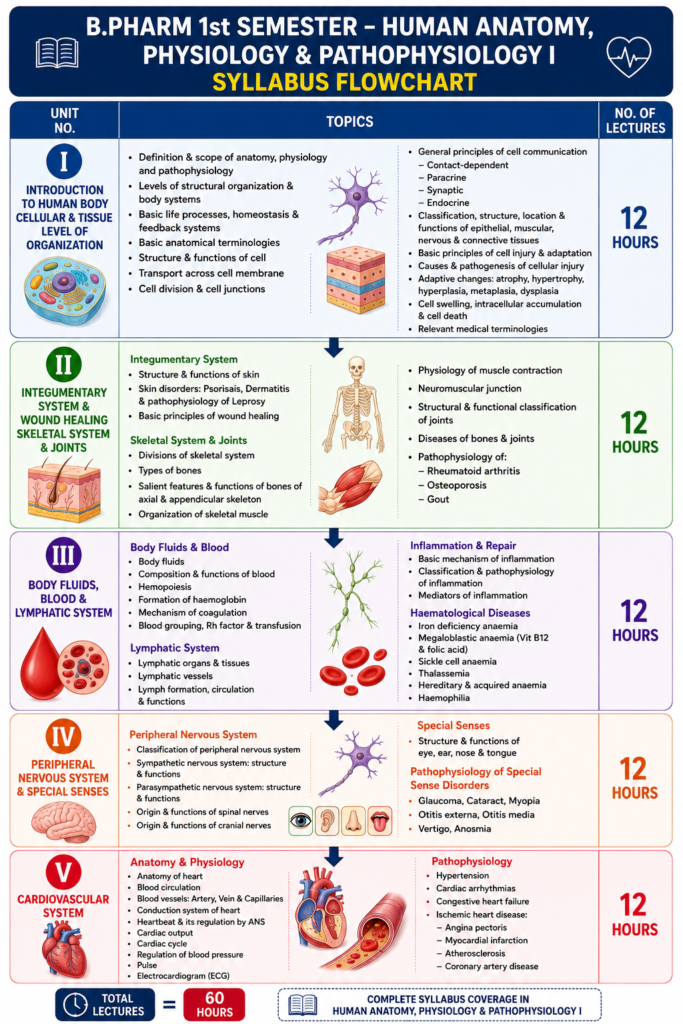
🫀 B.Pharm 1st Semester — Human Anatomy, Physiology & Pathophysiology I
Complete unit-wise syllabus based on the updated B.Pharm curriculum. The subject covers the structure and functions of the human body, normal physiological processes, basic pathological changes and important disease mechanisms.
🧠 Unit I — Introduction to Human Body & Cellular Organization
1. Introduction to Human Body
- Definition of Anatomy
- Definition of Physiology
- Definition of Pathophysiology
- Scope of Anatomy, Physiology and Pathophysiology
- Levels of Structural Organization
- Major Body Systems
- Basic Life Processes
- Homeostasis
- Basic Anatomical Terminology
2. Cellular Level of Organization
- Structure of a Typical Cell
- Functions of Cell Organelles
- Cell Membrane
- Transport Across Cell Membrane
- Passive Transport
- Active Transport
- Endocytosis
- Exocytosis
- Cell Division
- Mitosis
- Basic Concept of Meiosis
- Cell Junctions
3. Cell Communication
- General Principles of Cell Communication
- Intracellular Signalling
- Contact-Dependent Signalling
- Paracrine Signalling
- Synaptic Signalling
- Endocrine Signalling
4. Tissue Level of Organization
- Definition of Tissue
- Classification of Tissues
- Epithelial Tissue
- Structure, Types, Location and Functions of Epithelium
- Connective Tissue
- Types, Structure, Location and Functions of Connective Tissue
- Muscular Tissue
- Skeletal Muscle
- Cardiac Muscle
- Smooth Muscle
- Nervous Tissue
- Neurons
- Neuroglia
- Functions of Nervous Tissue
5. Homeostasis & Feedback Systems
- Definition of Homeostasis
- Importance of Homeostasis
- Components of Feedback System
- Negative Feedback
- Positive Feedback
- Examples of Feedback Mechanisms
- Physiological Significance of Feedback Systems
6. Basic Principles of Cell Injury & Adaptation
- Definition of Cell Injury
- Causes of Cellular Injury
- Reversible Cell Injury
- Irreversible Cell Injury
- Basic Pathogenesis of Cell Injury
- Cell Membrane Damage
- Mitochondrial Damage
- Ribosomal Damage
- Nuclear Damage
- Morphological Changes in Cell Injury
- Cell Swelling
- Intracellular Accumulation
- Cell Death
7. Cellular Adaptation
- Atrophy
- Hypertrophy
- Hyperplasia
- Metaplasia
- Dysplasia
8. Medical Terminology
- Common Anatomical Terms
- Common Physiological Terms
- Common Pathophysiological Terms
- Frequently Used Medical Terminology
⏱ Duration: 3 Hours
🦴 Unit II — Integumentary, Skeletal & Musculoskeletal System
Part A — Integumentary System
- Introduction to Integumentary System
- Structure and Functions of Skin
- Layers of Skin
- Epidermis
- Dermis
- Hypodermis / Subcutaneous Layer
- Layers of Epidermis
- Cells of Epidermis
- Skin Appendages
- Hair
- Nails
- Sweat Glands
- Sebaceous Glands
- Blood Supply and Nerve Supply of Skin
- Functions of Skin
- Protection and Sensation
- Temperature Regulation
- Excretion
- Vitamin D Synthesis
- Prevention of Water Loss
Skin Disorders
- Psoriasis
- Definition, Causes and Risk Factors
- Pathogenesis and Clinical Features
- Morphological Changes
- Complications and Basic Management Principles
- Dermatitis
- Types and Causes of Dermatitis
- Pathogenesis and Clinical Manifestations
- Basic Management Principles
- Leprosy
- Causative Organism
- Mode of Transmission
- Pathophysiology
- Effects on Skin and Peripheral Nerves
- Clinical Manifestations and Complications
Part B — Wound Healing
- Definition of Wound
- Types of Wounds
- Factors Affecting Wound Healing
- Hemostasis
- Inflammation
- Proliferation
- Remodeling / Maturation
- Role of Different Cells in Healing
- Primary Intention
- Secondary Intention
- Complications of Wound Healing
Part C — Skeletal System
- Divisions of Skeletal System
- Axial Skeleton
- Skull
- Vertebral Column
- Thoracic Cage
- Appendicular Skeleton
- Pectoral Girdle
- Upper Limbs
- Pelvic Girdle
- Lower Limbs
- Types of Bones
- Long Bones
- Short Bones
- Flat Bones
- Irregular Bones
- Sesamoid Bones
Structure and Functions of Bones
- Gross Structure of Bone
- Compact Bone
- Spongy / Cancellous Bone
- Periosteum
- Bone Marrow
- Functions of Bones
- Bone Formation
- Bone Remodeling
Major Bones of Axial & Appendicular Skeleton
- Skull
- Vertebral Column
- Ribs
- Sternum
- Clavicle
- Scapula
- Humerus
- Radius
- Ulna
- Pelvic Bones
- Femur
- Tibia
- Fibula
Part D — Skeletal Muscle
- Organization of Skeletal Muscle
- Muscle Fibre
- Sarcolemma
- Sarcoplasm
- Myofibrils
- Sarcomere
- Actin
- Myosin
- Regulatory Proteins
- Sliding Filament Theory
- Role of Calcium
- Role of ATP
- Cross-Bridge Cycle
- Relaxation of Muscle
Neuromuscular Junction
- Definition
- Structure
- Motor Neuron
- Synaptic Cleft
- Acetylcholine
- Acetylcholine Receptors
- Transmission of Nerve Impulse to Muscle
- Termination of Signal
Part E — Joints
- Classification of Joints
- Fibrous Joints
- Cartilaginous Joints
- Synovial Joints
- Synarthrosis
- Amphiarthrosis
- Diarthrosis
- Structure of Synovial Joints
- Types of Synovial Joints
- Examples and Functions
Diseases of Bones and Joints
- Rheumatoid Arthritis
- Autoimmune Mechanism
- Synovial Inflammation
- Pannus Formation
- Joint Destruction
- Osteoporosis
- Bone Remodeling Imbalance
- Loss of Bone Mass
- Fracture Risk
- Gout
- Hyperuricemia
- Monosodium Urate Crystal Formation
- Crystal Deposition and Inflammation
⏱ Duration: 3 Hours
🩸 Unit III — Body Fluids, Blood, Lymphatic System & Inflammation
1. Body Fluids
- Definition of Body Fluids
- Distribution of Body Water
- Intracellular Fluid (ICF)
- Extracellular Fluid (ECF)
- Composition of Body Fluids
- Functions of Body Fluids
- Fluid and Electrolyte Balance
2. Blood
- Definition of Blood
- Composition of Blood
- Plasma
- Formed Elements
- Transport Functions
- Regulatory Functions
- Protective Functions
3. Plasma
- Composition of Plasma
- Plasma Proteins
- Albumin
- Globulins
- Fibrinogen
- Functions of Plasma Proteins
4. Formed Elements of Blood
- RBCs — Erythrocytes
- Structure and Normal Characteristics
- Functions and Life Span of RBCs
- Destruction of RBCs
- WBCs — Leukocytes
- Granulocytes
- Agranulocytes
- Neutrophils
- Eosinophils
- Basophils
- Lymphocytes
- Monocytes
- Functions of WBCs
- Platelets
- Origin and Structure
- Functions of Platelets
- Role in Haemostasis
5. Hemopoiesis
- Definition of Hemopoiesis
- Sites of Blood Cell Formation
- Hematopoietic Stem Cells
- Formation of RBCs
- Formation of WBCs
- Formation of Platelets
- Regulation of Hemopoiesis
- Role of Erythropoietin
6. Haemoglobin
- Definition and Structure of Haemoglobin
- Heme
- Globin
- Basic Steps of Haemoglobin Synthesis
- Role of Iron
- Functions of Haemoglobin
- Breakdown of Haemoglobin
7. Haemostasis and Coagulation
- Definition of Haemostasis
- Vascular Spasm
- Platelet Plug Formation
- Coagulation
- Clotting Factors
- Intrinsic Pathway
- Extrinsic Pathway
- Common Pathway
- Thrombin Formation
- Fibrin Clot Formation
- Clot Retraction
- Fibrinolysis
8. Blood Groups
- ABO Blood Group System
- Antigens and Antibodies
- Blood Group A
- Blood Group B
- Blood Group AB
- Blood Group O
- Basic Blood Compatibility
9. Rh Factor & Blood Transfusion
- Rh Antigen
- Rh-Positive and Rh-Negative Blood
- Rh Incompatibility
- Haemolytic Disease of the Newborn
- Definition of Blood Transfusion
- Indications
- Compatibility Principles
- Transfusion Reactions
- Importance of Cross-Matching
10. Lymphatic System
- Primary Lymphoid Organs
- Bone Marrow
- Thymus
- Secondary Lymphoid Organs
- Lymph Nodes
- Spleen
- Tonsils
- Other Lymphoid Tissues
- Lymphatic Capillaries
- Lymphatic Vessels
- Lymphatic Trunks
- Lymphatic Ducts
- Lymph Formation and Circulation
- Functions of Lymphatic System
11. Inflammation and Repair
- Definition and Purpose of Inflammation
- Causes of Inflammation
- Cardinal Signs of Inflammation
- Acute Inflammation
- Chronic Inflammation
- Basic Pathophysiology of Inflammation
- Histamine
- Serotonin
- Prostaglandins
- Leukotrienes
- Bradykinin
- Cytokines
- Complement
- Nitric Oxide
- Regeneration
- Tissue Repair
- Fibrosis and Scar Formation
- Factors Affecting Repair
12. Haematological Diseases
- Iron Deficiency Anaemia
- Megaloblastic Anaemia
- Vitamin B12 Deficiency
- Folic Acid Deficiency
- Sickle Cell Anaemia
- Thalassemia
- Hereditary Anaemias
- Acquired Anaemias
- Haemophilia
- Haemophilia A
- Haemophilia B
- Basic Pathophysiology of Bleeding Disorders
⏱ Duration: 3 Hours
👁️ Unit IV — Peripheral Nervous System & Special Senses
1. Introduction to Peripheral Nervous System
- Definition of Peripheral Nervous System (PNS)
- Components of PNS
- Relationship Between CNS and PNS
- Functions of PNS
2. Classification of Peripheral Nervous System
- Sensory / Afferent Division
- Motor / Efferent Division
- Somatic Nervous System
- Autonomic Nervous System (ANS)
- Sympathetic Nervous System
- Parasympathetic Nervous System
3. Sympathetic Nervous System
- Origin of Sympathetic Nerves
- Preganglionic Neurons
- Postganglionic Neurons
- Sympathetic Ganglia
- Neurotransmitters
- Effects on Heart
- Effects on Blood Vessels
- Effects on Lungs
- Effects on Eyes
- Effects on Gastrointestinal Tract
- Effects on Urinary System
- Effects on Sweat Glands
4. Parasympathetic Nervous System
- Craniosacral Origin
- Preganglionic Neurons
- Postganglionic Neurons
- Parasympathetic Ganglia
- Neurotransmitters
- Effects on Heart
- Effects on Eyes
- Effects on Lungs
- Effects on Gastrointestinal Tract
- Effects on Urinary System
- Effects on Reproductive Organs
5. Spinal Nerves
- Definition
- Origin
- Formation of Spinal Nerves
- Dorsal Root
- Ventral Root
- Spinal Nerve Branches
- General Functions
6. Cranial Nerves
- Definition and Origin
- Classification of Cranial Nerves
- Sensory Cranial Nerves
- Motor Cranial Nerves
- Mixed Cranial Nerves
- I — Olfactory
- II — Optic
- III — Oculomotor
- IV — Trochlear
- V — Trigeminal
- VI — Abducens
- VII — Facial
- VIII — Vestibulocochlear
- IX — Glossopharyngeal
- X — Vagus
- XI — Accessory
- XII — Hypoglossal
7. Eye
- Structure of Eyeball
- Cornea
- Sclera
- Choroid
- Retina
- Iris
- Pupil
- Lens
- Ciliary Body
- Aqueous Humour
- Vitreous Humour
- Optic Nerve
- Functions of Eye
- Physiology of Vision
8. Ear
- External Ear
- Pinna
- External Auditory Canal
- Tympanic Membrane
- Middle Ear
- Malleus
- Incus
- Stapes
- Auditory / Eustachian Tube
- Inner Ear
- Cochlea
- Vestibule
- Semicircular Canals
- Hearing
- Maintenance of Balance and Equilibrium
9. Nose & Smell
- External Nose
- Nasal Cavity
- Nasal Mucosa
- Olfactory Receptors
- Olfactory Nerve
- Function of Nose
- Physiology of Olfaction
10. Tongue & Taste
- Gross Structure of Tongue
- Papillae
- Taste Buds
- Taste Receptors
- Sweet
- Sour
- Salty
- Bitter
- Umami
- Basic Taste Pathway
11. Pathophysiology of Special Sense Disorders
- Glaucoma
- Intraocular Pressure
- Aqueous Humour Imbalance
- Optic Nerve Damage
- Cataract
- Lens Opacity
- Myopia
- Refractive Abnormality
- Otitis Externa
- Otitis Media
- Eustachian Tube Dysfunction
- Vertigo
- Vestibular System Involvement
- Anosmia
- Olfactory Pathway Impairment
⏱ Duration: 3 Hours
❤️ Unit V — Cardiovascular System & Cardiovascular Pathophysiology
1. Introduction to Cardiovascular System
- Definition and Components
- Heart
- Blood Vessels
- Blood
- Major Functions of Cardiovascular System
2. Anatomy of Heart
- Location and Position of Heart
- Size and Shape
- Pericardium
- Epicardium
- Myocardium
- Endocardium
- Right Atrium
- Right Ventricle
- Left Atrium
- Left Ventricle
- Interatrial Septum
- Interventricular Septum
3. Valves of Heart
- Tricuspid Valve
- Pulmonary Valve
- Mitral / Bicuspid Valve
- Aortic Valve
- Functions of Heart Valves
- Blood Flow Through Heart
4. Blood Circulation
- Pulmonary Circulation
- Systemic Circulation
- Coronary Circulation
- Coronary Arteries
- Coronary Veins
- Blood Supply to Myocardium
- Importance of Coronary Circulation
5. Blood Vessels
- Arteries
- Tunica Intima
- Tunica Media
- Tunica Externa
- Functions of Arteries
- Veins
- Three Basic Layers of Veins
- Valves in Veins
- Functions of Veins
- Capillaries
- Structure of Capillaries
- Exchange of Oxygen and Carbon Dioxide
- Exchange of Nutrients and Waste Products
6. Cardiac Conduction System
- Sinoatrial (SA) Node
- Atrioventricular (AV) Node
- AV Bundle / Bundle of His
- Right and Left Bundle Branches
- Purkinje Fibres
- Natural Pacemaker of Heart
- Role of AV Node Delay
7. Heartbeat & Autonomic Regulation
- Definition of Heartbeat
- Properties of Cardiac Muscle
- Automaticity
- Rhythmicity
- Atrial Contraction
- Ventricular Contraction
- Sympathetic Regulation
- Parasympathetic Regulation
- Effect on Heart Rate
- Effect on Force of Contraction
- Effect on Cardiac Output
8. Cardiac Output
- Definition of Cardiac Output
- Heart Rate
- Stroke Volume
- Venous Return
- Preload
- Contractility
- Afterload
9. Cardiac Cycle
- Definition of Cardiac Cycle
- Atrial Systole
- Ventricular Systole
- Complete Cardiac Diastole
- Pressure Changes
- Valve Movements
- Blood Flow
- Heart Sounds
10. Blood Pressure & Regulation
- Definition of Blood Pressure
- Systolic Blood Pressure
- Diastolic Blood Pressure
- Pulse Pressure
- Mean Arterial Pressure
- Baroreceptor Reflex
- Autonomic Nervous System
- Vasomotor Centre
- Kidneys and Long-Term Regulation
- Renin–Angiotensin–Aldosterone System (RAAS)
- Regulation of Blood Volume
11. Pulse
- Definition of Pulse
- Origin of Arterial Pulse
- Pulse Rate
- Pulse Rhythm
- Pulse Volume
- Radial Pulse
- Carotid Pulse
- Brachial Pulse
- Femoral Pulse
12. Electrocardiogram (ECG)
- Definition of ECG
- Principle of ECG
- Importance of ECG
- P Wave — Atrial Depolarization
- QRS Complex — Ventricular Depolarization
- T Wave — Ventricular Repolarization
- Assessment of Heart Rhythm
- Conduction Abnormalities
- Arrhythmias
- Myocardial Injury / Ischaemia
13. Cardiovascular Pathophysiology
- Hypertension
- Risk Factors of Hypertension
- Primary Hypertension
- Secondary Hypertension
- Effects on Blood Vessels
- Target-Organ Damage
- Cardiac Arrhythmias
- Tachycardia
- Bradycardia
- Atrial Fibrillation
- Conduction Disturbances
- Congestive Heart Failure
- Left-Sided Heart Failure
- Right-Sided Heart Failure
- Reduced Cardiac Pumping Ability
- Compensatory Mechanisms
- Fluid Retention
14. Ischemic Heart Disease
- Definition of Ischemic Heart Disease
- Causes
- Reduced Coronary Blood Flow
- Myocardial Oxygen Supply-Demand Imbalance
- Clinical Manifestations
- Major Forms of Ischemic Heart Disease
15. Angina Pectoris
- Definition
- Myocardial Ischaemia
- Basic Classification of Angina
- Clinical Manifestations
- Mechanism of Angina
16. Myocardial Infarction
- Definition
- Causes
- Coronary Artery Obstruction
- Myocardial Ischaemia
- Irreversible Myocardial Cell Injury
- Necrosis
- Clinical Manifestations
- Complications
17. Atherosclerosis
- Definition
- Risk Factors
- Endothelial Dysfunction
- Lipid Accumulation
- Plaque Formation
- Plaque Progression
- Arterial Narrowing
- Reduced Blood Flow
- Complications
18. Coronary Artery Disease (CAD)
- Definition
- Causes
- Relationship with Atherosclerosis
- Coronary Artery Narrowing
- Reduced Myocardial Blood Flow
- Myocardial Ischaemia
- Clinical Manifestations
- Complications
Severe / Prolonged Ischaemia → Myocardial Necrosis → Myocardial Infarction
⏱ Duration: 3 Hours
B.Pharm 1st Semester Human Anatomy, Physiology and Pathophysiology I Notes PDF
Also Read:- Pharmaceutical Analysis Notes
B.Pharm 1st Semester HHuman Anatomy Physiology and Pathophysiology I Book PDF
Books are very important; you should definitely check out the books according to your syllabus. During your pharmacy studies, books from Nirali Prakashan and PV Sindhu are very helpful. You can download the PDFs from the link below.
- Human Anatomy Physiology and Pathophysiology I Nirali Prakashan Full Book PDF:- PDF
- Human Anatomy Physiology and Pathophysiology I PV Sindhu Full Book PDF:- PDF
1 thought on “B.Pharm 1st Semester Human Anatomy, Physiology and Pathophysiology I Notes PDF, Updated Syllabus & Books”