You will get here Physical Education class 12 CBSE notes Chapter 7: Physiology & Injuries in Sport. You can connect with us for every important update related to class 12.
Physical Education is a very important subject for you because it will help you increase your percentage. You can score high marks in this subject by studying notes and practicing MCQs. In this post, we will cover Chapter 7: Physiology & Injuries in Sport.
Q1. What are physiological factors determining physical fitness?
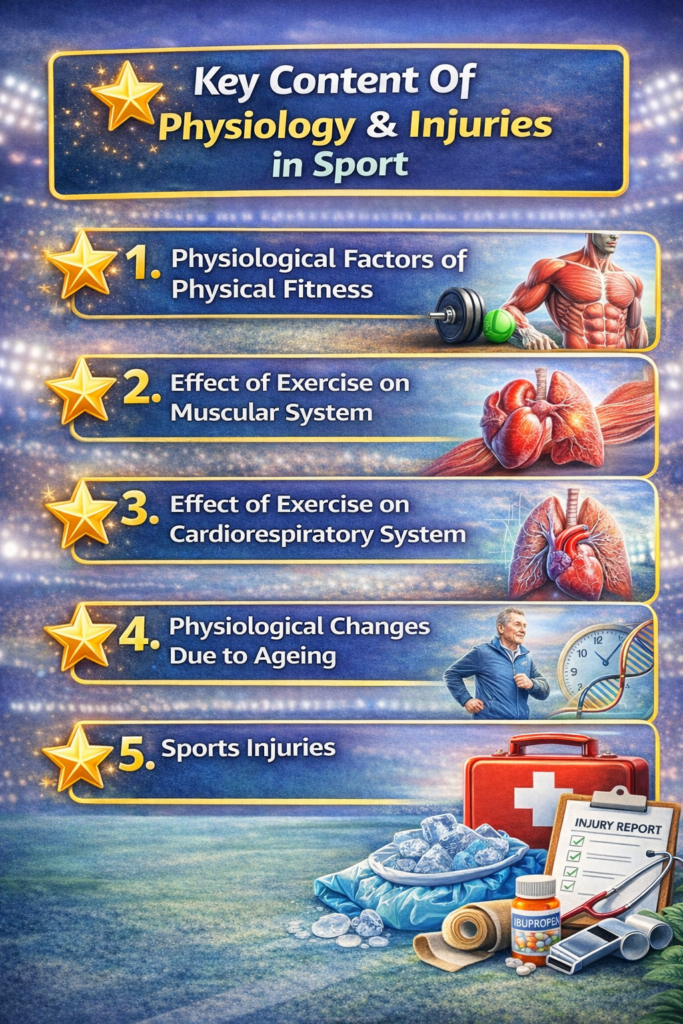
Physiological factors determining physical fitness include skeletal muscle factor, energy production factor and cardiorespiratory factor. These factors influence strength, endurance, speed and flexibility of the body.
Q2. What are slow twitch and fast twitch muscle fibres?
Slow twitch fibres help in endurance activities like long distance running and resist fatigue. Fast twitch fibres help in power and speed activities like sprinting, jumping and throwing but fatigue quickly.
Q3. What are the main energy systems of the body?
The body has three energy systems: ATP-CP system (for short duration up to 10 seconds), anaerobic system (for activities up to 2 minutes), and aerobic system (for long duration activities like marathon).
Q4. What are short term effects of exercise on muscular system?
Short term effects include increased blood supply, increased muscle temperature, increased flexibility, accumulation of lactate and micro tears in muscle fibres.
Q5. What are long term effects of exercise on muscular system?
Long term effects include muscle hypertrophy, increased strength of ligaments and tendons, increased mitochondria, increased myoglobin storage, increased glycogen storage and increased metabolism.
Q6. What are effects of exercise on cardiovascular system?
Exercise increases heart rate, stroke volume, cardiac output and blood circulation. Long term exercise increases heart size and strength, decreases resting heart rate and improves oxygen supply.
Q7. What are effects of exercise on respiratory system?
Exercise increases breathing rate, tidal volume and gas exchange. Long term training increases lung capacity, efficiency of respiratory muscles and pulmonary diffusion.
Q8. What are physiological changes due to ageing?
Ageing causes decrease in muscle strength, bone mass, cardiovascular efficiency, lung function and neural response. Body fat increases and reaction time becomes slower.
Q9. What are sports injuries?
Sports injuries refer to damage to body tissues, bones or joints caused during sports or exercise due to overuse, collision, improper technique or lack of conditioning.
Q10. What are soft tissue injuries in sports?
Soft tissue injuries involve damage to muscles, ligaments or skin. Examples include abrasion, contusion, laceration, strain, sprain and incision.
Q11. What is dislocation in sports injury?
Dislocation is the displacement of bones from their normal position in a joint due to external force. It causes pain, swelling and loss of movement.
Q12. What are types of fractures?
Types of fractures include greenstick fracture, comminuted fracture, transverse fracture, oblique fracture and impacted fracture.
2 thoughts on “Physical Education Notes | Class 12 – Chapter 7: Physiology & Injuries in Sport”