In this post, you will find complete B.Pharm 1st Semester Introduction to Pharmacognosy Notes based on the updated syllabus. Here, we will provide easy-to-understand notes, recommended books, previous year questions (PYQs), and important exam questions with answers to help you prepare better. You can also find the latest GPAT updates and other useful pharmacy-related information here. Join our Telegram channel to access semester-wise notes, study materials, and available book PDFs.
As you may have already understood, pursuing a B.Pharm degree is not as easy as it looks. Many students choose this course as just an option after 12th, but later they realize how much deep study and practical knowledge it actually requires.
B.Pharm is a 4-year professional course divided into 8 semesters. In the first semester, students are introduced to the fundamental concepts of pharmaceutical science through subjects designed according to the updated syllabus.
One of the important subjects in the B.Pharm 1st Semester updated syllabus is Introduction to Pharmacognosy. This subject introduces students to the fascinating world of medicines obtained from natural sources.
Through Introduction to Pharmacognosy, students learn about the history and development of pharmacognosy, sources of drugs, medicinal plants, crude drugs, cultivation and collection of natural drugs, quality control, plant metabolites, traditional systems of medicine, and important phyto-therapeutic agents.
This subject helps students understand how plants, animals, microorganisms, marine organisms, and other natural sources have contributed to the discovery and development of important medicines.
B.Pharm and D.Pharm Notes PDF (All Semester) – Complete Study Material & Syllabus
Why Introduction to Pharmacognosy is Important for B.Pharm Students
Introduction to Pharmacognosy is an important foundation subject for B.Pharm students because natural products have played a major role in the discovery of many important medicines.
The subject helps students understand:
- History and development of Pharmacognosy
- Different sources of drugs
- Classification of crude drugs
- Cultivation and collection of medicinal plants
- Processing and storage of natural drugs
- Quality control and standardization
- Adulteration of crude drugs
- Primary and secondary plant metabolites
- Traditional systems of medicine
- Role of Pharmacognosy in modern medicine
- Important medicinal plants and phyto-therapeutic agents
Students will also learn about important natural drugs such as Morphine, Quinine, Aspirin, Warfarin, Penicillin, Cephalosporin, Taxol, and Artemisinin, which have played an important role in the history of drug discovery.
The subject also introduces important medicinal plants and phyto-therapeutic agents such as Ashwagandha, Tulsi, Turmeric, Brahmi, Giloy, Neem, Garlic, Arjuna, Gymnema, Aloe, Shatavari, and Vasaka.
A strong understanding of Introduction to Pharmacognosy will help students build a foundation for advanced subjects related to natural products, medicinal plants, herbal medicines, phytochemistry, and drug discovery.
At Pulse by Anubhav, we try to provide easy-to-understand B.Pharm notes, updated syllabus, important questions, PYQs, books, and study materials to help pharmacy students throughout their academic journey. 💊📚
Prepare for your B.Pharm 1st Semester Introduction to Pharmacognosy exam with easy, unit-wise and exam-focused quick handwritten notes. Revise natural drug sources, medicinal plants, crude drug classification, quality control, plant metabolites and important phyto-therapeutic agents in less time.
Also Read- Who Is Medhavi Bidhuri? Delhi Cricketer Goes Viral for Her Unique ‘6-7’ Celebration
Updated Subjects in B.Pharm 1st Semester (As per New PCI Syllabus)
Here is the latest subject list for B.Pharm 1st Semester including theory and practical subjects.
Theory Subjects
- BP101T – Basics of Python Programming for Pharmaceutical Sciences
- BP102T – General Pharmacy
- BP103T – Healthcare Psychology and Communication Skills
- BP104T – Human Anatomy, Physiology and Pathophysiology I
- BP105T – Introduction to Pharmacognosy
- BP106T – Pharmaceutical Inorganic and Analytical Chemistry
Practical Subjects
- BP107P – General Pharmacy Practical
- BP108P – Healthcare Psychology and Communication Skills Practical
- BP109P – Human Anatomy, Physiology and Pathophysiology I Practical
- BP110P – Introduction to Pharmacognosy Practical
- BP111P – Pharmaceutical Inorganic and Analytical Chemistry Practical
Basics of Python Programming for Pharmaceutical Sciences Notes Link
B.Pharm 1st Semester Introduction to Pharmacognosy Science Syllabus
Before downloading the notes, please take a look at the Introduction to Pharmacognosy syllabus to understand what topics are covered.
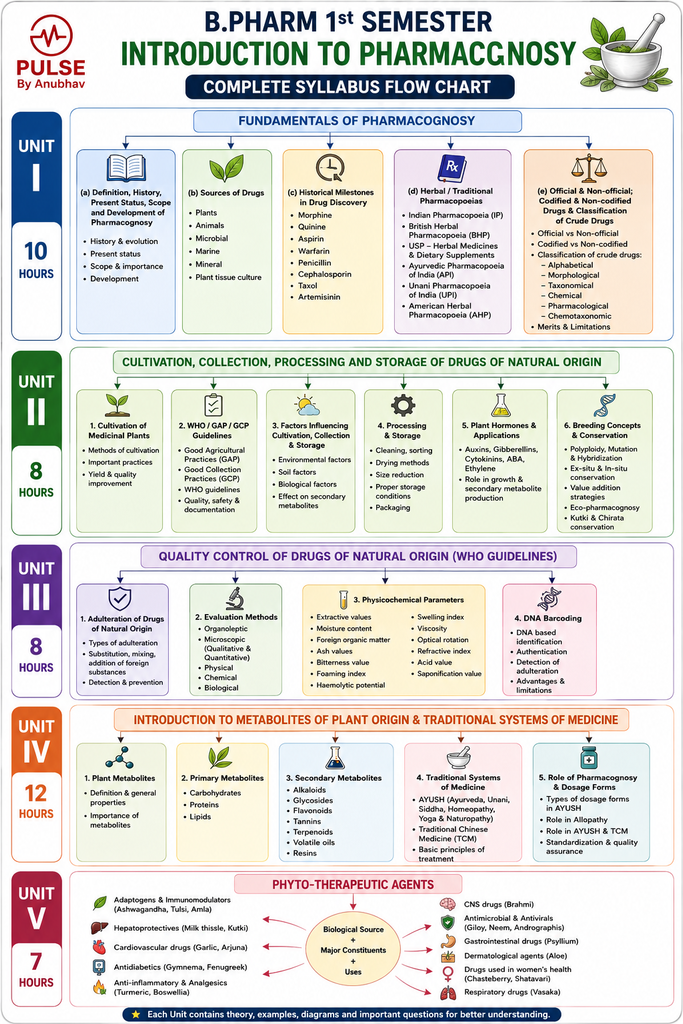
Unit I – Fundamentals of Pharmacognosy
Introduction to Pharmacognosy
- Definition of Pharmacognosy
- History and development of Pharmacognosy
- Present status and scope of Pharmacognosy
- Development and importance of Pharmacognosy in modern pharmacy
Sources of Drugs
- Plant sources
- Animal sources
- Microbial sources
- Marine sources
- Mineral sources
- Plant tissue culture
Historical Milestones in Drug Discovery
Study of the discovery, source, important constituents, and therapeutic importance of:
- Morphine
- Quinine
- Aspirin
- Warfarin
- Penicillin
- Cephalosporin
- Taxol
- Artemisinin
Herbal and Traditional Pharmacopoeias
Introduction to:
- Indian Pharmacopoeia (IP)
- British Herbal Pharmacopoeia (BHP)
- United States Pharmacopeia – Herbal Medicines and Dietary Supplements
- Ayurvedic Pharmacopoeia of India (API)
- Unani Pharmacopoeia of India (UPI)
- American Herbal Pharmacopoeia (AHP)
Official and Non-Official Drugs
- Official drugs
- Non-official drugs
- Codified drugs
- Non-codified drugs
Classification of Crude Drugs
Classification based on:
- Alphabetical classification
- Morphological classification
- Taxonomical classification
- Chemical classification
- Pharmacological classification
- Chemotaxonomic classification
Also includes:
- Merits
- Limitations
Total Lectures: 10 Hours
Unit II – Cultivation, Collection, Processing and Storage of Drugs of Natural Origin
Cultivation of Medicinal Plants
- Methods of plant cultivation
- Importance of cultivation of medicinal plants
- Factors influencing cultivation
- Role of cultivation in improving yield and quality
Good Agricultural and Collection Practices
Introduction to:
- WHO guidelines
- Good Agricultural Practices (GAP)
- Good Collection Practices (GCP)
Factors Affecting Medicinal Plants
Factors influencing:
- Cultivation
- Collection
- Processing
- Storage
Plant Hormones
Introduction and applications of:
- Auxins
- Gibberellins
- Cytokinins
- Abscisic acid
- Ethylene
Plant Improvement and Secondary Metabolites
Application of:
- Polyploidy
- Mutation
- Hybridization
With reference to:
- Plant improvement
- Enhancement of secondary metabolites
- Improvement in medicinal plant yield and quality
Conservation of Medicinal Plants
- In-situ conservation
- Ex-situ conservation
- Conservation of medicinal plant biodiversity
Value Addition of Medicinal Plants
Strategies for:
- Improved cultivation
- Processing
- Quality improvement
- Sustainable utilization and commercialization
Eco-Pharmacognosy
- Concept of eco-pharmacognosy
- Sustainable utilization of medicinal plants
- Conservation of endangered medicinal plants
Conservation of Important Medicinal Plants
With special reference to:
- Kutki
- Chirata
Total Lectures: 8 Hours
Unit III – Quality Control of Drugs of Natural Origin
Quality Control and WHO Guidelines
- Importance of quality control
- WHO guidelines for drugs of natural origin
- Standardization of natural drugs
- Quality, purity, safety, and identity of crude drugs
Adulteration of Drugs of Natural Origin
- Definition and concept
- Types of adulteration
- Methods of adulteration
- Detection and prevention of adulteration
Organoleptic Evaluation
Evaluation based on:
- Colour
- Odour
- Taste
- Size
- Shape
- Texture
- Other sensory characters
Microscopic Evaluation
Qualitative Microscopy
- Identification of characteristic tissues and cells
- Stomata
- Trichomes
- Fibres
- Vessels
- Starch grains
- Calcium oxalate crystals
Quantitative Microscopy
- Stomatal number
- Stomatal index
- Palisade ratio
- Vein-islet number
- Vein termination number
Physical Evaluation
- Solubility
- Melting point
- Specific gravity
- Optical rotation
- Refractive index
- Viscosity
Chemical Evaluation
- Identification of chemical constituents
- Qualitative chemical tests
- Quantitative estimation
- Chemical markers
Biological Evaluation
- Bioassays
- Potency determination
- Comparison with standard preparations
Physicochemical Parameters
- Extractive values
- Moisture content
- Foreign organic matter
- Ash values
- Bitterness value
- Foaming index
- Haemolytic potential
- Swelling index
- Viscosity
- Optical rotation
- Refractive index
- Acid value
- Saponification value
DNA Barcoding
- Introduction to DNA barcoding
- Identification and authentication of medicinal plants
- Detection of adulteration and substitution
- Applications in quality control and standardization
Total Lectures: 8 Hours
Unit IV – Introduction to Metabolites of Plant Origin and Traditional Systems of Medicine
Plant Metabolites
- Definition of plant metabolites
- General properties and characteristics
- Classification of plant metabolites
Primary Metabolites
Introduction to:
- Carbohydrates
- Proteins
- Lipids
Secondary Metabolites
Introduction to:
- Alkaloids
- Glycosides
- Flavonoids
- Tannins
- Terpenoids
- Volatile oils
- Resins
Traditional Systems of Medicine
Basic principles of treatment in:
- Ayurveda
- Yoga
- Naturopathy
- Unani
- Siddha
- Homeopathy
Traditional Chinese Medicine
- Basic principles of Traditional Chinese Medicine (TCM)
- Role of natural products and herbal medicines
AYUSH Dosage Forms
Introduction to different:
- Solid dosage forms
- Liquid dosage forms
- Semi-solid dosage forms
- Traditional formulations
Role of Pharmacognosy
Role of Pharmacognosy in:
- Allopathy
- AYUSH
- Traditional systems of medicine
- Traditional Chinese Medicine (TCM)
Total Lectures: 12 Hours
Unit V – Phyto-Therapeutic Agents
Adaptogens and Immunomodulators
- Ashwagandha
- Tulsi
- Amla
Hepatoprotective Drugs
- Milk Thistle
- Kutki
Cardiovascular Drugs
- Garlic
- Arjuna
Antidiabetic Drugs
- Gymnema
- Fenugreek
Anti-inflammatory and Analgesic Drugs
- Turmeric
- Boswellia
CNS Drugs
- Brahmi
Antimicrobial and Antiviral Drugs
- Giloy
- Neem
- Andrographis
Gastrointestinal Drugs
- Psyllium
Dermatological Agents
- Aloe
Drugs Used in Women’s Health
- Chasteberry
- Shatavari
Respiratory Drugs
- Vasaka
For each phyto-therapeutic agent, study:
- Biological source
- Major constituents
- Important therapeutic uses
Total Lectures: 7 Hours
B.Pharm 1st Semester Introduction to Pharmacognosy Notes PDF
Also Read:- Pharmaceutical Analysis Notes
B.Pharm 1st Semester Introduction to Pharmacognosy Book PDF
Books are very important; you should definitely check out the books according to your syllabus. During your pharmacy studies, books from Nirali Prakashan and PV Sindhu are very helpful. You can download the PDFs from the link below.
- Introduction to Pharmacognosy Nirali Prakashan Full Book PDF:- PDF
- Introduction to Pharmacognosy PV Sindhu Full Book PDF:- PDF
Also read- B.Pharm and D.Pharm Notes PDF (All Semester) – Complete Study Material & Syllabus
❓ Introduction to Pharmacognosy FAQs
What is Introduction to Pharmacognosy?
Introduction to Pharmacognosy is a B.Pharm 1st Semester subject that introduces students to medicines obtained from natural sources. It covers crude drugs, medicinal plants, sources of drugs, quality control, plant metabolites, traditional systems of medicine and phyto-therapeutic agents.
What are the main units in Introduction to Pharmacognosy?
The subject is divided into five units: Fundamentals of Pharmacognosy, Cultivation and Conservation of Drugs of Natural Origin, Quality Control of Natural Drugs, Plant Metabolites and Traditional Systems of Medicine, and Phyto-Therapeutic Agents.
What are the different sources of drugs studied in Pharmacognosy?
Drugs of natural origin may be obtained from plants, animals, microorganisms, marine organisms, minerals and plant tissue culture. These sources have contributed significantly to the discovery and development of important medicines.
What is a crude drug?
A crude drug is a natural substance obtained from plant, animal, mineral or other natural sources and used in its raw or minimally processed form for medicinal or pharmaceutical purposes.
Why is cultivation of medicinal plants important?
Proper cultivation helps ensure a regular supply of medicinal plants with better quality and yield. Environmental conditions, soil, climate, plant genetics and agricultural practices can influence the quantity and quality of active constituents.
What is adulteration of crude drugs?
Adulteration refers to the lowering of the quality of a crude drug through substitution, mixing with inferior materials, addition of foreign substances, use of exhausted drugs or other intentional and unintentional practices.
What methods are used for evaluation of natural drugs?
Drugs of natural origin can be evaluated using organoleptic, microscopic, physical, chemical and biological methods. Physicochemical parameters such as ash values, extractive values, moisture content and foreign organic matter are also important.
What are primary and secondary metabolites?
Primary metabolites are essential for normal growth and metabolism and include carbohydrates, proteins and lipids. Secondary metabolites include alkaloids, glycosides, flavonoids, tannins, terpenoids, volatile oils and resins, many of which have medicinal importance.
What is DNA barcoding in Pharmacognosy?
DNA barcoding is a molecular identification technique that uses specific DNA markers to authenticate medicinal plants and help detect adulteration, substitution and closely related species.
Which medicinal plants are important in Unit V of Introduction to Pharmacognosy?
Important phyto-therapeutic agents include Ashwagandha, Tulsi, Amla, Milk Thistle, Kutki, Garlic, Arjuna, Gymnema, Fenugreek, Turmeric, Boswellia, Brahmi, Giloy, Neem, Andrographis, Psyllium, Aloe, Chasteberry, Shatavari and Vasaka.
2 thoughts on “B.Pharm 1st Semester Introduction to Pharmacognosy Notes PDF, Updated Syllabus & Books”