Radhe Radhe, B.Pharm students! In this post, you will find the notes for your 8th semester Computer Aided Drug Design subject . Here you will find notes, books, previous year questions (PYQs), and important question-answers related to your pharmacy course Syllabus. You will also find GPAT updates here and exam tips. Here You will find pharmacy-related vacancies, so stay calm and connected with Pulse by Anubhav. Join Our Telegram Channel As Well As Bookmark Our Site For The Latest Update.
As you may have realized, pursuing a B.Pharm degree is not easy. Many people initially choose it as just one option, but later they discover how much studying is involved. Your B.Pharm course is divided into 8 semesters. In which the eight semester, you have to study total number of 4 subjects . In this subject you have to select the subject that you have interest and you want to follow the same in your higher study. You won’t have to study any additional subjects in this semester.
The pharmacy field is a very important medical field. Here, pharmacists not only dispense medication to patients but also educate them about the medicines. In the pharmaceutical industry, these same pharmacists manufacture the medicines and conduct research on them.
The link to download notes for all units is given below. If you want to download the PDF without reading the post, you can download the PDF by clicking on the link given below. You can also join our Telegram channel for future updates.
The Subjects in the 8th semester of B.Pharm are:
Core Subjects
- Biostatistics and Research Methodology
- Social and Preventive Pharmacy
Elective Subjects
- Pharma Marketing Management
- Pharmaceutical Regulatory Science
- Pharmacovigilance
- Quality Control and Standardization of Herbals
- Computer Aided Drug Design
- Cell and Molecular Biology
- Cosmetic Science
- Pharmacological Screening Methods
- Advanced Instrumentation Techniques
- Dietary Supplements and Nutraceuticals
- Pharmaceutical Product Development
In Computer Aided Drug Design, you will be taught how the drug delivery takes place and how the research on the medicine dose are perform.
B.Pharm 8th Semester Computer Aided Drug Design Syllabus
Before downloading the notes, please take a look at the Computer Aided Drug Design syllabus to understand what topics are covered.
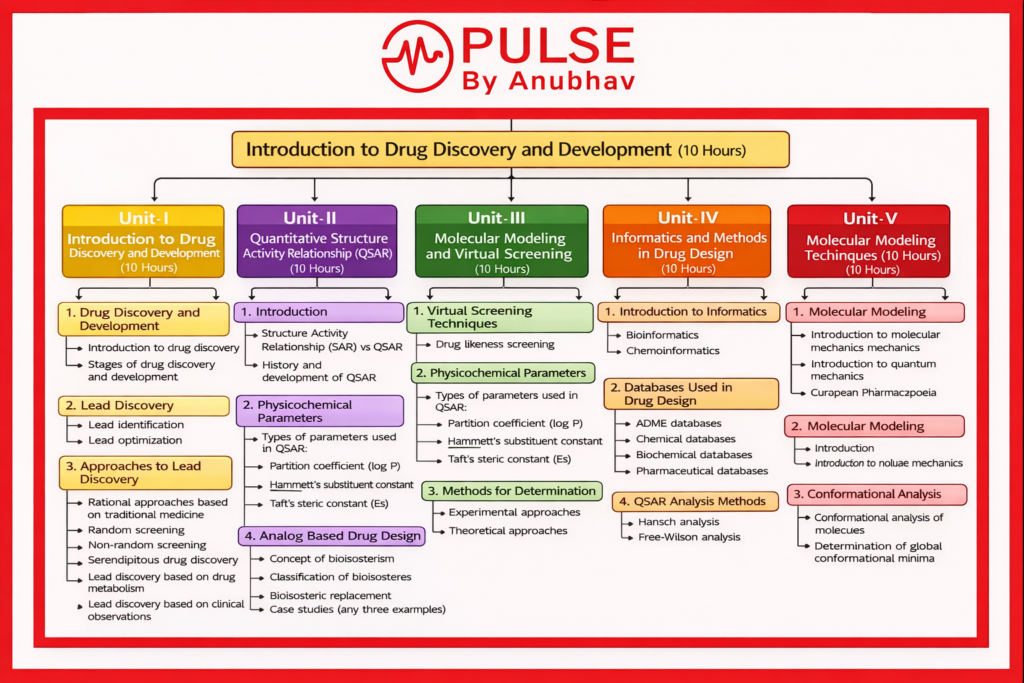
Unit I — Introduction to Drug Discovery and Development
1. Drug Discovery and Development
- Introduction to drug discovery
- Stages of drug discovery and development
2. Lead Discovery
- Lead identification
- Lead optimization
3. Approaches to Lead Discovery
- Rational approaches based on traditional medicine
- Random screening
- Non-random screening
- Serendipitous drug discovery
- Lead discovery based on drug metabolism
- Lead discovery based on clinical observations
4. Analog Based Drug Design
- Concept of bioisosterism
- Classification of bioisosteres
- Bioisosteric replacement
- Case studies (any three examples)
Unit II — Quantitative Structure Activity Relationship (QSAR)
1. Introduction
- Structure Activity Relationship (SAR) vs Quantitative Structure Activity Relationship (QSAR)
- History and development of QSAR
2. Physicochemical Parameters
Types of parameters used in QSAR:
- Partition coefficient (log P)
- Hammett’s substituent constant (σ)
- Taft’s steric constant (Es)
3. Methods for Determination
- Experimental approaches
- Theoretical approaches
4. QSAR Analysis Methods
- Hansch analysis
- Free-Wilson analysis
5. 3D-QSAR Techniques
- COMFA (Comparative Molecular Field Analysis)
- COMSIA (Comparative Molecular Similarity Indices Analysis)
Unit III — Molecular Modeling and Virtual Screening
1. Virtual Screening Techniques
- Drug likeness screening
2. Pharmacophore Concepts
- Pharmacophore mapping
- Pharmacophore-based screening
3. Molecular Docking
Types of docking:
- Rigid docking
- Flexible docking
- Manual docking
- Docking-based screening
4. De Novo Drug Design
- Concept and applications
Unit IV — Informatics and Methods in Drug Design
1. Introduction to Informatics
- Bioinformatics
- Chemoinformatics
2. Databases Used in Drug Design
- ADME databases
- Chemical databases
- Biochemical databases
- Pharmaceutical databases
Unit V — Molecular Modeling Techniques
1. Molecular Modeling
- Introduction to molecular mechanics
- Introduction to quantum mechanics
2. Energy Calculations
- Energy minimization methods
3. Conformational Analysis
- Conformational analysis of molecules
- Determination of global conformational minima
Also Read- Not Drinking Enough Water? Discover the Effects of Dehydration on Your Body
B.Pharm 8th Semester Computer Aided Drug Design Notes PDF
💻 Download B.Pharm – Computer Aided Drug Design (CADD) Notes (PCI Syllabus | Unit-wise | Flowchart PDF)
⚡ Computer Aided Drug Design notes are prepared in simple exam-oriented flowchart format specially for B.Pharm students – quick revision & high scoring.
🚀 Join Pulse Pharma Notes Telegram Channel 📘 Download Complete CADD Flowchart Notes (PDF)Also Read:- B.Pharm 7th Semester Industrial Pharmacy-2 Notes
B.Pharm 8th Semester Computer Aided Drug Design Book PDF
Books are very important; you should definitely check out the books according to your syllabus. During your pharmacy studies, books from Nirali Prakashan and PV Sindhu are very helpful. You can download the PDFs from the link below.
- Pharmaceutical Computer Aided Drug Design Nirali Prakashan Full Book PDF:- PDF
- Pharmaceutical Computer Aided Drug Design PV Sindhu Full Book PDF:- PDF
- Pharmaceutical Computer Aided Drug Design Thakur Publication Full Book PDF:- PDF
- Pharmaceutical Computer Aided Drug Design The Point Publication Full Book PDF: PDF
❓ Pharmaceutical Computer Aided Drug Design FAQs (B.Pharm 8th Semester)
❓ Pharmaceutical Computer Aided Drug Design (CADD) FAQs (B.Pharm 8th Semester – PCI Syllabus)
What is Computer Aided Drug Design (CADD)?
Computer Aided Drug Design (CADD) is a computational approach used to design and develop new drugs using computer software and molecular modeling techniques. It helps predict drug interactions with biological targets and speeds up the drug discovery process.
What are the main stages of drug discovery and development?
The major stages include target identification, lead discovery, lead optimization, preclinical studies, clinical trials and regulatory approval. Computer aided techniques help accelerate these stages in modern pharmaceutical research.
What is QSAR in drug design?
QSAR (Quantitative Structure Activity Relationship) is a method that correlates chemical structure with biological activity. It uses physicochemical parameters such as partition coefficient, Hammett constant and steric parameters to predict drug activity.
What is molecular docking?
Molecular docking is a computational technique used to predict the interaction between a drug molecule and its target protein. It helps determine the binding affinity and orientation of a drug within the active site of the receptor.
What is pharmacophore mapping in drug design?
Pharmacophore mapping identifies the essential structural features responsible for biological activity. These features are used to screen databases and design new molecules with improved therapeutic effects.
What is the role of bioinformatics and chemoinformatics in drug discovery?
Bioinformatics and chemoinformatics help manage and analyze biological and chemical data. They assist in target identification, molecular modeling, database screening and prediction of drug properties such as ADME.
What are the advantages of computer aided drug design?
CADD reduces the time and cost of drug discovery, improves accuracy in predicting drug-target interactions and helps identify potential drug candidates before laboratory testing.
What is virtual screening in drug discovery?
Virtual screening is a computational technique used to search large chemical databases to identify compounds that are most likely to bind to a specific drug target.