Radhe Radhe, D.Pharm students! In this post, you will find the notes for your 1st year Human Anatomy and Physiology subject . Here you will find notes, books, previous year questions (PYQs), and important question-answers related to your pharmacy course Syllabus. You will also find GPAT updates here and exam tips. Here You will find pharmacy-related vacancies, so stay calm and connected with Pulse by Anubhav. Join Our Telegram Channel As Well As Bookmark Our Site For The Latest Update.
You see, the field of pharmacy constitutes a significant part of the medical healthcare sector. The Diploma in Pharmacy—commonly referred to as D.Pharm—is a two-year course; however, completing it allows you to gain quick entry into the job market. The syllabus for the first year of this program is structured around five subjects.
The pharmacy field is a very important medical field. Here, pharmacists not only dispense medication to patients but also educate them about the medicines. In the pharmaceutical industry, these same pharmacists manufacture the medicines and conduct research on them.
The link to download notes for all units is given below. If you want to download the PDF without reading the post, you can download the PDF by clicking on the link given below. You can also join our Telegram channel for future updates.
Also Read- B.Pharm 8th Semester Cosmetic Science Notes
The Subjects in the 1st year of D.Pharm are:
- Pharmaceutics
- Pharmaceutical Chemistry
- Pharmacognosy
- Human Anatomy and Physiology
- Social Pharmacy
In pharmaceutical Human Anatomy and Physiology , you will be taught how the dose of a drug is made and how the drug is made, which chemical is mixed in it, when and how much, all this will be taught to you.
D.Pharm 1st Year Human Anatomy and Physiology Syllabus
Before downloading the notes, please take a look at the Human Anatomy and Physiology syllabus to understand what topics are covered.
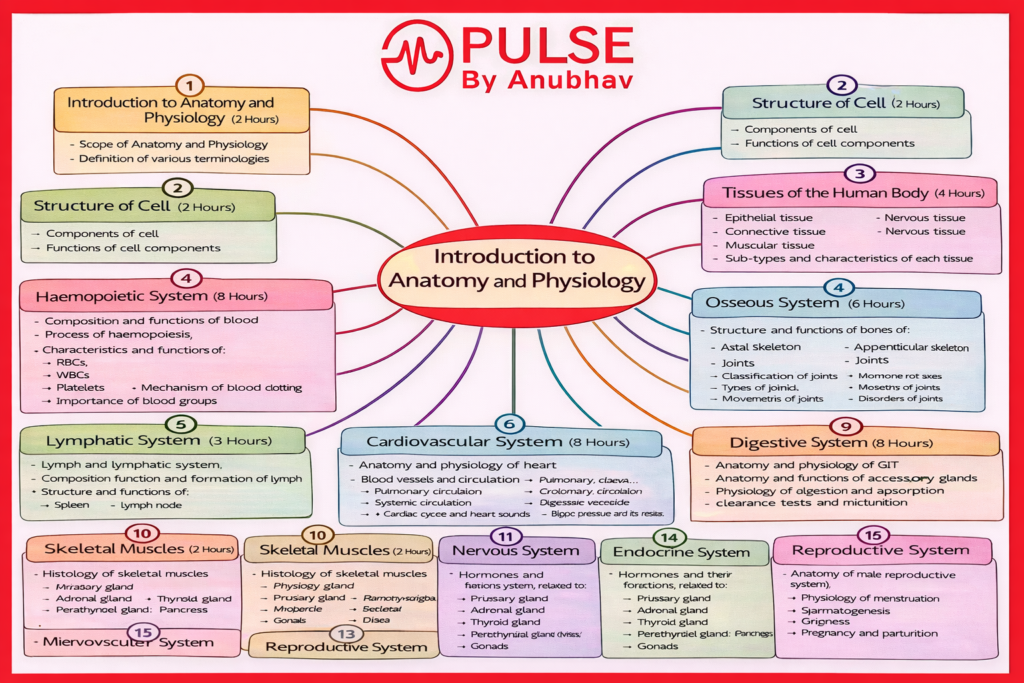
Chapter 1: Introduction to Anatomy and Physiology
- Scope of Anatomy and Physiology
- Definition of various terminologies
Chapter 2: Structure of Cell
- Components of cell
- Functions of cell components
Chapter 3: Tissues of the Human Body
- Epithelial tissue
- Connective tissue
- Muscular tissue
- Nervous tissue
- Sub-types and characteristics of each tissue
Chapter 4: Osseous System
- Structure and functions of bones of:
- Axial skeleton
- Appendicular skeleton
- Joints:
- Classification of joints
- Types of joints
- Movements of joints
- Disorders of joints
Chapter 5: Haemopoietic System
- Composition and functions of blood
- Process of haemopoiesis
- Characteristics and functions of:
- RBCs
- WBCs
- Platelets
- Mechanism of blood clotting
- Importance of blood groups
Chapter 6: Lymphatic System
- Lymph and lymphatic system
- Composition, function, and formation of lymph
- Structure and functions of:
- Spleen
- Lymph node
Chapter 7: Cardiovascular System
- Anatomy and physiology of heart
- Blood vessels and circulation:
- Pulmonary circulation
- Coronary circulation
- Systemic circulation
- Cardiac cycle and heart sounds
- Basics of ECG
- Blood pressure and its regulation
Chapter 8: Respiratory System
- Anatomy of respiratory organs and their functions
- Regulation and mechanism of respiration
- Respiratory volumes and capacities – definitions
Chapter 9: Digestive System
- Anatomy and physiology of GIT
- Anatomy and functions of accessory glands
- Physiology of digestion and absorption
Chapter 10: Skeletal Muscles
- Histology of skeletal muscles
- Physiology of muscle contraction
- Disorders of skeletal muscles
Chapter 11: Nervous System
- Classification of nervous system
- Anatomy and physiology of:
- Cerebrum
- Cerebellum
- Midbrain
- Functions of:
- Hypothalamus
- Medulla oblongata
- Basal ganglia
- Spinal cord:
- Structure
- Reflexes
- Cranial nerves:
- Names
- Functions
- Anatomy and physiology of:
- Sympathetic nervous system
- Parasympathetic nervous system (ANS)
Chapter 12: Sense Organs
Anatomy and physiology of:
- Eye
- Ear
- Skin
- Tongue
- Nose
Chapter 13: Urinary System
- Anatomy and physiology of urinary system
- Physiology of urine formation
- Renin-angiotensin system
- Clearance tests and micturition
Chapter 14: Endocrine System
Hormones and their functions related to:
- Pituitary gland
- Adrenal gland
- Thyroid gland
- Parathyroid gland
- Pancreas
- Gonads
Chapter 15: Reproductive System
- Anatomy of male reproductive system
- Anatomy of female reproductive system
- Physiology of menstruation
- Spermatogenesis
- Oogenesis
- Pregnancy and parturition
Also Read- Oscars 2026: Best Dressed Stars & Most Unforgettable Red Carpet Looks
D.Pharm 1st Year Human Anatomy and Physiology Notes PDF
💊 Download D.Pharm – Human Anatomy & Physiology Notes (PCI Syllabus | Chapter-wise | Flowchart PDF)
⚡ Human Anatomy & Physiology notes are prepared in simple exam-oriented flowchart format specially for D.Pharm students – quick revision & better scoring.
🚀 Join Pulse Pharma Notes Telegram Channel 📘 Download Complete Human Anatomy & Physiology Flowchart Notes (PDF)B.Pharm 1st year Human Anatomy and Physiology Book PDF
Books are very important; you should definitely check out the books according to your syllabus. During your pharmacy studies, books from Nirali Prakashan and PV Sindhu are very helpful. You can download the PDFs from the link below.
- Pharmaceutical Human Anatomy and Physiology Nirali Prakashan Full Book PDF:- PDF
- Pharmaceutical Human Anatomy and Physiology PV Sindhu Full Book PDF:- PDF
- Pharmaceutical Human Anatomy and Physiology Thakur Publication Full Book PDF:- PDF
- Pharmaceutical Human Anatomy and Physiology The Point Publication Full Book PDF: PDF
Also Read- D.Pharm 1st Year Pharmaceutical Pharmacognosy Notes
❓ Pharmaceutical Human Anatomy and Physiology FAQs (D.Pharm 1st Year)
❓ Frequently Asked Questions (FAQs)
D.Pharm 1st Year Notes
| Subject Name | Notes Link |
|---|---|
| 💊 Pharmaceutics | View Notes |
| 🧪 Pharmaceutical Chemistry | View Notes |
| 🌿 Pharmacognosy | View Notes |
| 🫀 Human Anatomy and Physiology | View Notes |
| 🌍 Social Pharmacy | View Notes |
3 thoughts on “D.Pharm 1st Year Human Anatomy and Physiology Notes”