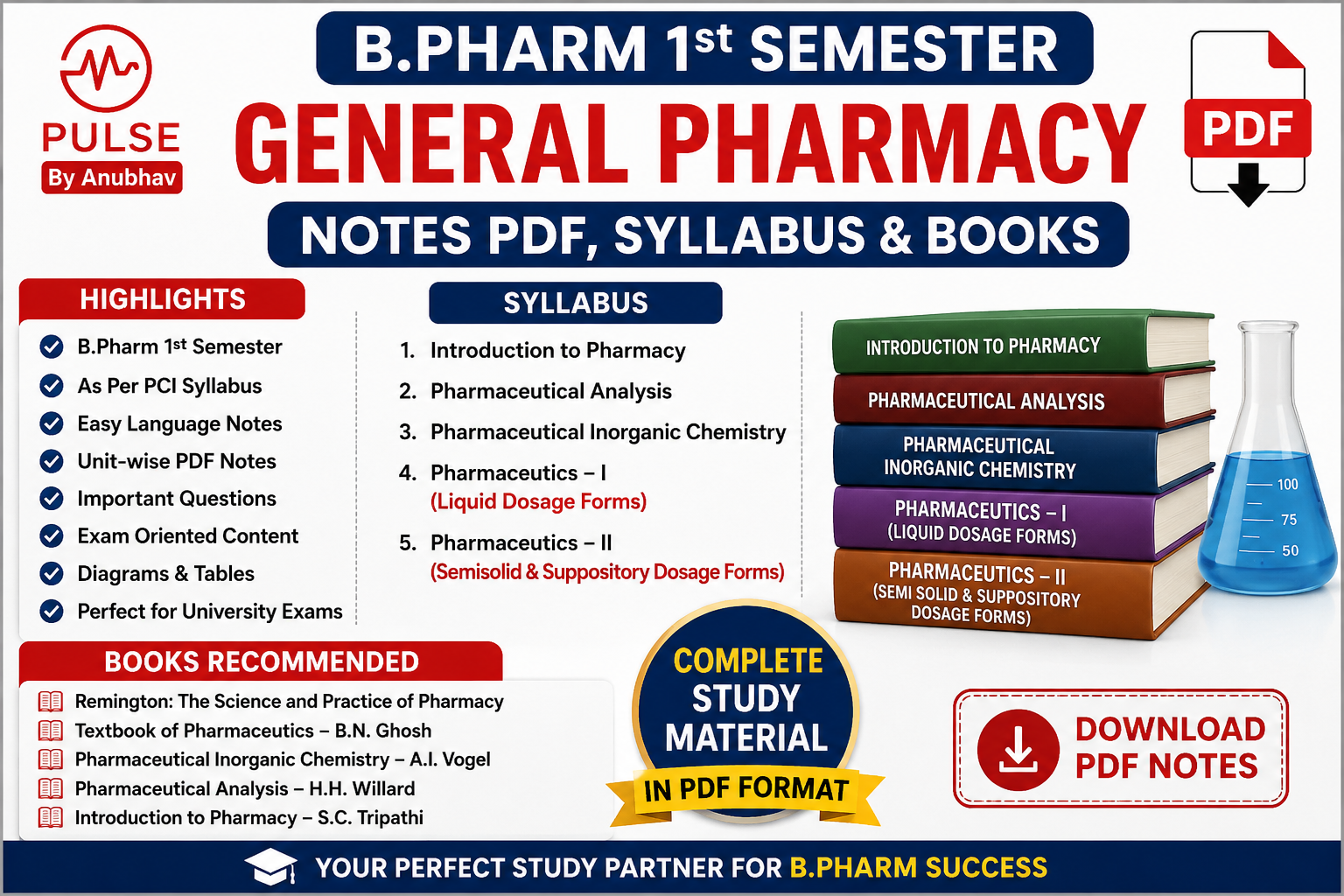
Radhe Radhe, B.Pharm students! In this post, you will find the notes for your 1st semester General Pharmacy subject . Here you will find notes, books, previous year questions (PYQs), and important question-answers related to your pharmacy course Updated syllabus. You will also find GPAT updates here. Follow our Telegram link; you will find all the semester notes and book PDFs there.
As you may have already understood, pursuing a B.Pharm degree is not as easy as it looks. Many students choose this course as just an option after 12th, but later they realize how much deep study and practical knowledge it actually requires.
B.Pharm is a 4-year professional course divided into 8 semesters. In the first semester, you are introduced to the core foundation of pharmaceutical science, along with modern subjects like General Pharmacy, which is newly added in the updated syllabus.
This clearly shows that pharmacy is now moving towards technology + data-driven healthcare, where programming and data analysis are becoming important for research and drug development.
B.Pharm and D.Pharm Notes PDF (All Semester) – Complete Study Material & Syllabus
Why B.Pharm is Important in Healthcare
B.Pharm is not only about medicines — it is one of the most important courses in the healthcare sector. This course helps students understand how medicines are prepared, tested, distributed, and used safely for patients.
A pharmacist plays a major role in the medical field. They help doctors and patients by providing the correct medicines and proper guidance related to drug usage. A pharmacist also explains:
- How to take medicines properly
- Benefits of medicines
- Possible side effects
- Safe dosage and precautions
Today, the pharmacy profession is growing rapidly because healthcare industries, hospitals, research labs, and pharmaceutical companies all require skilled pharmacy professionals.
If you study B.Pharm seriously, you can build a strong career in:
- Pharmaceutical industries
- Hospitals and clinics
- Drug research centers
- Medical coding & pharmacovigilance
- Government healthcare sectors
At Pulse by Anubhav, we always try to provide updated B.Pharm notes, syllabus PDFs, PYQs, and study materials to help pharmacy students in their academic journey.
Updated Subjects in B.Pharm 1st Semester (As per New PCI Syllabus)
Here is the latest subject list for B.Pharm 1st Semester including theory and practical subjects.
Theory Subjects
- BP101T – Basics of Python Programming for Pharmaceutical Sciences
- BP102T – General Pharmacy
- BP103T – Healthcare Psychology and Communication Skills
- BP104T – Human Anatomy, Physiology and Pathophysiology I
- BP105T – Introduction to Pharmacognosy
- BP106T – Pharmaceutical Inorganic and Analytical Chemistry
Practical Subjects
- BP107P – General Pharmacy Practical
- BP108P – Healthcare Psychology and Communication Skills Practical
- BP109P – Human Anatomy, Physiology and Pathophysiology I Practical
- BP110P – Introduction to Pharmacognosy Practical
- BP111P – Pharmaceutical Inorganic and Analytical Chemistry Practical
Special Highlight: Python in Pharmacy 📊
One of the biggest updates in the new B.Pharm syllabus is:
👉 Basics of Python Programming for Pharmaceutical Sciences
This modern subject introduces pharmacy students to the digital and technical side of healthcare. It helps students understand how technology is used in pharmaceutical research and data handling.
With this subject, students can learn to:
- Analyze pharmaceutical data
- Create graphs and concentration-time curves
- Work with research datasets
- Understand digital healthcare systems
- Improve research and analytical skills
This change shows how pharmacy education is becoming more technology-oriented and future-ready for modern healthcare industries.
Also Read- B.Pharm 1st Semester Introduction to Pharmacognosy Notes PDF, Updated Syllabus & Books
Basics of Python Programming for Pharmaceutical Sciences Notes Link
B.Pharm 1st Semester General Pharmacy Science Syllabus
Before downloading the notes, please take a look at the General Pharmacy syllabus to understand what topics are covered.
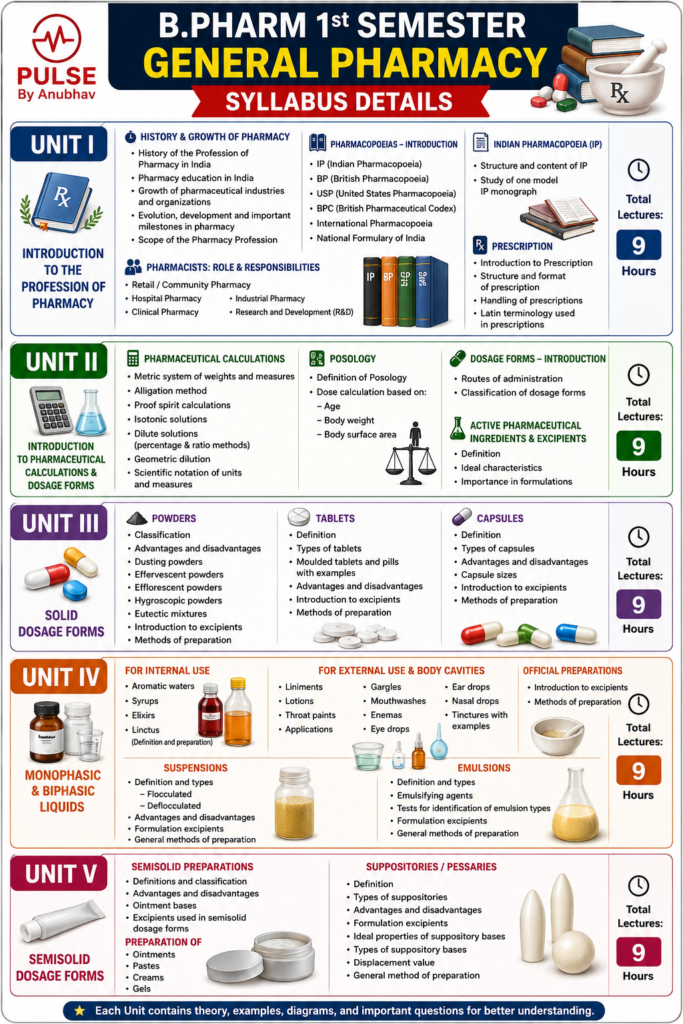
Unit I – Introduction to the Profession of Pharmacy
History of the Profession of Pharmacy in India
- Pharmacy education in India
- Growth of pharmaceutical industries and organizations
- Evolution, development, and important milestones in pharmacy
Scope of the Pharmacy Profession
Role and responsibilities of pharmacists in:
- Retail / Community Pharmacy
- Hospital Pharmacy
- Clinical Pharmacy
- Industrial Pharmacy
- Research and Development (R&D)
Pharmacopoeias
Introduction to:
- IP (Indian Pharmacopoeia)
- BP (British Pharmacopoeia)
- USP (United States Pharmacopoeia)
- BPC (British Pharmaceutical Codex)
- International Pharmacopoeia
- National Formulary of India
Also Includes:
- Structure and content of IP
- Study of one model IP monograph
Introduction to Prescription
- Structure and format of prescription
- Handling of prescriptions
- Latin terminology used in prescriptions
Total Lectures: 9 Hours
Unit II – Introduction to Pharmaceutical Calculations and Dosage Forms
Pharmaceutical Calculations
- Metric system of weights and measures
- Alligation method
- Proof spirit calculations
- Isotonic solutions
- Dilute solutions (percentage & ratio methods)
- Geometric dilution
- Scientific notation of units and measures
Posology
- Definition of Posology
- Dose calculation based on:
- Age
- Body weight
- Body surface area
Introduction to Dosage Forms
- Routes of administration
- Classification of dosage forms
Active Pharmaceutical Ingredients & Excipients
- Definition
- Ideal characteristics
- Importance in formulations
Total Lectures: 9 Hours
Unit III – Solid Dosage Forms
Powders
- Classification
- Advantages and disadvantages
- Dusting powders
- Effervescent powders
- Efflorescent powders
- Hygroscopic powders
- Eutectic mixtures
- Introduction to excipients
- Methods of preparation
Tablets
- Definition
- Types of tablets
- Moulded tablets and pills with examples
- Advantages and disadvantages
- Introduction to excipients
- Methods of preparation
Capsules
- Definition
- Types of capsules
- Advantages and disadvantages
- Capsule sizes
- Introduction to excipients
- Methods of preparation
Total Lectures: 9 Hours
Unit IV – Monophasic and Biphasic Liquids
For Internal Use
- Aromatic waters
- Syrups
- Elixirs
- Linctus
(Definition and preparation)
For External Use and Body Cavities
- Liniments
- Lotions
- Throat paints
- Applications
- Gargles
- Mouthwashes
- Enemas
- Eye drops
- Ear drops
- Nasal drops
- Tinctures with examples
Official Preparations
- Introduction to excipients
- Methods of preparation
Suspensions
- Definition and types
- Flocculated
- Deflocculated
- Advantages and disadvantages
- Formulation excipients
- General methods of preparation
Emulsions
- Definition and types
- Emulsifying agents
- Tests for identification of emulsion types
- Formulation excipients
- General methods of preparation
Total Lectures: 9 Hours
Unit V – Semisolid Dosage Forms
Semisolid Preparations
- Definitions and classification
- Advantages and disadvantages
- Ointment bases
- Excipients used in semisolid dosage forms
- Preparation of:
- Ointments
- Pastes
- Creams
- Gels
Suppositories / Pessaries
- Definition
- Types of suppositories
- Advantages and disadvantages
- Formulation excipients
- Ideal properties of suppository bases
- Types of suppository bases
- Displacement value
- General method of preparation
Total Lectures: 9 Hours
Also Read- Aisha Ahmed (Actress) Height, Weight, Age, Boyfriend, Biography & More | Pulse by Anubhav
B.Pharm 1st Semester General Pharmacy Notes PDF
Also Read:- Pharmaceutical Analysis Notes
B.Pharm 1st Semester General Pharmacy Book PDF
Books are very important; you should definitely check out the books according to your syllabus. During your pharmacy studies, books from Nirali Prakashan and PV Sindhu are very helpful. You can download the PDFs from the link below.
Also read- Rashmeet Kaur Wiki, Height, Age, Relationships & Music Career | Pulse by Anubhav
3 thoughts on “B.Pharm 1st Semester General Pharmacy Notes PDF, Updated Syllabus & Books”