Radhe Radhe, B.Pharm students! In this post, you will find the notes for your 8th semester Pharmacovigilance subject . Here you will find notes, books, previous year questions (PYQs), and important question-answers related to your pharmacy course Syllabus. You will also find GPAT updates here and exam tips. Here You will find pharmacy-related vacancies, so stay calm and connected with Pulse by Anubhav. Join Our Telegram Channel As Well As Bookmark Our Site For The Latest Update.
As you may have realized, pursuing a B.Pharm degree is not easy. Many people initially choose it as just one option, but later they discover how much studying is involved. Your B.Pharm course is divided into 8 semesters. In which the eight semester, you have to study total number of 4 subjects . In this subject you have to select the subject that you have interest and you want to follow the same in your higher study. You won’t have to study any additional subjects in this semester.
The pharmacy field is a very important medical field. Here, pharmacists not only dispense medication to patients but also educate them about the medicines. In the pharmaceutical industry, these same pharmacists manufacture the medicines and conduct research on them.
The link to download notes for all units is given below. If you want to download the PDF without reading the post, you can download the PDF by clicking on the link given below. You can also join our Telegram channel for future updates.
The Subjects in the 8th semester of B.Pharm are:
Core Subjects
- Biostatistics and Research Methodology
- Social and Preventive Pharmacy
Elective Subjects
- Pharma Marketing Management
- Pharmaceutical Regulatory Science
- Pharmacovigilance
- Quality Control and Standardization of Herbals
- Computer Aided Drug Design
- Cell and Molecular Biology
- Cosmetic Science
- Pharmacological Screening Methods
- Advanced Instrumentation Techniques
- Dietary Supplements and Nutraceuticals
- Pharmaceutical Product Development
In Pharmacovigilance, you will be taught how the drug delivery takes place and how the research on the medicine dose are perform it comes under pharmacology department.
B.Pharm 8th Semester Pharmacovigilance Syllabus
Before downloading the notes, please take a look at the Pharmacovigilance syllabus to understand what topics are covered.
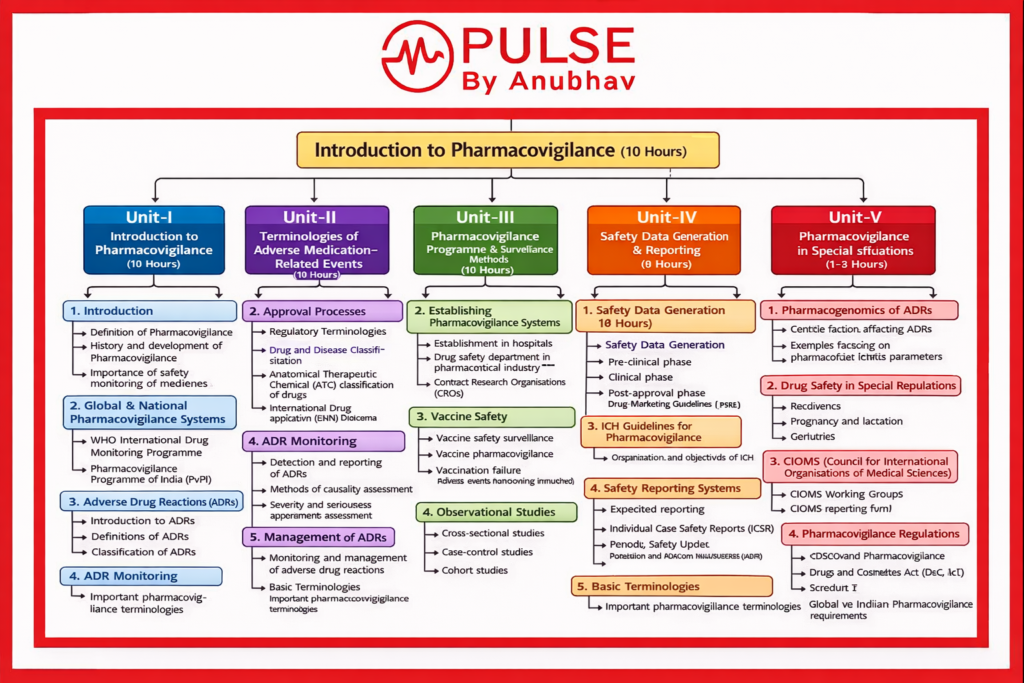
Unit I — Introduction to Pharmacoviigilance
1. Introduction
- Definition of Pharmacoviigilance
- History and development of Pharmacoviigilance
- Importance of safety monitoring of medicines
2. Global & National Pharmacovigiilance Systems
- WHO International Drug Monitoring Programme
- Pharmacovigiilance Programme of India (PvPI)
3. Adverse Drug Reactions (ADRs)
- Introduction to ADRs
- Definitions of ADRs
- Classification of ADRs
4. ADR Monitoring
- Detection and reporting of ADRs
- Methods of causality assessment
- Severity and seriousness assessment
- Predictability and preventability assessment
5. Management of ADRs
- Monitoring and management of adverse drug reactions
6. Basic Terminologies
- Important pharmacovigiilance terminologies
Unit II — Terminologies of Adverse Medication-Related Events
1. Regulatory Terminologies
2. Drug and Disease Classification
- Anatomical Therapeutic Chemical (ATC) classification of drugs
- International Classification of Diseases (ICD)
3. Drug Identification Systems
- Defined Daily Dose (DDD)
- International Non-Proprietary Names (INN)
4. Drug Dictionaries and Coding Systems
- WHO Adverse Reaction Terminologies (WHO-ART)
- MedDRA (Medical Dictionary for Regulatory Activities)
- Standardised MedDRA Queries (SMQ)
- WHO Drug Dictionary
- EudraVigilance Medicinal Product Dictionary
5. Information Resources in Pharmacoviigilance
- Basic drug information resources
- Specialized ADR information resources
6. Establishing Pharmaacovigilance Programme
Unit III — Pharmacovigiilance Programme & Surveillance Methods
1. Establishing Pharmacovigilance Systems
- Establishment in hospitals
- Drug safety department in pharmaceutical industry
- Contract Research Organisations (CROs)
- Establishing national pharmcovigilance programmes
2. Vaccine Safety
- Vaccine safety surveillance
- Vaccine pharmaacovigilance
- Vaccination failure
- Adverse events following immunization (AEFI)
3. Pharmaacovigilance Methods
Passive Surveillance
- Spontaneous reporting
- Case series
Stimulated Reporting
Active Surveillance
- Sentinel sites
- Drug event monitoring
- Registries
4. Observational Studies
- Cross-sectional studies
- Case-control studies
- Cohort studies
5. Targeted Clinical Investigations
6. Communication in Pharmaacovigilance
- Effective communication in pharmaacovigilance
- Drug safety crisis management
- Communication with:
- Regulatory agencies
- Business partners
- Healthcare professionals
- Media
Unit IV — Safety Data Generation & Reporting
1. Safety Data Generation
- Pre-clinical phase
- Clinical phase
- Post-approval phase (Post-Marketing Surveillance – PMS)
2. ICH Guidelines for Pharmaacovigilance
- Organization and objectives of ICH
3. Safety Reporting Systems
- Expedited reporting
- Individual Case Safety Reports (ICSR)
- Periodic Safety Update Reports (PSUR)
- Post-approval expedited reporting
4. Pharmacovigilance Planning
5. Good Clinical Practice (GCP)
- GCP in pharmacovigilancee studies
Unit V — Pharmacovigilaance in Special Situations
1. Pharmacogenomics of ADRs
- Genetic factors affecting ADRs
- Examples focusing on pharmacokinetic parameters
2. Drug Safety in Special Populations
- Paediatrics
- Pregnancy and lactation
- Geriatrics
3. CIOMS (Council for International Organizations of Medical Sciences)
- CIOMS Working Groups
- CIOMS reporting form
4. Pharmacovigilancee Regulations in India
- CDSCO and Pharmacovigilancee
- Drugs and Cosmetics Act (D&C Act)
- Schedule Y
5. Global vs Indian Pharmacoovigilance Requirements
- Differences in regulatory requirements
Also Read- Not Drinking Enough Water? Discover the Effects of Dehydration on Your Body
B.Pharm 8th Semester Pharmacovigilance Notes PDF
💊 Download B.Pharm – Pharmacovigilance Notes (PCI Syllabus | Unit-wise | Flowchart PDF)
⚡ Pharmacovigilance notes are prepared in simple exam-oriented flowchart format specially for B.Pharm students – quick revision & high scoring.
🚀 Join Pulse Pharma Notes Telegram Channel 📘 Download Complete Pharmacovigilance Flowchart Notes (PDF)Also Read:- B.Pharm 8th Semester Pharmaceutical Regulatory Science Notes
B.Pharm 8th Semester Biostatistics and Research Methodology Book PDF
Books are very important; you should definitely check out the books according to your syllabus. During your pharmacy studies, books from Nirali Prakashan and PV Sindhu are very helpful. You can download the PDFs from the link below.
- Pharmaceutical Pharmacovigilance Nirali Prakashan Full Book PDF:- PDF
- Pharmaceutical Pharmacovigilance PV Sindhu Full Book PDF:- PDF
- Pharmaceutical Pharmacovigilance Thakur Publication Full Book PDF:- PDF
- Pharmaceutical Pharmacovigilance The Point Publication Full Book PDF: PDF
❓ Pharmaceutical Pharmacovigilance FAQs (B.Pharm 8th Semester)
❓ Pharmacovigilance FAQs (B.Pharm 8th Semester – PCI Syllabus)
What is Pharmacovigilance?
Pharmacovigilance is the science and activities related to detecting, assessing, understanding and preventing adverse effects or any other drug-related problems. It helps ensure the safety and effectiveness of medicines used by patients.
What is the importance of pharmacovigilance in healthcare?
Pharmacovigilance helps identify adverse drug reactions (ADRs), ensures safe use of medicines, improves patient safety and helps regulatory authorities monitor drug safety after medicines are released into the market.
What is the Pharmacovigilance Programme of India (PvPI)?
The Pharmacovigilance Programme of India (PvPI) is a national programme launched by the Government of India to monitor adverse drug reactions and ensure safe use of medicines across the country.
What are adverse drug reactions (ADRs)?
Adverse Drug Reactions (ADRs) are unwanted or harmful effects experienced after the administration of a drug at normal therapeutic doses used for treatment, diagnosis or prevention of disease.
What are the different methods used in pharmacovigilance?
Pharmacovigilance methods include passive surveillance such as spontaneous reporting and case series, and active surveillance methods such as sentinel sites, drug event monitoring and patient registries.
What is MedDRA in pharmacovigilance?
MedDRA (Medical Dictionary for Regulatory Activities) is a standardized medical terminology used internationally to classify and code adverse drug reactions and other safety information related to medicines.
What is pharmacovigilance in vaccine safety?
Vaccine pharmacovigilance focuses on monitoring adverse events following immunization (AEFI), evaluating vaccine safety and ensuring vaccines remain safe for public health use.
What are ICSR and PSUR in pharmacovigilance?
ICSR (Individual Case Safety Report) is a detailed report of a single adverse drug reaction case, while PSUR (Periodic Safety Update Report) is a regulatory document submitted periodically to evaluate the safety profile of a medicine.