Metals and Non-metals is a chapter in your science subject. Radhe Radhe to all my dear children! You all will have to work very hard for your board exams to get good marks. In this post, I will try to cover all the important topics of your 10th-grade science syllabus so that you can understand and remember them.
Metals and Non-metals, which is your third chapter, falls under the chemistry section of science. All the information you need to study in this chapter will be found in this post.
👉 Skip everything and click here to directly view the Notes PDF
🔹 1. Classification of Elements
Also Read- CBSE Class 10 Science Chapter 2 Acids, Bases and Salts
CBSE Class 10 Science – Chapter 2
Metals and Non-metals
Complete Class 10 Science Chapter 3 notes, NCERT book PDF
aur official Telegram channel ka direct access yahan se milega.
Q1. Which property allows metals to be beaten into thin sheets?
Ductility
Sonority
Malleability
Hardness
Q2. Which metal is liquid at room temperature?
Sodium
Mercury
Iron
Aluminium
Q3. Which non-metal conducts electricity?
Sulphur
Graphite
Phosphorus
Iodine
Q4. Which metal reacts violently with cold water?
Iron
Calcium
Sodium
Copper
Q5. Which gas is released when metal reacts with acid?
Oxygen
Hydrogen
Nitrogen
Carbon dioxide
Q6. Aluminium oxide is an example of:
Basic oxide
Amphoteric oxide
Acidic oxide
Neutral oxide
Q7. Which metal is stored in kerosene?
Iron
Zinc
Sodium
Copper
Q8. Rusting of iron requires:
Only air
Only water
Air and water
Carbon dioxide
Q9. Which metal is the best conductor of heat?
Iron
Silver
Lead
Mercury
Q10. Which metal does not react with water?
Sodium
Calcium
Gold
Magnesium
Also Read- CBSE Class 10 Science Chapter 1 Chemical Reactions and Equations
Q1. What is meant by metallic lustre?
Metallic lustre refers to the shiny appearance of metals in their pure state,
such as iron, copper and aluminium.
Q2. Why can metals be beaten into thin sheets?
Metals can be beaten into thin sheets due to the property called malleability.
Gold and silver are the most malleable metals.
Q3. What is ductility?
Ductility is the property of metals by which they can be drawn into thin wires.
Gold is the most ductile metal.
Q4. Why are cooking utensils made of metals like aluminium and copper?
Aluminium and copper are good conductors of heat and have high melting points,
making them suitable for cooking utensils.
Q5. Why are electric wires coated with PVC or rubber?
PVC or rubber is an insulator and prevents electric shock by stopping the
flow of electricity to the surroundings.
Q6. What does it mean when metals are said to be sonorous?
Sonorous metals produce a ringing sound when struck, which is why metals are
used to make bells.
Q7. Which non-metal conducts electricity and why?
Graphite, an allotrope of carbon, conducts electricity due to the presence
of free electrons.
Q8. Why is sodium stored under kerosene oil?
Sodium reacts violently with air and water, so it is stored under kerosene
oil to prevent accidental reactions.
1
Chemical Reactions and Equations
4
Carbon and Its Compounds
6
Control and Coordination
7
How do Organisms Reproduce?
9
Light – Reflection and Refraction
10
The Human Eye and the Colorful World
12
Magnetic Effects of Electric Current
Related 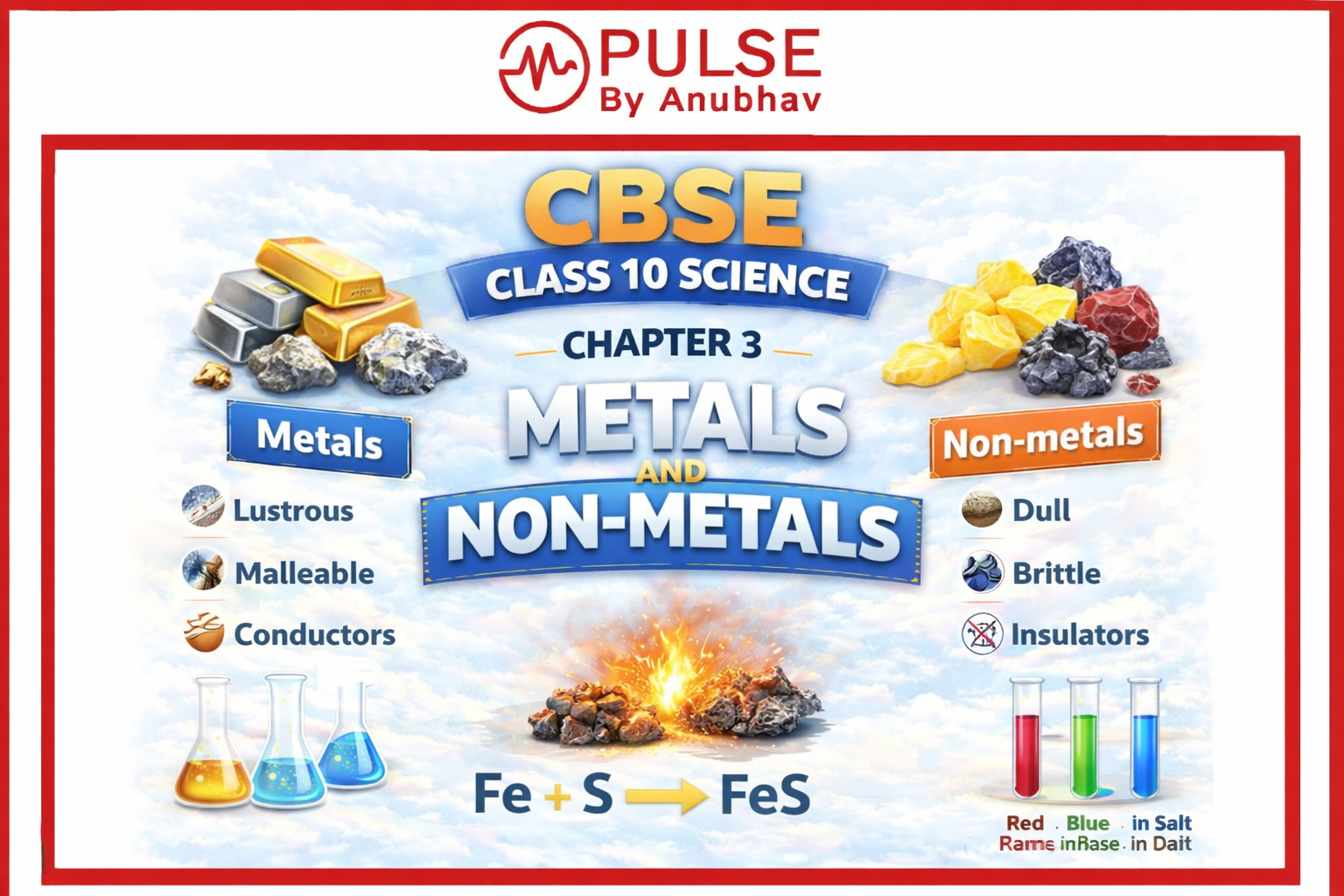
5 thoughts on “CBSE Class 10 Science Chapter 3 Metals and Non-metals”