You will get here Physical Education class 12 CBSE notes Chapter 10: Training in Sports. You can connect with us for every important update related to class 12.
Physical Education is a very important subject for you because it will help you increase your percentage. You can score high marks in this subject by studying notes and practicing MCQs. In this post, we will cover Chapter 10: Training in Sports.
Also Read- Physical Education Notes | Class 12 – Chapter 1: Management of Sporting Events
Key Content Of Chapter 10 Training in Sports
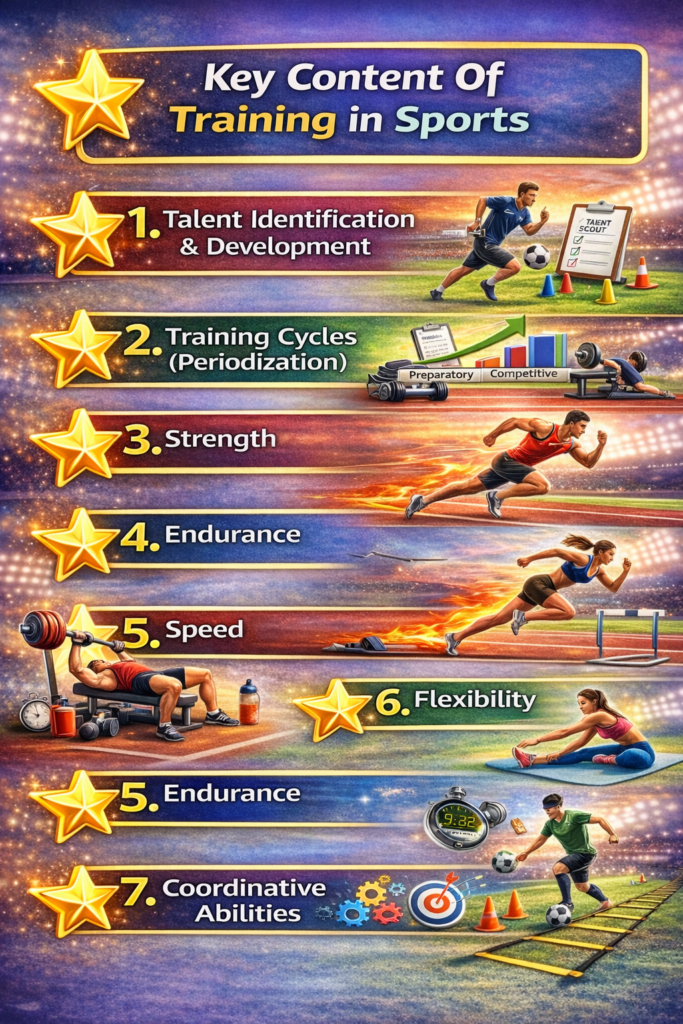
⭐ 1. Talent Identification & Development
✅ Talent
- Normal se zyada ability ya aptitude.
- Without much effort better performance.
✅ Talent Identification
- Potential athletes ko early stage par identify karna.
- Scientific testing se future performance predict.
✅ Talent Development
- Training aur environment provide karke performance improve karna.
✅ Stages of Talent Identification
- Talent Detection → new talent discover
- Talent Identification → potential recognize
- Talent Development → training provide
- Talent Selection → best choose
- Talent Transfer → sport change for better success
✅ Components of Talent Identification
- Physical factors
- Physiological factors
- Psychological factors
- Technical/tactical skills
- Performance results
✅ Importance
- Hidden talent discover
- Early development possible
- International level athletes produce
- Country ke liye asset
⭐ 2. Training Cycles (Periodization)
✅ Micro Cycle
- Duration → 3–10 days
- Shortest training cycle
- Load + recovery planning
✅ Meso Cycle
- Duration → 3–6 weeks
- Skill learning
- Fitness development
- Competition preparation
✅ Macro Cycle
- Duration → 3–12 months
- Long term performance goal
- Several mesocycles included
⭐ 3. Strength
✅ Meaning
- Muscles ki resistance overcome karne ki ability.
✅ Types of Strength
🔹 Static Strength (Isometric)
- No movement.
- Example → plank.
🔹 Dynamic Strength (Isotonic)
- Movement visible.
✅ Dynamic Strength Types
- Maximum strength → maximum force (weightlifting)
- Explosive strength → strength + speed (jumping)
- Strength endurance → long time force (cycling)
✅ Methods to Develop Strength
- Isometric exercise
- Isotonic exercise
- Isokinetic exercise
⭐ 4. Endurance
✅ Meaning
- Long time activity continue karne ki ability.
- Ability to resist fatigue.
✅ Types (Nature Based)
- Basic endurance → long duration low intensity
- General endurance → general fitness
- Specific endurance → sport specific
✅ Types (Duration Based)
- Speed endurance → up to 45 sec
- Short term → 45 sec–2 min
- Medium term → 2–11 min
- Long term → 11+ min
✅ Methods to Develop Endurance
- Continuous method
- Interval method
- Repetition method
- Fartlek method (speed play)
⭐ 5. Speed
✅ Meaning
- Movement quickly perform karne ki ability.
✅ Types of Speed
- Reaction ability → signal response
- Acceleration ability → speed gain
- Movement speed → single movement speed
- Locomotor ability → maintain speed
- Speed endurance → high speed long time
✅ Methods to Improve Speed
- Acceleration runs
- Pace runs
⭐ 6. Flexibility
✅ Meaning
- Joint ki range of motion.
✅ Types
- Passive flexibility → external help
- Active flexibility → self movement
- Static flexibility
- Dynamic flexibility
✅ Methods to Improve
- Slow stretching
- Stretch & hold
- Ballistic method
- PNF technique
✅ Importance
- Injury prevention
- Better posture
- Smooth movement
- Better performance
⭐ 7. Coordinative Abilities
✅ Meaning
- Movement control aur efficiency ability.
✅ Types
- Orientation ability
- Differentiation ability
- Coupling ability
- Rhythm ability
- Reaction ability
- Adaptation ability
- Balance ability
Class 12 Physical Education Chapter 10: Training in Sports Notes
CBSE Class 12 Physical Education – Unit 10
Training in Sports
Complete Class 12 Physical Education Unit 10 notes, syllabus,
book PDF aur official Telegram channel ka direct access yahan se milega.
Physical Education Chapter 10 Training in Sports MCQs
Q1. Talent identification is a ______ process.
Q2. Which is the first step of talent identification?
Q3. The shortest training cycle is:
Q4. Duration of meso cycle is:
Q5. Ability to overcome resistance is called:
Q6. Strength + speed combination is known as:
Q7. Ability to resist fatigue is called:
Q8. Swedish word meaning “speed play” is:
Q9. Range of motion around a joint is called:
Q10. Ability to maintain balance is:
Q11. Circuit training mainly improves:
Q12. Running at uniform speed for set distance is:
Also Read:- Physical Education Notes | Class 12 – Chapter 9: Psychology and Sports
FAQs About Training in Sports
Q1. What is Talent Identification in Sports?
Talent identification is the process of selecting individuals with potential ability
and skills at an early stage to achieve high performance in sports. It helps in finding
and developing future athletes based on physical, physiological and psychological factors.
Q2. What is Talent Development in Sports?
Talent development is the process of providing proper training, environment and coaching
to athletes to improve their abilities and achieve higher performance in sports.
Q3. What are training cycles in sports?
Training cycles are systematic planning of training to improve performance. They include
micro cycle (short duration), meso cycle (medium duration) and macro cycle (long duration).
Q4. What is Micro Cycle?
Micro cycle is the shortest training cycle lasting 3–10 days. It focuses on daily training
load, recovery and improvement of performance.
Q5. What is Meso Cycle?
Meso cycle is a medium duration training cycle lasting 3–6 weeks. It helps in improving
skills, fitness components and preparing athletes for competition.
Q6. What is Macro Cycle?
Macro cycle is the longest training cycle lasting 3–12 months. It aims at achieving peak
performance for major competitions.
Q7. What are main fitness components in sports training?
Main fitness components include strength, endurance, speed, flexibility and coordinative abilities.
These components help improve overall sports performance.
Q8. What is Strength in sports?
Strength is the ability of muscles to overcome resistance or exert force. It plays an important
role in activities like weightlifting, jumping and throwing.
Q9. What is Endurance?
Endurance is the ability to resist fatigue and perform activities for a long duration such as
running, cycling and swimming.
Q10. What is Speed in sports?
Speed is the ability to perform movements quickly in minimum time. It is important in sprinting
and fast sports movements.
Q11. What is Flexibility?
Flexibility is the ability to perform movements with greater range of motion at a joint.
It helps prevent injuries and improves performance.
Q12. What are Coordinative Abilities?
Coordinative abilities are abilities that help control body movements efficiently such as balance,
reaction, rhythm and orientation ability.
Class 12 Physical Education Notes
Chapter I
1 thought on “Physical Education Notes | Class 12 – Chapter 10: Training in Sports”