You will get here Physical Education class 12 CBSE notes Chapter 8: Biomechanics and Sports. You can connect with us for every important update related to class 12.
Physical Education is a very important subject for you because it will help you increase your percentage. You can score high marks in this subject by studying notes and practicing MCQs. In this post, we will cover Chapter 8: Biomechanics and Sports.
Also Read- Physical Education Notes | Class 12 – Chapter 1: Management of Sporting Events
Key Content Of Chapter 8 Biomechanics and Sports
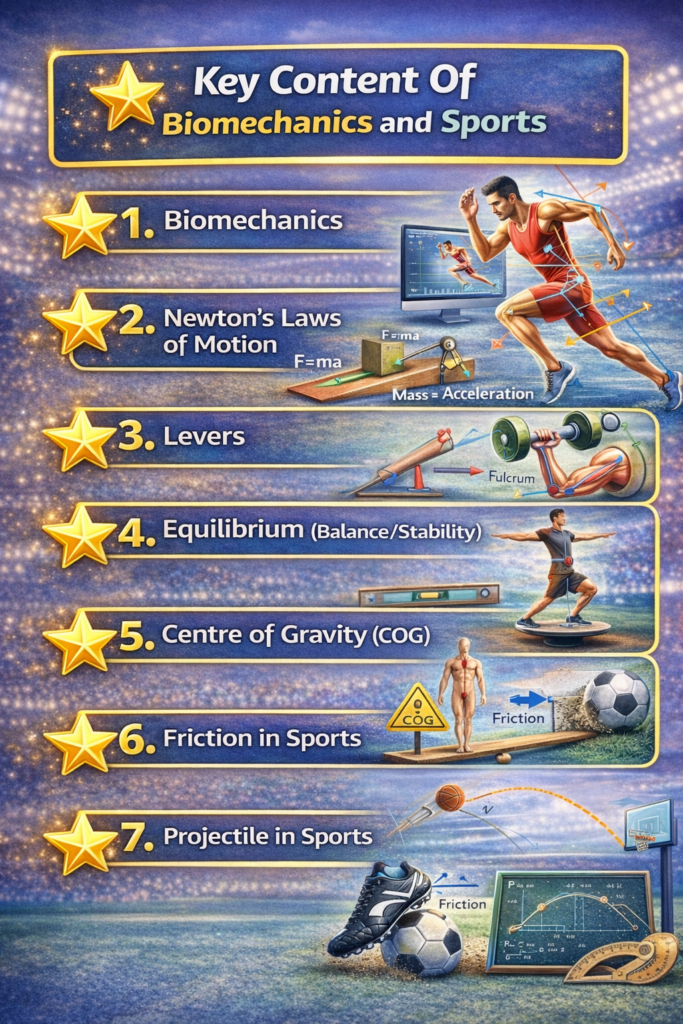
⭐ 1. Biomechanics
- Study of human body movement using mechanical principles.
- Explains how muscles, bones, joints work together.
- Helps in:
- Improving sports performance
- Preventing injuries
- Improving technique.
⭐ 2. Newton’s Laws of Motion
First Law (Law of Inertia)
- Body remains at rest or motion unless external force acts.
👉 Example: Football remains still until kicked.
Second Law (Law of Acceleration / Momentum)
- Force = Mass × Acceleration (F = ma).
- More force → more acceleration.
👉 Example: Shot put distance increases with force.
Third Law (Action–Reaction)
- Every action has equal opposite reaction.
👉 Example: Swimmer pushes water backward → moves forward.
⭐ 3. Levers
- Lever → rigid bar that moves around a fulcrum.
- Components:
- Fulcrum (joint)
- Effort (muscle force)
- Load (resistance)
✅ Types of Levers
- First class → Fulcrum in middle (neck movement).
- Second class → Load in middle (standing on toes).
- Third class → Effort in middle (biceps action) — most common.
⭐ 4. Equilibrium (Balance/Stability)
- State of balance of body.
✅ Types:
- Static equilibrium → balance at rest.
- Dynamic equilibrium → balance during movement.
✅ Factors affecting stability:
- Lower centre of gravity
- Larger base of support
- Greater body weight
- More friction
⭐ 5. Centre of Gravity (COG)
- Point where body weight is concentrated.
- Lower COG → more stability.
👉 Example: Wrestlers bend knees for balance.
Importance:
- Helps movement
- Helps balance
- Helps throwing & lifting
- Helps acceleration.
⭐ 6. Friction in Sports
- Force opposing motion between surfaces.
- Helps grip and control movement.
✅ Types of Friction
- Static friction
- Sliding friction
- Rolling friction
- Fluid friction
✅ Methods to reduce friction:
- Polishing
- Lubrication
- Streamlining
- Wheels/ball bearings
Advantages → better grip, movement control.
Disadvantages → injuries, wear & tear.
⭐ 7. Projectile in Sports
- Object moving under gravity after being thrown.
- Path → parabolic trajectory.
Examples:
- Basketball shot
- Javelin throw
- Long jump
✅ Factors affecting projectile:
- Gravity
- Air resistance
- Speed of release
- Angle of release
- Height of release
- Spin
Class 12 Physical Education Chapter 8: Biomechanics and Sports
CBSE Class 12 Physical Education – Unit 8
Biomechanics and Sports
Complete Class 12 Physical Education Unit 8 notes, syllabus,
book PDF aur official Telegram channel ka direct access yahan se milega.
Physical Education Chapter 8 Biomechanics and Sports MCQs
Q1. Newton’s First Law of Motion is known as:
A. Law of Inertia
B. Law of Reaction
C. Law of Effect
D. Law of Force
✅ Correct Answer: Law of Inertia
Q2. According to Newton’s Second Law, force equals:
A. Mass × Acceleration
B. Velocity × Time
C. Distance × Speed
D. Weight × Gravity
✅ Correct Answer: Mass × Acceleration
Q3. For every action there is equal and opposite reaction is:
A. Newton’s Third Law
B. Newton’s First Law
C. Newton’s Second Law
D. Law of Momentum
✅ Correct Answer: Newton’s Third Law
Q4. A lever is a:
A. Rigid bar rotating around a fulcrum
B. Muscle contraction
C. Joint movement
D. Force production
✅ Correct Answer: Rigid bar rotating around a fulcrum
Q5. Which lever is most common in the human body?
A. Third class lever
B. First class lever
C. Second class lever
D. No lever
✅ Correct Answer: Third class lever
Q6. State of balance of body is called:
A. Equilibrium
B. Motion
C. Friction
D. Velocity
✅ Correct Answer: Equilibrium
Q7. Balance during movement is called:
A. Dynamic equilibrium
B. Static equilibrium
C. Stability
D. Gravity
✅ Correct Answer: Dynamic equilibrium
Q8. Centre of gravity is the point where:
A. Body weight is concentrated
B. Energy is produced
C. Muscles contract
D. Blood flows
✅ Correct Answer: Body weight is concentrated
Q9. Force that opposes motion between two surfaces is:
A. Friction
B. Gravity
C. Speed
D. Momentum
✅ Correct Answer: Friction
Q10. Which friction occurs in air or water?
A. Fluid friction
B. Static friction
C. Rolling friction
D. Sliding friction
✅ Correct Answer: Fluid friction
Q11. A projectile follows which path?
A. Parabolic path
B. Circular path
C. Straight path
D. Zigzag path
✅ Correct Answer: Parabolic path
Q12. Which factor affects projectile motion?
A. Angle of release
B. Blood pressure
C. Digestion
D. Temperature
✅ Correct Answer: Angle of release
Q13. Roberto Carlos famous free kick curved due to:
A. Magnus effect
B. Gravity only
C. Friction only
D. Velocity
✅ Correct Answer: Magnus effect
Also Read:- Physical Education Notes | Class 12 – Chapter 7: Physiology & Injuries in Sport
FAQs About Biomechanics and Sports
Q1. What is biomechanics in sports?
Biomechanics is the study of movement of the human body and how muscles, bones and joints work together to produce motion. It helps improve sports performance and prevent injuries.
Q2. What are Newton’s Laws of Motion?
Newton’s Laws of Motion include the Law of Inertia (first law), Law of Acceleration or Momentum (second law), and Law of Action and Reaction (third law). These laws explain movement in sports activities.
Q3. What is Newton’s First Law and its application in sports?
Newton’s First Law states that an object remains at rest or in motion unless acted upon by external force. Example: a football remains still until kicked.
Q4. What is Newton’s Second Law and its application in sports?
Newton’s Second Law states that force equals mass × acceleration. Greater force produces greater acceleration. Example: stronger force in shot put increases distance.
Q5. What is Newton’s Third Law in sports?
Newton’s Third Law states that every action has equal and opposite reaction. Example: a swimmer pushes water backward to move forward.
Q6. What is a lever and its types?
A lever is a rigid bar that moves around a fulcrum. Types include first class lever, second class lever and third class lever used in human body movements.
Q7. What is equilibrium in sports?
Equilibrium is the state of balance or stability of the body. It helps athletes maintain posture and control during sports activities.
Q8. What are types of equilibrium?
There are two types of equilibrium: static equilibrium (balance at rest) and dynamic equilibrium (balance during movement).
Q9. What is centre of gravity?
Centre of gravity is the point where body weight is concentrated. Lower centre of gravity increases stability in sports like wrestling.
Q10. What is friction in sports?
Friction is a force that opposes motion between two surfaces. It helps athletes run, stop and maintain grip but excessive friction can cause injuries.
Q11. What are types of friction?
Types of friction include static friction, sliding friction, rolling friction and fluid friction.
Q12. What is projectile in sports?
A projectile is an object that moves under the influence of gravity after being thrown. Examples include javelin throw, basketball shot and long jump.
Q13. What factors affect projectile motion?
Factors affecting projectile motion include gravity, air resistance, speed of release, angle of release, height of release and spin.
Class 12 Physical Education Notes
Chapter I