Welcome, B.Sc Nursing students! In this post, you will find B.Sc Nursing 1st Semester Applied Anatomy and Applied Physiology Notes prepared according to the Indian Nursing Council (INC) Competency-Based Curriculum. Here, you’ll get unit-wise notes, important diagrams, exam-oriented questions, viva questions, NCLEX-style MCQs, previous year questions (PYQs), quick revision points, and study resources to help you prepare effectively for your university examinations. You will also find the latest nursing updates, educational resources, and study tips. Stay connected with Pulse by Anubhav, join our Telegram channel, and bookmark our website for the latest B.Sc Nursing notes and updates.
Pursuing a B.Sc Nursing degree is both rewarding and challenging. The course is designed to build a strong foundation in nursing science, anatomy, physiology, patient care, and clinical skills. During the 1st semester, one of the most important subjects is Applied Anatomy and Applied Physiology, as it helps students understand the normal structure and functions of the human body. This knowledge is essential for providing safe and effective nursing care throughout your academic and professional career.
📚 Complete B.Sc Nursing 1st Semester Applied Anatomy and Applied Physiology Notes (INC Curriculum)
Applied Anatomy and Applied Physiology form the backbone of nursing education. By studying this subject, students gain a clear understanding of body systems such as the respiratory, digestive, circulatory, endocrine, musculoskeletal, renal, reproductive, and nervous systems. A strong understanding of these topics enables nursing students to assess patients accurately, recognize abnormalities, assist in medical procedures, and deliver evidence-based patient care during clinical postings and hospital practice.
On this page, you will find complete unit-wise notes, important diagrams, exam-oriented questions, viva questions, NCLEX-style MCQs, quick revision points, and downloadable PDF notes based on the Indian Nursing Council (INC) Competency-Based Curriculum. If you prefer offline study, you can directly download the complete PDF using the link provided below. For the latest B.Sc Nursing notes, study materials, university updates, and exam preparation resources, join our Telegram channel and bookmark Pulse by Anubhav for regular updates.
Also Read- B.Pharm and D.Pharm Notes PDF (All Semester) – Complete Study Material & Syllabus
The Subjects in the 1st Semester of B.Sc Nursing are:
Core Subjects
- General Science
- Communicative English
- Applied Anatomy & Applied Physiology
- Applied Sociology & Psychology
- Nursing Foundations
Among these subjects, Applied Anatomy & Applied Physiology is one of the most important foundational subjects in the first semester. In this subject, you will learn the structure and functions of the human body, including all the major body systems such as the respiratory, digestive, circulatory, endocrine, musculoskeletal, sensory, renal, reproductive, and nervous systems. These concepts help nursing students understand normal body functions, recognize abnormalities, and provide safe, effective patient care during clinical practice.
A strong understanding of Applied Anatomy & Applied Physiology is essential for succeeding in future nursing subjects, clinical postings, practical examinations, and university exams. It also builds the foundation for developing accurate patient assessment skills, understanding disease processes, and delivering evidence-based nursing care.
B.Sc Nursing 1st Semester Applied Anatomy and Applied Physiology INC Syllabus
Before downloading the notes, please take a look at the Applied Anatomy and Applied Physiology syllabus to understand what topics are covered according to the Indian Nursing Council (INC) Competency-Based Curriculum.
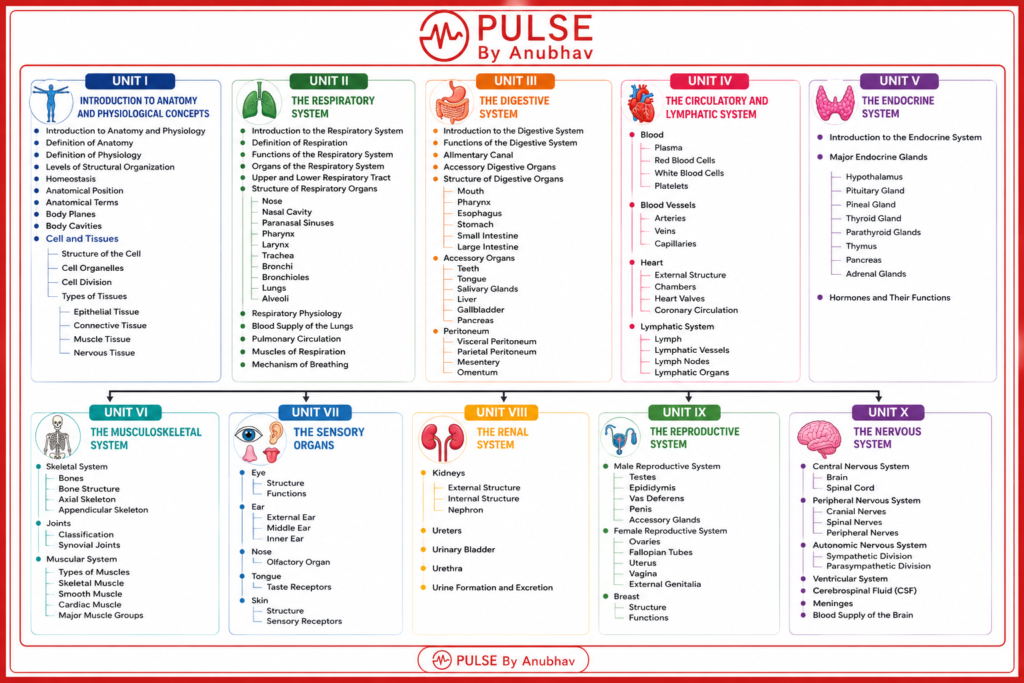
📘 Unit I — Introduction to Anatomy and Physiological Concepts
Introduction to Anatomy and Physiology
- Definition of Anatomy
- Definition of Physiology
- Levels of Structural Organization
- Homeostasis
- Anatomical Position
- Anatomical Terms
- Body Planes
- Body Cavities
Cell and Tissues
- Structure of the Cell
- Cell Organelles
- Cell Division
- Types of Tissues
- Epithelial Tissue
- Connective Tissue
- Muscle Tissue
- Nervous Tissue
🫁 Unit II — The Respiratory System
- Introduction to the Respiratory System
- Definition of Respiration
- Functions of the Respiratory System
- Organs of the Respiratory System
- Upper and Lower Respiratory Tract
Structure of Respiratory Organs
- Nose
- Nasal Cavity
- Paranasal Sinuses
- Pharynx
- Larynx
- Trachea
- Bronchi
- Bronchioles
- Lungs
- Alveoli
Respiratory Physiology
- Blood Supply of the Lungs
- Pulmonary Circulation
- Muscles of Respiration
- Mechanism of Breathing
🍽️ Unit III — The Digestive System
- Introduction to the Digestive System
- Functions of the Digestive System
- Alimentary Canal
- Accessory Digestive Organs
Structure of Digestive Organs
- Mouth
- Pharynx
- Esophagus
- Stomach
- Small Intestine
- Large Intestine
Accessory Organs
- Teeth
- Tongue
- Salivary Glands
- Liver
- Gallbladder
- Pancreas
Peritoneum
- Visceral Peritoneum
- Parietal Peritoneum
- Mesentery
- Omentum
❤️ Unit IV — The Circulatory and Lymphatic System
Blood
- Plasma
- Red Blood Cells
- White Blood Cells
- Platelets
Blood Vessels
- Arteries
- Veins
- Capillaries
Heart
- External Structure
- Chambers
- Heart Valves
- Coronary Circulation
Lymphatic System
- Lymph
- Lymphatic Vessels
- Lymph Nodes
- Lymphatic Organs
🧪 Unit V — The Endocrine System
- Introduction to the Endocrine System
- Major Endocrine Glands
- Hypothalamus
- Pituitary Gland
- Pineal Gland
- Thyroid Gland
- Parathyroid Glands
- Thymus
- Pancreas
- Adrenal Glands
- Hormones and Their Functions
🦴 Unit VI — The Musculoskeletal System
Skeletal System
- Bones
- Bone Structure
- Axial Skeleton
- Appendicular Skeleton
Joints
- Classification
- Synovial Joints
Muscular System
- Types of Muscles
- Skeletal Muscle
- Smooth Muscle
- Cardiac Muscle
- Major Muscle Groups
👁️ Unit VII — The Sensory Organs
- Eye
- Structure
- Functions
- Ear
- External Ear
- Middle Ear
- Inner Ear
- Nose
- Olfactory Organ
- Tongue
- Taste Receptors
- Skin
- Structure
- Sensory Receptors
💧 Unit VIII — The Renal System
- Kidneys
- External Structure
- Internal Structure
- Nephron
- Ureters
- Urinary Bladder
- Urethra
- Urine Formation and Excretion
👶 Unit IX — The Reproductive System
Male Reproductive System
- Testes
- Epididymis
- Vas Deferens
- Penis
- Accessory Glands
Female Reproductive System
- Ovaries
- Fallopian Tubes
- Uterus
- Vagina
- External Genitalia
Breast
- Structure
- Functions
🧠 Unit X — The Nervous System
Central Nervous System
- Brain
- Spinal Cord
Peripheral Nervous System
- Cranial Nerves
- Spinal Nerves
- Peripheral Nerves
Autonomic Nervous System
- Sympathetic Division
- Parasympathetic Division
Ventricular System
- Cerebrospinal Fluid (CSF)
- Meninges
- Blood Supply of the Brain
Also read- Pamala Serena Biography: Age, Height, Net Worth, Boyfriend, Lock Upp 2 & UN Ambassador of Peace
B.Sc Nursing 1st Semester Applied Anatomy and Applied Physiology Notes PDF
🩺 Download B.Sc Nursing 1st Semester – Applied Anatomy & Applied Physiology Notes (INC Curriculum | Unit-wise PDF)
⚡ These B.Sc Nursing Applied Anatomy & Applied Physiology Notes are prepared according to the Indian Nursing Council (INC) Competency-Based Curriculum. The notes are written in a simple, exam-oriented format to help students prepare for university exams, practicals, viva, and clinical postings.
🚀 Join Pulse Nursing Notes Telegram Channel 📘 Download Complete Applied Anatomy & Applied Physiology Notes (PDF) 📚 View Complete INC SyllabusMaster Applied Anatomy & Physiology with Confidence
Applied Anatomy & Applied Physiology is one of the most important foundation subjects in the first semester of B.Sc Nursing. A clear understanding of this subject helps you build strong concepts for clinical practice, patient assessment, medical-surgical nursing, pharmacology, pathology, and many advanced nursing subjects.
These notes are prepared according to the Indian Nursing Council (INC) Competency-Based Curriculum and are designed using a simple, exam-oriented approach. Every unit includes easy explanations, important concepts, diagrams, nursing applications, clinical correlations, viva questions, university questions, NCLEX-style MCQs, and quick revision points to make your preparation faster and more effective.
❓ Frequently Asked Questions (FAQs)
Here are the most commonly asked questions about B.Sc Nursing 1st Semester Applied Anatomy and Applied Physiology Notes.
What are Applied Anatomy and Applied Physiology in B.Sc Nursing?
Applied Anatomy and Applied Physiology is a core first-semester subject that explains the structure and functions of the human body. It forms the foundation for clinical nursing practice and patient care.
Are these notes based on the Indian Nursing Council (INC) syllabus?
Yes. These notes are prepared according to the latest Indian Nursing Council (INC) Competency-Based Curriculum for B.Sc Nursing students.
Do these notes include all 10 units?
Yes. These notes cover all major units including Anatomy, Respiratory System, Digestive System, Circulatory System, Endocrine System, Musculoskeletal System, Sensory Organs, Renal System, Reproductive System, and Nervous System.
Can I download the complete PDF notes?
Yes. The complete unit-wise PDF notes are available through our official Pulse Nursing Notes Telegram channel.
Are these notes enough for university exams?
These notes are exam-oriented and include diagrams, nursing applications, clinical correlations, viva questions, MCQs, and quick revision points. Students should also refer to their prescribed textbooks for comprehensive preparation.
Are these notes useful for practicals and viva?
Yes. They include nursing applications, clinical significance, diagrams, and viva-focused concepts to help students prepare for practical examinations.
Is this subject important for future nursing studies?
Absolutely. A strong understanding of anatomy and physiology is essential for subjects like Medical-Surgical Nursing, Pharmacology, Pathology, Obstetrics, Community Health Nursing, and critical patient care.
I’m not that much of a online reader to be honest but your sites really nice, keep it up! I’ll go ahead and bookmark your website to come back down the road. Many thanks