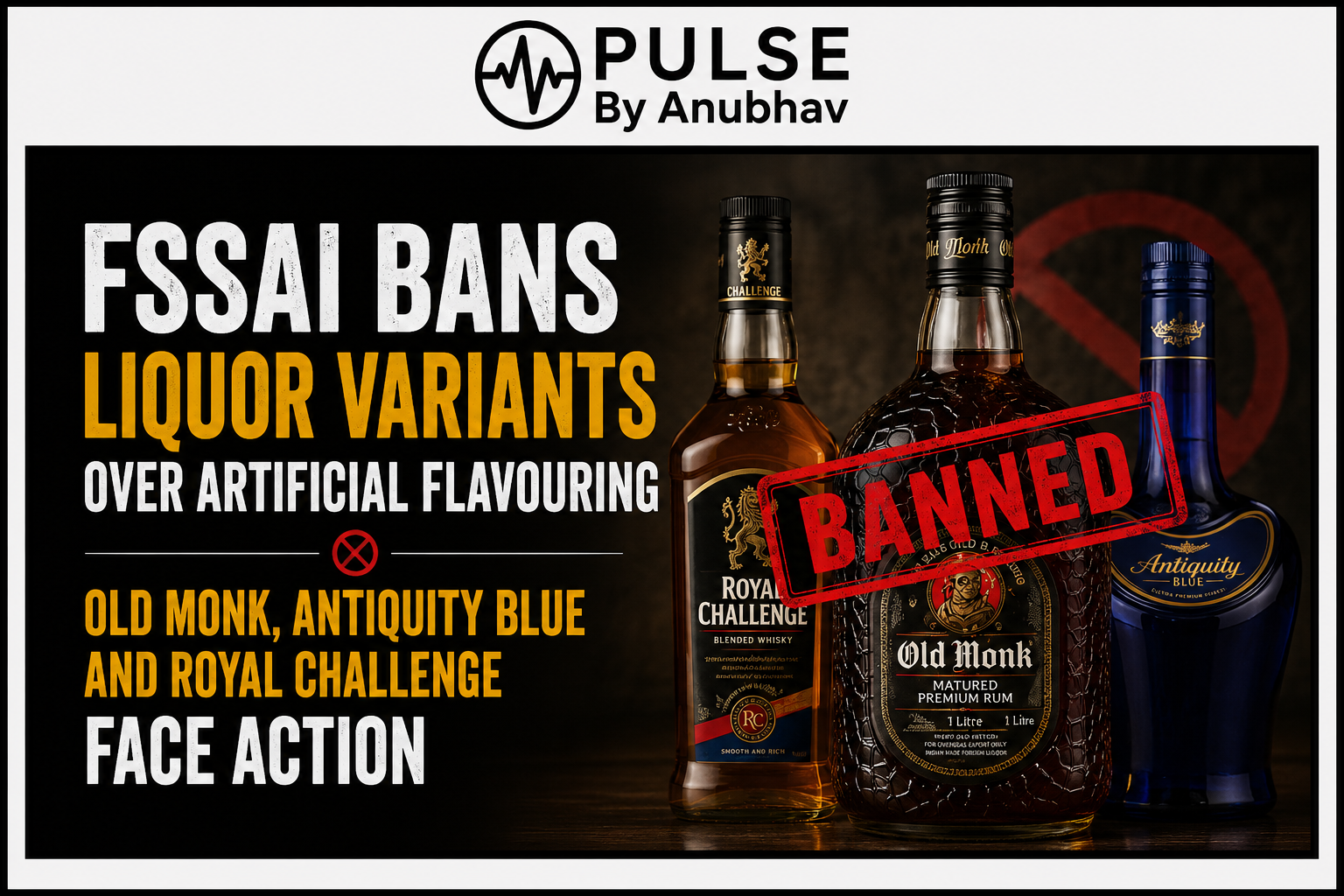
FSSAI bans liquor variants including Old Monk, Antiquity Blue and Royal Challenge over artificial flavouring and misleading labelling concerns.
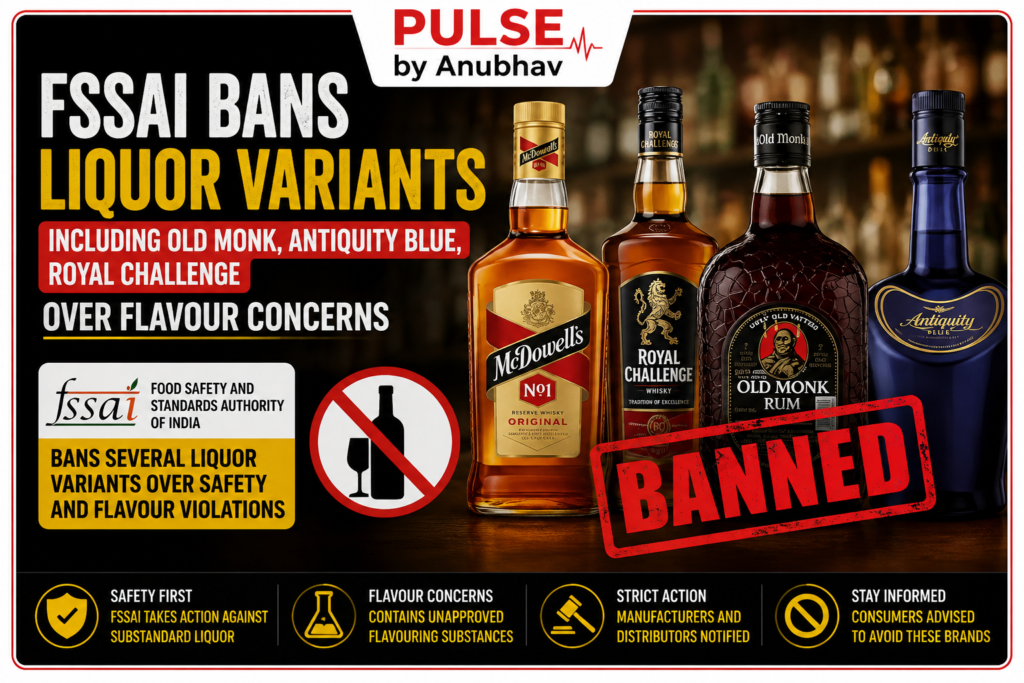
FSSAI has taken enforcement action against select liquor variants, including Old Monk, Antiquity Blue, Royal Challenge, McDowell’s No. 1 and Bagpiper, after laboratory tests reportedly detected external artificial or nature-identical flavouring. Three Old Monk variants—The Legend, Gold Reserve and XXX Matured Rum—are among the affected products. FSSAI also raised concerns over misleading age claims and said standard rum and whisky should derive their character from recognised ingredients and manufacturing processes.
FSSAI Bans Liquor Variants Over Artificial Flavouring: Old Monk, Antiquity Blue and Royal Challenge Face Action
The Food Safety and Standards Authority of India (FSSAI) has initiated enforcement action against several popular liquor products after laboratory testing reportedly detected the use of external artificial or nature-identical flavouring substances. The action has brought well-known names such as Old Monk, Antiquity Blue, Royal Challenge, McDowell’s No. 1 and Bagpiper under the spotlight.
However, consumers should note an important distinction: the regulatory action concerns select products manufactured at identified facilities, rather than automatically meaning that every variant of these brands has been banned everywhere.
According to the regulator, standardised alcoholic beverages such as rum and whisky are expected to develop their characteristic taste and aroma through recognised production processes, including the use of appropriate raw materials, fermentation, distillation and maturation. FSSAI’s concern is that some tested products allegedly used added flavouring to imitate characteristics that should normally develop through these processes.
Which Old Monk Variants Face FSSAI Action?
Three Old Monk products manufactured by Mohan Rocky Springwater’s Khopoli unit in Maharashtra are among those affected by the enforcement action:
- Old Monk The Legend
- Old Monk Gold Reserve
- Old Monk XXX Matured Rum
The issue is not simply about adding flavours such as coffee or vanilla to an alcoholic beverage. Natural flavouring substances can be permitted under applicable regulations in certain circumstances.
FSSAI’s objection concerns the alleged addition of flavours designed to mimic the inherent character of the spirit itself—for example, adding “rum flavour” to a product marketed as rum or “whisky flavour” to whisky.
The regulator’s position is that such a method could potentially substitute characteristics that should otherwise come from ingredients and recognised manufacturing or maturation processes.
Antiquity Blue and Royal Challenge Whisky Also Affected
The action extends beyond Old Monk.
Antiquity Blue Whisky and Royal Challenge Whisky, manufactured by United Spirits at a facility in Madhya Pradesh, are also among the products identified in the regulatory action.
United Spirits’ McDowell’s No. 1 Rum, manufactured at its Baramati facility, has also been named.
Other affected products include:
- Bagpiper Deluxe Whisky – INBREW Beverages, Madhya Pradesh
- Old Cask Deluxe XXX Rum – INBREW Beverages, Madhya Pradesh
- Central Province Whisky – Associated Alcohol & Breweries, Madhya Pradesh
- McDowell’s No. 1 Celebration Matured XXX Rum – Associated Alcohol & Breweries, Madhya Pradesh
This makes the FSSAI bans liquor development wider than the headlines surrounding Old Monk alone, with products linked to multiple manufacturers and facilities coming under scrutiny.
Why Did FSSAI Take Action Against These Liquor Products?
The central issue is how a standard rum or whisky gets its distinctive flavour and aroma.
Traditionally, those characteristics are developed through ingredients and manufacturing processes. Rum, for instance, derives its character from materials such as molasses and subsequent production processes, while whisky develops its profile through grain or malt, distillation and maturation.
FSSAI said testing of samples from multiple manufacturers found external artificial or nature-identical flavours in certain products.
According to the regulator, adding a flavour that imitates the alcoholic beverage’s own expected character can potentially mask the actual composition of the drink.
In simple terms, selling a spirit with externally created “rum-like” flavour as standard rum could give consumers a different impression about how that flavour was produced.
Laboratory findings cited by authorities reportedly classified the tested products as substandard because of these external flavouring substances.
Why Is ‘Rum Flavour in Rum’ a Problem?
This is where the FSSAI’s argument becomes particularly interesting.
Adding an additional flavour to create a clearly flavoured alcoholic drink is different from using “rum flavour” to make a product taste like the standard rum category under which it is being sold.
FSSAI has said there is no internationally recognised manufacturing practice in which rum flavour is added to rum or whisky flavour is added to whisky as a substitute for their inherent characteristics.
According to the regulator, allowing such practices could potentially enable manufacturers to reduce reliance on natural raw materials or maturation while still producing a familiar taste and aroma.
Old Monk’s ‘7 Years’ Age Claim Also Comes Under Scanner
FSSAI has also raised a separate labelling issue involving an Old Monk XXX Rum variant.
Authorities flagged a “7 Years Old Blended” claim after an investigation reportedly found that the major component of the product was neutral, unmatured spirit, while matured rum spirit represented less than 5% of the blend.
Under the Food Safety and Standards (Alcoholic Beverages) Regulations, age-related declarations for blended alcoholic beverages must correspond to the youngest spirit present in the blend.
Therefore, according to the regulator, presenting such a product with a seven-year age claim could give consumers a misleading impression about the age and composition of the complete blend.
This means the Old Monk case involves two separate regulatory concerns: added flavouring and product labelling.
Should These Products Be Called Flavoured Spirits Instead?
According to the government’s explanation, a product that relies on externally added flavouring to mimic the character of rum or whisky may need to be identified appropriately rather than being presented simply as a standard spirit.
Depending on its composition, terminology such as “Rum-Flavoured Spirit” or “Whisky-Flavoured Spirit” may more accurately communicate the nature of the product.
The regulator has also stressed the importance of clear front-of-pack information so consumers understand what they are purchasing.
This is important because the controversy is not simply about whether flavouring exists in alcohol. The bigger regulatory question is whether the name, composition and labelling of the product accurately represent what is inside the bottle.
Also Read- Pradeep Rawat Dies at 74 After Cancer Battle; ‘Ghajini’ and ‘Lagaan’ Actor Passes Away
Is Every Old Monk, Antiquity Blue or Royal Challenge Bottle Banned?
No such broad conclusion should be drawn from the available information.
The action identifies specific products and manufacturing facilities. It has not been clearly established that every bottle sold under the affected brand names, regardless of where it was manufactured, is covered by the restriction.
That distinction is especially important for brands that may be manufactured or bottled at multiple facilities.
Therefore, describing the development simply as “FSSAI bans Old Monk” can be misleading without explaining that specific variants and manufacturing units have been identified in the enforcement action.
FSSAI Scrutiny Expands to More Manufacturers
The regulatory drive may not end with the currently named products.
Authorities have also conducted inspections and collected samples from Mandexi Distilleries & Breweries in Goa.
Notices have reportedly been issued to another six manufacturers in Maharashtra, and additional regulatory measures could follow depending on investigation and laboratory findings.
This suggests that FSSAI is examining the broader industry’s manufacturing and labelling practices rather than focusing exclusively on one liquor company.
Diageo India Challenges Related FSSAI Action
The regulatory action has also resulted in a legal dispute.
Diageo India has challenged a related FSSAI order before the Bombay High Court. The company has disputed the regulator’s interpretation and maintained that its labelling and manufacturing practices comply with applicable requirements and established industry practices.
This legal challenge is significant because it could help clarify how India’s alcoholic beverage regulations apply to flavouring substances, product classification and labelling.
Until the legal and regulatory proceedings develop further, the regulator’s findings and the manufacturers’ positions should be treated separately.
What Does the FSSAI Liquor Action Mean for Consumers?
For consumers, the biggest takeaway is transparency.
When someone purchases a matured rum or whisky, the product name, age declaration and description can influence expectations about its ingredients, production process and quality.
FSSAI’s enforcement action indicates that regulators want those characteristics to be represented accurately, particularly where external flavouring is involved.
It does not necessarily mean that the affected products are unsafe to consume merely because they have been classified as substandard. In food regulation, “substandard” can relate to a product failing to meet prescribed composition, manufacturing or labelling standards.
Consumers should therefore avoid interpreting the action as proof of a health hazard unless authorities specifically issue such a warning.
Also Read-Jharkhand Student Protest Over JPSC, JSSC Exam Row Intensifies; CJP Extends Support
Popular Liquor Brands, Variants & Price Guide
A quick look at popular variants sold under major liquor brands mentioned in the FSSAI enforcement action.
| Variant | Common Size | Indicative Price | Category |
|---|---|---|---|
| Old Monk XXX Matured Rum FSSAI Action* | 750 ml | ₹500–₹900 | Dark Rum |
| Old Monk Gold Reserve FSSAI Action* | 750 ml | ₹700–₹1,200 | Premium Rum |
| Old Monk The Legend FSSAI Action* | 750 ml | ₹1,000–₹1,800+ | Premium Dark Rum |
Old Monk is one of India’s best-known dark rum labels. The FSSAI action discussed in this report concerns specified variants linked to the identified manufacturing unit and alleged flavouring and labelling issues.
| Variant | Common Size | Indicative Price | Category |
|---|---|---|---|
| Royal Challenge Whisky FSSAI Action* | 750 ml | ₹700–₹1,200 | Indian Whisky |
Royal Challenge is an established Indian whisky label. The regulatory development concerns a product manufactured at an identified United Spirits facility in Madhya Pradesh.
| Variant | Common Size | Indicative Price | Category |
|---|---|---|---|
| Antiquity Blue Whisky FSSAI Action* | 750 ml | ₹900–₹1,600 | Premium Indian Whisky |
Antiquity Blue is positioned in the premium segment of the Indian whisky market. It is among the United Spirits products named in the recent FSSAI enforcement action.
| Variant | Common Size | Indicative Price | Category |
|---|---|---|---|
| McDowell’s No. 1 Rum FSSAI Action* | 750 ml | ₹450–₹850 | Rum |
| McDowell’s No. 1 Celebration Matured XXX Rum FSSAI Action* | 750 ml | ₹450–₹900 | Dark Rum |
Specific McDowell’s rum products manufactured at facilities identified by authorities have been included in the enforcement action. This should not automatically be interpreted as a ban on every McDowell’s product.
| Variant | Common Size | Indicative Price | Category |
|---|---|---|---|
| Bagpiper Deluxe Whisky FSSAI Action* | 750 ml | ₹500–₹900 | Indian Whisky |
Bagpiper is a long-running Indian whisky label. The product named in the FSSAI action is Bagpiper Deluxe Whisky manufactured by INBREW Beverages in Madhya Pradesh.
| Variant | Common Size | Indicative Price | Category |
|---|---|---|---|
| Old Cask Deluxe XXX Rum FSSAI Action* | 750 ml | ₹400–₹800 | XXX Rum |
Old Cask Deluxe XXX Rum manufactured by INBREW Beverages in Madhya Pradesh is another product identified in the regulatory action.
| Variant | Common Size | Indicative Price | Category |
|---|---|---|---|
| Central Province Whisky FSSAI Action* | 750 ml | Varies by state | Indian Whisky |
Central Province Whisky is among the products linked to Associated Alcohol & Breweries in Madhya Pradesh that have been named in the enforcement action.
FSSAI Bans Liquor Variants: What Happens Next?
The controversy involving Old Monk, Antiquity Blue, Royal Challenge, McDowell’s, Bagpiper and other liquor products could become an important test of how India’s alcohol industry handles flavouring, maturation claims and product labelling.
FSSAI maintains that the characteristic aroma and taste of standard rum and whisky should result from recognised ingredients and manufacturing processes rather than external flavours designed to imitate those characteristics.
Manufacturers, meanwhile, may challenge how existing regulations are being interpreted and applied.
With inspections continuing and additional manufacturers receiving notices, further action cannot be ruled out.
For readers following the FSSAI bans liquor story, Pulse by Anubhav will keep tracking regulatory updates, affected products and any clarification on whether restrictions remain limited to specific manufacturing facilities or expand further.
Also Read-Bhai Tera Star Hai Box Office Day 3: Raghav Juyal Film Struggles to Gain Momentum
FAQs About FSSAI Bans Liquor
FSSAI Liquor Ban: Frequently Asked Questions
Quick answers about Old Monk, Antiquity Blue, Royal Challenge and other liquor variants facing FSSAI action.
What liquor brands has FSSAI taken action against?
The FSSAI action covers select products linked to brands including Old Monk, Antiquity Blue, Royal Challenge, McDowell’s No. 1, Bagpiper, Old Cask and Central Province. The action relates to specified products and manufacturing facilities rather than automatically applying to every product sold under these brand names.
Which Old Monk variants are affected by FSSAI action?
Old Monk The Legend, Old Monk Gold Reserve and Old Monk XXX Matured Rum manufactured by Mohan Rocky Springwater’s Khopoli unit in Maharashtra are among the products named in the enforcement action.
Why did FSSAI take action against Old Monk variants?
FSSAI raised concerns over external artificial or nature-identical flavouring allegedly being used to mimic the characteristic taste and aroma of standard rum. The regulator also raised a separate concern over an age-related claim on an Old Monk XXX Rum variant.
Are Antiquity Blue and Royal Challenge banned?
Antiquity Blue Whisky and Royal Challenge Whisky manufactured at an identified United Spirits facility in Madhya Pradesh are among the products covered by the regulatory action. This should not automatically be interpreted as a blanket nationwide ban on every bottle sold under these brand names.
Why is artificial flavouring a concern in rum and whisky?
According to FSSAI, standard rum and whisky should develop their characteristic aroma and taste through recognised ingredients and manufacturing processes. The regulator objects to external flavours being used to imitate the inherent character of the spirit while the product is marketed as standard rum or whisky.
What was the issue with Old Monk’s 7-year claim?
Authorities said an Old Monk XXX Rum variant carrying a seven-year blended claim contained predominantly neutral, unmatured spirit, while matured rum spirit accounted for only a small portion of the blend. FSSAI regulations require an age declaration to reflect the youngest spirit present in a blend.
Does substandard liquor mean it is unsafe to drink?
Not necessarily. A “substandard” classification can mean that a product does not meet prescribed composition, manufacturing or labelling standards. It should not automatically be interpreted as a finding that the product poses a health hazard unless authorities specifically issue such a warning.
Is FSSAI investigating more liquor manufacturers?
Authorities have carried out additional inspections and sampling, including at a facility in Goa, while notices have also reportedly been issued to other manufacturers in Maharashtra. Further action may depend on laboratory findings and ongoing investigations.
3 thoughts on “FSSAI Bans Liquor Variants Including Old Monk, Antiquity Blue, Royal Challenge Over Flavour Concerns”