You will get here Chemistry Class 12 CBSE Notes and MCQs Chapter 4: The d – and f – Block Elements . You can connect with us for every important update related to class 12.
Chemistry is a very important subject for your board exam because it will help you increase your percentage and give big support in your entrance exam like JEE and NEET. You can score high marks in this subject by studying notes and practicing MCQs. In this post, we will cover Chapter 4: The d – and f – Block Elements .
Key Content Of Chapter 4 The d – and f – Block Elements
🔷 1. General Introduction 🔷 2. Electronic Configuration 🔷 3. Occurrence of Transition Metals 🔷 4. Characteristics of Transition Metals 🔷 5. Preparation & Properties
Class 12 Chemistry Chapter 4: The d – and f – Block Elements Notes
CBSE Class 12 Chemistry – Unit 4
The d- and f-Block Elements (Transition Metals, K₂Cr₂O₇, KMnO₄)
Complete Class 12 Chemistry Unit 4 (d- and f-Block Elements) notes, syllabus,
NCERT book PDF aur official Telegram channel ka direct access yahan se milega.
Is unit me transition elements ka introduction, electronic configuration,
metallic character, ionisation enthalpy, oxidation states, colour,
magnetic properties, catalytic behaviour, interstitial compounds,
alloy formation aur K₂Cr₂O₇ & KMnO₄ ki preparation aur properties cover hai.
Chemistry Chapter 4 The d – and f – Block Elements MCQs
Q1. Transition elements are characterized by:
A. Partially filled d-orbitals
B. Completely filled s-orbitals
C. Filled p-orbitals
D. No valence electrons
✅ Correct Answer: Partially filled d-orbitals
Q2. General electronic configuration of d-block elements is:
A. (n-1)d¹–¹⁰ ns¹–²
B. ns² np⁶
C. (n-2)f¹–¹⁴
D. ns² only
✅ Correct Answer: (n-1)d¹–¹⁰ ns¹–²
Q3. Variable oxidation states of transition metals are due to:
A. Participation of ns and (n−1)d electrons
B. Large atomic size
C. Presence of neutrons
D. High electronegativity
✅ Correct Answer: Participation of ns and (n−1)d electrons
Q4. Colour of transition metal compounds is due to:
A. d–d electronic transitions
B. Nuclear reactions
C. Ionisation of s-electrons
D. Atomic mass
✅ Correct Answer: d–d electronic transitions
Q5. Magnetic properties of transition metals depend on:
A. Number of unpaired electrons
B. Number of protons
C. Density
D. Atomic size
✅ Correct Answer: Number of unpaired electrons
Q6. Which of the following is NOT a transition element?
A. Fe
B. Cu
C. Zn
D. Cr
✅ Correct Answer: Zn
Q7. Interstitial compounds are formed when:
A. Small atoms occupy spaces in metal lattice
B. Metals dissolve in water
C. Two metals react with oxygen
D. Metal forms ionic bond
✅ Correct Answer: Small atoms occupy spaces in metal lattice
Q8. Colour of potassium permanganate (KMnO₄) is:
A. Orange
B. Purple
C. Green
D. Blue
✅ Correct Answer: Purple
Q9. Potassium dichromate (K₂Cr₂O₇) is:
A. Strong oxidising agent
B. Reducing agent
C. Neutral salt
D. Catalyst only
✅ Correct Answer: Strong oxidising agent
Q10. Transition metals show catalytic activity mainly due to:
A. Variable oxidation states
B. Low density
C. Small atomic number
D. Absence of electrons
✅ Correct Answer: Variable oxidation states
Chemistry Chapter 4 The d – and f – Block Elements Quick Revision
🔷 1. General Introduction
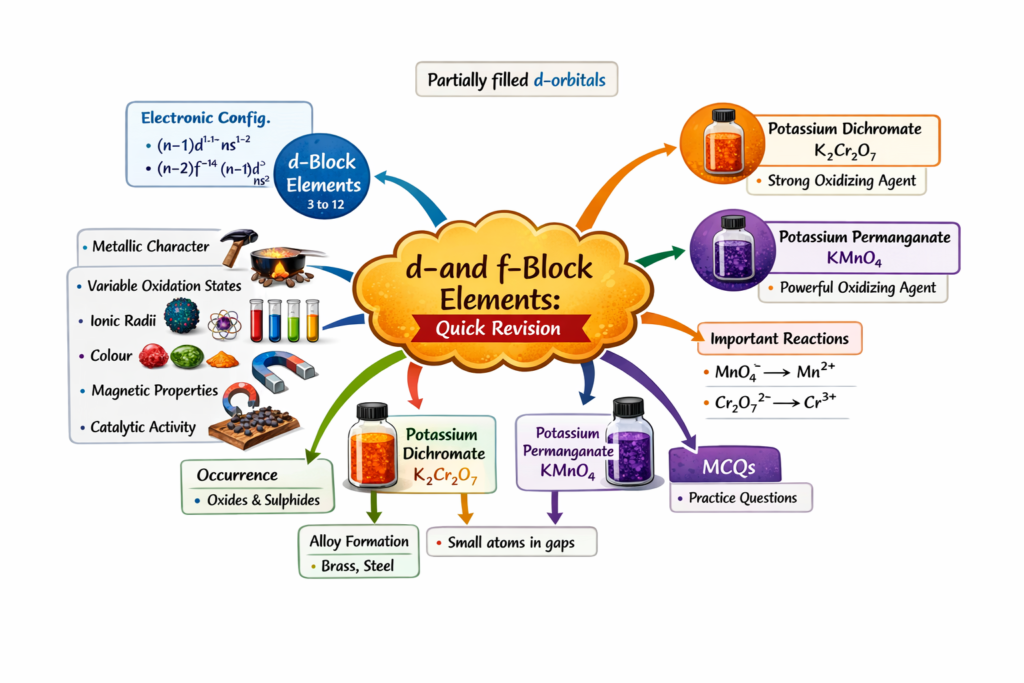
🔹 Basic Idea (Concept) d-block aur f-block elements periodic table ke transition elements hote hain jo s-block aur p-block ke beech transition show karte hain.
🔹 Transition Elements Jin elements ke d-orbitals partially filled hote hain (ground state ya oxidation state me).
🔹 d-Block Elements Group 3 se 12 tak ke elements.
🔹 f-Block Elements Lanthanides aur Actinides — inner transition elements kehlate hain.
🔷 2. Electronic Configuration
🔹 d-Block Configuration (n–1)d¹–¹⁰ ns¹–² general configuration hoti hai.
Transition elements are elements that have partially filled d-orbitals in their ground state or in any oxidation state. They are located in the d-block of the periodic table (Groups 3–12).
Why do transition elements show variable oxidation states?
Transition elements show variable oxidation states because both ns and (n−1)d electrons participate in bonding. Since energy difference between these orbitals is small, different numbers of electrons can be lost.
Why are transition metal compounds coloured?
Transition metal compounds are coloured due to d–d electronic transitions. When electrons absorb visible light and move between d-orbitals, complementary colour is observed.
What is lanthanoid contraction?
Lanthanoid contraction is the gradual decrease in atomic and ionic size across the lanthanoid series due to poor shielding of 4f electrons.
Why is Zn not considered a transition element?
Zinc has completely filled d-orbitals (3d¹⁰ configuration) in both ground state and common oxidation state (+2), so it does not have partially filled d-orbitals.
What is the colour of KMnO₄ and why?
KMnO₄ is purple in colour due to electronic transitions in the permanganate ion (MnO₄⁻).
Why do transition metals act as catalysts?
Transition metals act as catalysts due to their variable oxidation states and ability to form intermediate complexes with reactants.
What are interstitial compounds?
Interstitial compounds are formed when small atoms like hydrogen, carbon or nitrogen occupy spaces in the metal lattice. They are hard and have high melting points.
1 thought on “CBSE Class 12 Chemistry Chapter 4: The d – and f – Block Elements – Notes + MCQs | Quick Revision”