You will get here Chemistry Class 12 CBSE Notes and MCQs Chapter 6: Haloalkanes and Haloarenes . You can connect with us for every important update related to class 12.
Chemistry is a very important subject for your board exam because it will help you increase your percentage and give big support in your entrance exam like JEE and NEET. You can score high marks in this subject by studying notes and practicing MCQs. In this post, we will cover Chapter 6: Haloalkanes and Haloarenes .
Complete Class 12 Chemistry Unit 6 (Haloalkanes & Haloarenes) notes, syllabus,
NCERT book PDF aur official Telegram channel ka direct access yahan se milega.
Isme nomenclature, nature of C–X bond, SN1 & SN2 reactions, haloarenes substitution,
stereochemistry, aur important compounds jaise DDT, Freons, Chloroform aur Carbon
Tetrachloride ke uses aur environmental effects cover hain.
Chemistry Chapter 6 Haloalkanes and Haloarenes MCQs
Q1. Haloalkanes are compounds in which halogen is attached to:
A. Alkyl group
B. Aromatic ring only
C. Nitrogen atom
D. Oxygen atom
✅ Correct Answer: Alkyl group
Q2. Carbon–halogen bond in haloalkanes is:
A. Polar
B. Non-polar
C. Ionic
D. Metallic
✅ Correct Answer: Polar
Q3. Which bond is strongest among the following?
A. C–F
B. C–Cl
C. C–Br
D. C–I
✅ Correct Answer: C–F
Q4. SN1 reaction proceeds through formation of:
A. Carbocation intermediate
B. Free radical
C. Carbanion
D. Complex ion
✅ Correct Answer: Carbocation intermediate
Q5. SN2 reaction is characterised by:
A. Inversion of configuration
B. Racemisation
C. Carbocation formation
D. Rearrangement
✅ Correct Answer: Inversion of configuration
Q6. Haloarenes are less reactive towards nucleophilic substitution due to:
A. Resonance stabilization of C–X bond
B. Low boiling point
C. High solubility
D. Ionic bond formation
✅ Correct Answer: Resonance stabilization of C–X bond
Q7. Halogen in haloarenes is:
A. Ortho-para directing but deactivating
B. Meta directing
C. Activating group
D. Neutral group
✅ Correct Answer: Ortho-para directing but deactivating
Q8. Freons cause:
A. Ozone layer depletion
B. Water pollution only
C. Soil erosion
D. Acid rain
✅ Correct Answer: Ozone layer depletion
Q9. DDT is mainly used as:
A. Insecticide
B. Fertilizer
C. Antiseptic
D. Refrigerant
✅ Correct Answer: Insecticide
Q10. Optical activity is shown by compounds having:
A. Chirality
B. Symmetry
C. Double bond
D. Ionic bond
✅ Correct Answer: Chirality
Chemistry Chapter 6 Haloalkanes and Haloarenes Quick Revision
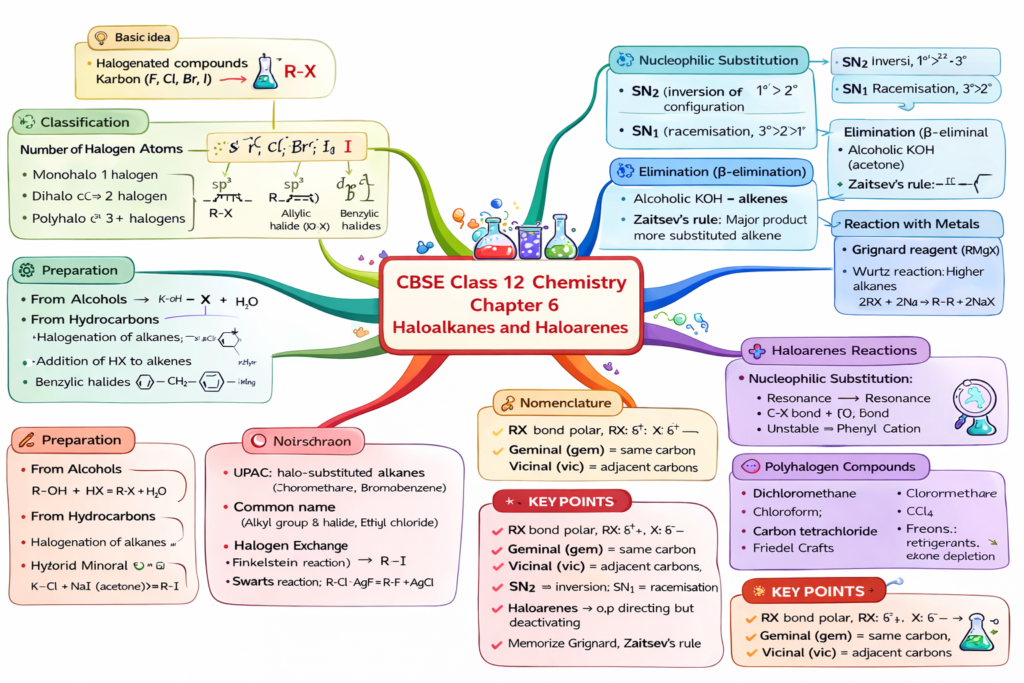
🔹 Haloalkanes & Haloarenes (Basic Idea) Haloalkanes aur haloarenes organic compounds hote hain jisme halogen atoms (F, Cl, Br, I) carbon se bonded hote hain. Ye industry, medicine aur environment me important role play karte hain.
🔹 Classification of Halogen Compounds Halogen compounds ko number of halogen atoms ke basis par mono-, di-, ya polyhalogen compounds me classify kiya jata hai. Structure ke basis par haloalkanes aur haloarenes me divide hote hain.
🔹 Nomenclature IUPAC system me halogen ko prefix (fluoro-, chloro-, bromo-, iodo-) ke roop me use karke compound ka naam rakha jata hai.
🔹 Nature of C–X Bond Halogen carbon se zyada electronegative hota hai isliye C–X bond polar hoti hai. Carbon par partial positive aur halogen par partial negative charge hota hai.
🔹 Preparation of Haloalkanes Haloalkanes alcohols, alkanes ya alkenes se prepare kiye jate hain jaise free radical halogenation, addition reactions aur substitution reactions se.
🔹 Preparation of Haloarenes Haloarenes electrophilic substitution reactions se bante hain jaise benzene par halogenation Lewis acid catalyst ki presence me.
🔹 Physical Properties Haloalkanes ka boiling point molecular mass badhne par badhta hai. Ye water me slightly soluble aur organic solvents me soluble hote hain.
🔹 Chemical Reactions of Haloalkanes Haloalkanes mainly nucleophilic substitution (SN1, SN2), elimination aur reaction with metals show karte hain.
🔹 Haloarenes Reactions Haloarenes nucleophilic substitution me less reactive hote hain lekin electrophilic substitution reactions me ortho-para directing effect show karte hain.
🔹 Stereochemistry Concepts Chirality, optical activity, inversion of configuration aur racemisation jaise concepts substitution reactions ko explain karte hain.
🔹 Important Polyhalogen Compounds Dichloromethane, chloroform, carbon tetrachloride, freons aur DDT important polyhalogen compounds hain jo industrial use aur environmental effects dono rakhte hain.
Haloalkanes organic compounds hote hain jisme halogen atom (F, Cl, Br, I) alkyl group se bonded hota hai.
What are haloarenes? +
Haloarenes me halogen atom directly aromatic ring ke carbon se bonded hota hai, jaise chlorobenzene.
Why is C–X bond polar? +
Halogen carbon se zyada electronegative hota hai, isliye bond polar ho jati hai jisme carbon par partial positive aur halogen par partial negative charge hota hai.
Why are haloarenes less reactive than haloalkanes? +
Haloarenes me C–X bond resonance ke karan partial double bond character show karta hai aur sp² hybridised carbon bond ko strong bana deta hai.
What is SN1 reaction? +
SN1 substitution reaction two-step mechanism hota hai jisme carbocation intermediate banta hai aur racemisation hoti hai.
What is SN2 reaction? +
SN2 ek single-step nucleophilic substitution reaction hai jisme inversion of configuration hoti hai.
Why are alkyl halides insoluble in water? +
Water ke strong hydrogen bonds break karne ke liye sufficient energy release nahi hoti, isliye alkyl halides water me soluble nahi hote.
What are freons and their effect? +
Freons refrigerants aur aerosol propellants me use hote hain lekin ozone layer depletion ka major cause hain.
What is DDT and why is it harmful? +
DDT ek insecticide hai jo environment me accumulate hota hai aur ecological imbalance create karta hai.
1 thought on “CBSE Class 12 Chemistry Chapter 6: Haloalkanes and Haloarenes – Notes + MCQs | Quick Revision”