CBSE Class 12 Chemistry Chapter 9: Amines – Notes + MCQs | Quick Revision - Pulse By Anubhav

CBSE Class 12 Chemistry Chapter 9: Amines – Notes + MCQs | Quick Revision

You will get here Chemistry Class 12 CBSE Notes and MCQs Chapter 9: Amines. You can connect with us for every important update related to class 12.
Short Notes of Chemistry Class 12 PDF download
Class 12 Chemistry Chapter 9 Amines notes PDF
Handwritten Notes for Class 12 Chemistry PDF Download
Chemistry Quick Revision Notes Class 12
Organic Chemistry Class 12 Notes PDF download
Class 12 Chemistry Chapter 10 notes
Class 12 Chemistry Chapter 1 notes PDF download
Class 12 Chemistry Notes Handwritten
Cbse class 12 chemistry chapter 9 amines notes solutions
Short notes of amines Class 12 PDF
Cbse class 12 chemistry chapter 9 amines notes questions
Cbse class 12 chemistry chapter 9 amines notes hand
Amines Class 12 notes self study
Amines Class 12 Notes PW
Amines Class 12 PDF Download
Amines Class 12 Notes PDF maharashtra board
Amines notes class 12
Amines notes pdf
Amines notes class 12 pdf
Amines Notes board study
Amines handwritten notes PDF
Amines Class 12 Handwritten Notes
Amines notes class 11
Amines Notes Handwritten

Chemistry is a very important subject for your board exam because it will help you increase your percentage and give big support in your entrance exam like JEE and NEET. You can score high marks in this subject by studying notes and practicing MCQs. In this post, we will cover Chapter 9: Amines .

Also Read- Sophie Shine Wedding, Biography, Career & Personal Life

Key Content Of Chapter 9 Amines
Short Notes of Chemistry Class 12 PDF download
Class 12 Chemistry Chapter 9 Amines notes PDF
Handwritten Notes for Class 12 Chemistry PDF Download
Chemistry Quick Revision Notes Class 12
Organic Chemistry Class 12 Notes PDF download
Class 12 Chemistry Chapter 10 notes
Class 12 Chemistry Chapter 1 notes PDF download
Class 12 Chemistry Notes Handwritten
Cbse class 12 chemistry chapter 9 amines notes solutions
Short notes of amines Class 12 PDF
Cbse class 12 chemistry chapter 9 amines notes questions
Cbse class 12 chemistry chapter 9 amines notes hand
Amines Class 12 notes self study
Amines Class 12 Notes PW
Amines Class 12 PDF Download
Amines Class 12 Notes PDF maharashtra board
Amines notes class 12
Amines notes pdf
Amines notes class 12 pdf
Amines Notes board study
Amines handwritten notes PDF
Amines Class 12 Handwritten Notes
Amines notes class 11
Amines Notes Handwritten

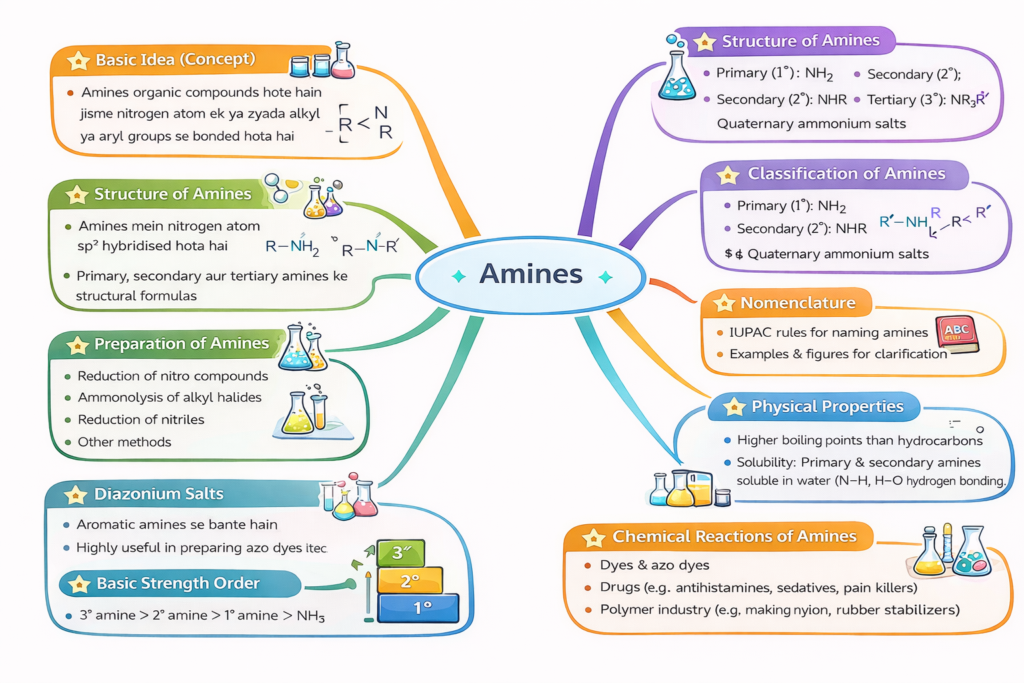
🔹 Basic Idea (Concept)
🔹 Structure of Amines
🔹 Classification of Amines
🔹 Nomenclature
🔹 Preparation of Amines
🔹 Physical Properties
🔹 Chemical Reactions of Amines
🔹 Basic Strength Order
⭐ Diazonium Salts
⭐ Commercial Uses of Amines

Class 12 Chemistry Chapter 9: Amines Notes

CBSE Class 12 Chemistry – Unit 9
Amines & Diazonium Salts
Complete Class 12 Chemistry Unit 9 (Amines) notes, syllabus, NCERT book PDF aur official Telegram channel ka direct access yahan se milega. Isme nomenclature, classification, preparation methods, physical & chemical properties, basic strength order, identification tests (Carbylamine & Hinsberg), aur diazonium salts ke preparation aur reactions cover kiye gaye hain.

Also Read- Jemimah Rodrigues: Why She’s Trending, Biography, Net Worth, Age, Lifestyle & Career 2026

Chemistry Chapter 9 Amines MCQs

CBSE Class 12 Chemistry — Unit 9: Amines (MCQs)

1. Amines are derivatives of:

2. Structure of amines is generally:

3. Which of the following is a primary amine?

4. Which test is used to identify primary amines?

5. Amines show basic nature due to:

6. Which method gives only primary amines?

7. Boiling point order of amines is:

8. Hinsberg reagent is used for:

9. Diazonium salts are prepared from:

10. Diazonium salts are important in:

Chemistry Chapter 9 Amines Quick Revision

🔹 Basic Idea (Real Life + Concept)

Amines ammonia (NH₃) ke derivatives hote hain jisme hydrogen atoms alkyl ya aryl groups se replace ho jaate hain. Nitrogen par lone pair hone ki wajah se amines basic nature show karte hain aur medicines, dyes aur fibres me use hote hain.


🔹 Structure of Amines

Amines me nitrogen atom sp³ hybridised hota hai aur molecule pyramidal shape show karta hai. Lone pair repulsion ki wajah se bond angle 109.5° se thoda kam (~108°) hota hai.


🔹 Classification of Amines

Amines ko hydrogen replacement ke basis par classify kiya jata hai:

  • Primary amine (1°) → R–NH₂
  • Secondary amine (2°) → R₂NH
  • Tertiary amine (3°) → R₃N

Same groups → simple amines
Different groups → mixed amines.


🔹 Nomenclature

Amines ko common aur IUPAC system se name kiya jata hai.

  • Common name: Alkyl + amine (methylamine)
  • IUPAC name: Alkane → “e” replace by “amine” (methanamine)
  • Secondary aur tertiary me N- prefix use hota hai.
  • Aromatic amine example → Aniline (Benzenamine).

🔹 Preparation of Amines

Amines banane ke main methods:

  • Nitro compounds ka reduction → amines
  • Alkyl halides ka ammonolysis
  • Nitriles ka reduction
  • Amides ka reduction
  • Gabriel phthalimide synthesis (primary amine)
  • Hoffmann bromamide reaction (one carbon less amine)

🔹 Physical Properties

  • Lower amines gases hote hain (fishy smell).
  • Higher amines liquids ya solids hote hain.
  • Lower amines water soluble hote hain (hydrogen bonding).
  • Solubility chain length badhne par decrease hoti hai.
  • Boiling point order: Primary > Secondary > Tertiary.

🔹 Chemical Reactions of Amines

✔ Basic Nature

Amines acids ke saath salt banate hain.

✔ Alkylation

Amines alkyl halides se react karke higher amines banate hain.

✔ Acylation

Amines acyl chloride se react karke amides banate hain.

✔ Carbylamine Reaction

Primary amines chloroform + KOH ke saath foul smell isocyanide banate hain (test for 1° amine).

✔ Reaction with Nitrous Acid

Primary, secondary aur tertiary amines different products dete hain.

✔ Electrophilic Substitution

Aromatic amines me –NH₂ group ortho-para directing hota hai.


🔹 Basic Strength Order

Amines ki basic strength electron density aur structure par depend karti hai.

  • Aliphatic amines > Ammonia > Aromatic amines
  • Aqueous solution me order generally:
    Secondary > Primary > Tertiary > NH₃
  • Aromatic amines resonance ki wajah se weak base hote hain.

⭐ Diazonium Salts

Aromatic primary amines nitrous acid se react karke diazonium salts banate hain (273–278 K).
Ye aromatic compounds me different groups introduce karne aur azo dyes banane me use hote hain.


⭐ Commercial Uses of Amines

  • Medicines aur pharmaceuticals
  • Dyes aur polymers
  • Synthetic fibres
  • Agrochemicals
  • Insect attractants
  • Chemical synthesis intermediates

Also Read- CBSE Class 12 Chemistry Chapter 8: Aldehydes, Ketones and Carboxylic Acids – Notes + MCQs | Quick Revision

FAQs About Chapter Amines Notes

⭐ FAQs – CBSE Class 12 Chemistry Chapter 9 (Amines)
1. What are amines in chemistry?
Amines are derivatives of ammonia (NH₃) in which one or more hydrogen atoms are replaced by alkyl or aryl groups. They contain a nitrogen atom with a lone pair of electrons, which makes them basic in nature.
2. How are amines classified?
Amines are classified as primary (1°), secondary (2°), and tertiary (3°) depending on how many hydrogen atoms of ammonia are replaced by alkyl or aryl groups.
3. What is the structure and shape of amines?
Amines have a pyramidal structure with nitrogen atom in sp³ hybridisation. The bond angle is slightly less than 109.5° due to lone pair repulsion.
4. What are the main methods of preparation of amines?
Amines can be prepared by reduction of nitro compounds, ammonolysis of alkyl halides, reduction of nitriles and amides, Gabriel phthalimide synthesis, and Hoffmann bromamide reaction.
5. How can primary, secondary and tertiary amines be identified?
Primary amines give a positive Carbylamine test. Hinsberg test is used to distinguish primary, secondary, and tertiary amines based on their solubility behaviour.
6. Why are aliphatic amines stronger bases than aromatic amines?
In aliphatic amines, alkyl groups increase electron density on nitrogen (+I effect). In aromatic amines, lone pair electrons are delocalised into the benzene ring, making them less available for protonation.
7. What are diazonium salts?
Diazonium salts have the general formula Ar–N₂⁺X⁻. They are formed by the reaction of primary aromatic amines with nitrous acid at low temperature (273–278 K).
8. Why are diazonium salts important in organic synthesis?
Diazonium salts are important intermediates because the diazo group can be replaced by various functional groups like –Cl, –Br, –I, –OH, –CN, and –NO₂. They are also used in the preparation of azo dyes.
9. What are the commercial uses of amines?
Amines are widely used as intermediates in the synthesis of medicines, dyes, synthetic fibres, agrochemicals, and polymers.

📘 CBSE Class 12 Chemistry – All Units

Unit 10: Biomolecules
View Post
Unit 9: Amines
View Post
Unit 8: Aldehydes, Ketones and Carboxylic Acids
View Post
Unit 7: Alcohols, Phenols and Ethers
View Post
Unit 6: Haloalkanes and Haloarenes
View Post
Unit 5: Coordination Compounds
View Post
Unit 4: d and f Block Elements
View Post
Unit 3: Chemical Kinetics
View Post
Unit 2: Electrochemistry
View Post
Unit 1: Solutions
View Post

1 thought on “CBSE Class 12 Chemistry Chapter 9: Amines – Notes + MCQs | Quick Revision”

Leave a Comment