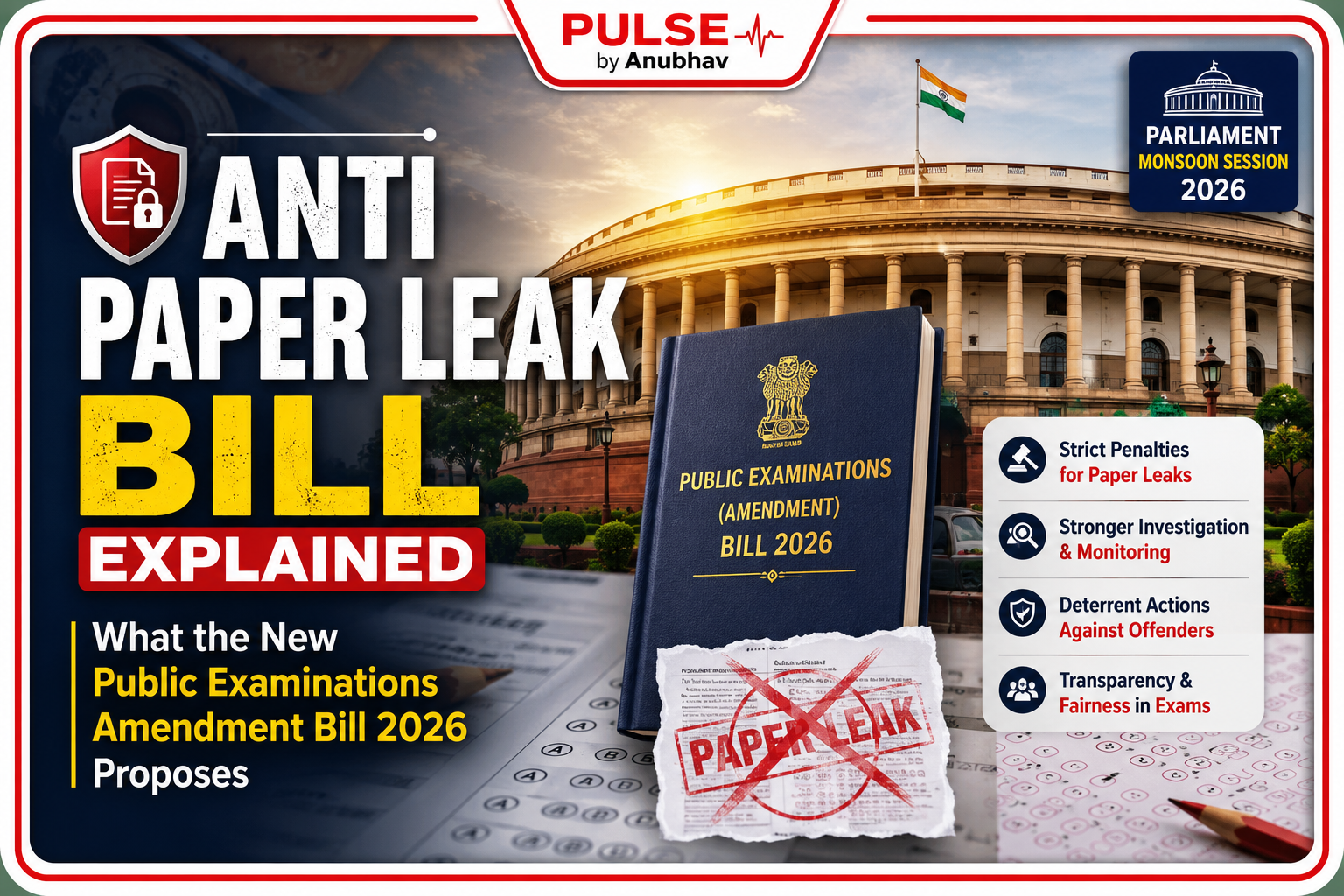
Anti Paper Leak Bill explained: Know the key provisions, tougher penalties, and the latest Parliament Monsoon Session 2026 updates on the proposed law.
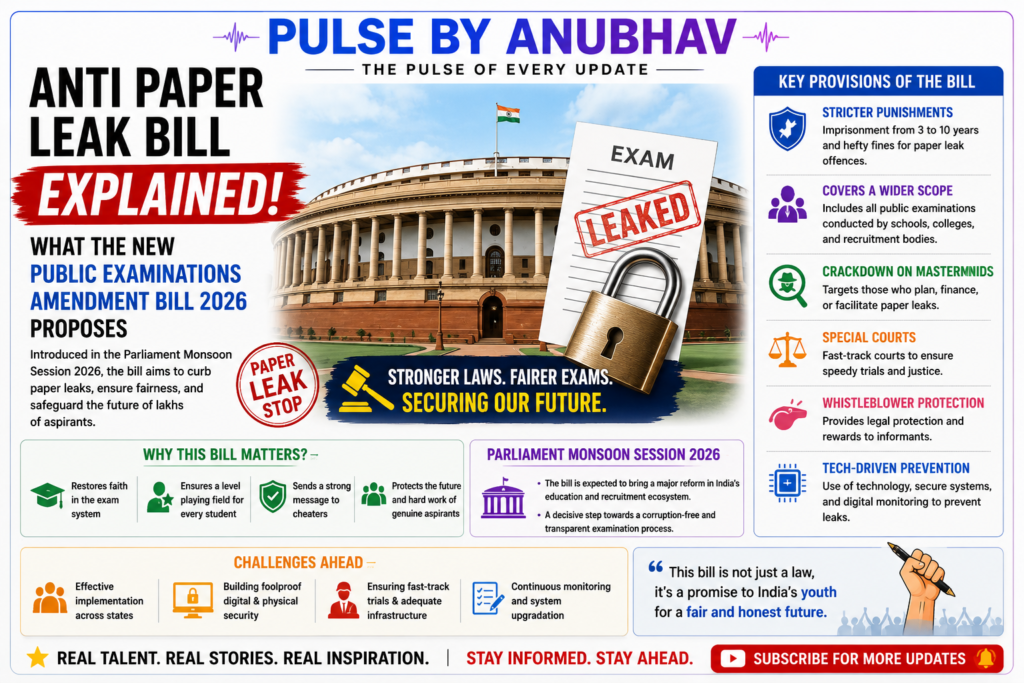
The Anti Paper Leak Bill, officially called the Public Examinations (Prevention of Unfair Means) Amendment Bill, 2026, was introduced during the Parliament Monsoon Session 2026 to strengthen India’s fight against exam paper leaks and organised cheating. The Bill proposes stricter punishments, faster investigations, Special Task Forces, and dedicated fast-track courts to protect students and restore trust in public examinations. Despite the government’s push for debate, Parliament witnessed repeated disruptions as the Opposition continued protests over alleged police action against students. Stay with Pulse by Anubhav for the latest updates on Parliament and education reforms.
Anti Paper Leak Bill Explained: Why Parliament Monsoon Session 2026 Turned Into a Political Flashpoint
The Parliament Monsoon Session 2026 witnessed another stormy day as the Centre introduced the anti paper leak bill, officially known as the Public Examinations (Prevention of Unfair Means) Amendment Bill, 2026, in the Lok Sabha. While the government described the legislation as a crucial reform to protect students and restore trust in public examinations, the Opposition continued its protests, preventing a detailed discussion in Parliament.
The proposed law comes in the wake of the nationwide NEET controversy and aims to crack down on organised paper leak networks, examination mafias, and large-scale cheating. However, instead of focusing solely on the Bill, Parliament remained divided over allegations of police action against protesting students, making the issue one of the biggest talking points of the Parliament Monsoon Session 2026.
Why the Anti Paper Leak Bill Became the Centre of Attention
The government introduced the anti paper leak bill as part of a broader effort to strengthen India’s examination system after repeated allegations of paper leaks in competitive exams.
The amendment seeks to make the existing 2024 law much stricter by introducing tougher punishments, faster investigations, dedicated Special Task Forces, and fast-track courts for examination-related offences. According to the Centre, the objective is to ensure that deserving students do not lose opportunities because of organised cheating or examination fraud.
The Bill is expected to cover major public examinations conducted by central agencies and strengthen accountability among examination authorities, contractors, and organised criminal networks involved in leaks.
Also Read- Mirabai Chanu Wins Gold at Commonwealth Games 2026 as India Adds Three Weightlifting Medals
Kiren Rijiju Urges Political Parties to Debate the Bill
Parliamentary Affairs Minister Kiren Rijiju repeatedly appealed to all political parties to participate in the discussion instead of disrupting proceedings.
Government Says Students Should Be the Priority
Rijiju argued that the proposed legislation directly concerns crores of students and young aspirants preparing for competitive examinations across India.
According to him, Parliament had allocated sufficient time for discussion, and even several Opposition MPs had submitted amendments to the Bill, indicating that meaningful debate was possible.
He also stated that avoiding discussion on such an important issue could send the wrong message to students who are expecting reforms in the examination system.
Congress Accused of Blocking the Debate
The minister claimed that the Opposition had earlier demanded examination reforms but later disrupted proceedings when the Bill was introduced.
He further alleged that continuous disruptions could damage the Congress party’s public image, urging members to debate the legislation rather than resort to protests inside Parliament.
Opposition Continues Protest Despite Dharmendra Pradhan’s Resignation
Although former Union Education Minister Dharmendra Pradhan resigned following the NEET controversy, the Opposition maintained that its concerns had not been addressed completely.
Congress leaders insisted that the issue was no longer limited to the resignation of the Education Minister but had expanded to alleged police action against students during protests held on July 20.
Opposition MPs demanded that Union Home Minister Amit Shah make a statement in Parliament regarding the alleged use of excessive force against students, saying the matter required immediate discussion before any legislative business could proceed.
Because of these demands, both the Lok Sabha and Rajya Sabha witnessed repeated interruptions throughout the day.
Also Read- Samsung Galaxy S27 Leak: s27 ultra Could Get a 5,700mAh Battery as Pro Model Eyes 5,200mAh
Speaker Om Birla Helps Break the Deadlock
Consensus Emerges After Meetings With Political Parties
Lok Sabha Speaker Om Birla played an important role in reducing tensions by holding discussions with leaders from both the ruling alliance and the Opposition.
Following his intervention, political parties broadly agreed that the anti paper leak bill deserved a detailed discussion because it affects millions of students across the country.
Sources indicated that Parliament may take up an extended debate before putting the legislation to vote.
Healthy Debate Encouraged
Birla emphasised that democratic debate is essential for legislation that directly impacts India’s education system and the future of competitive examinations.
He also encouraged all parties to propose amendments during the discussion so that the final law reflects broader parliamentary consensus.
Major Provisions of the Anti Paper Leak Bill 2026
The proposed amendment significantly strengthens the existing Public Examinations Act through stricter punishments and faster legal procedures.
Some of the key proposals include:
- Maximum imprisonment of up to 10 years for organised examination fraud.
- Fine of up to ₹50 lakh for individuals convicted of serious offences.
- Fine of up to ₹5 crore for service providers involved in malpractice.
- Fine of up to ₹10 crore for organised criminal networks involved in paper leaks.
- Creation of Special Task Forces (STFs) for investigation.
- Mandatory completion of investigations within two months.
- Special fast-track courts for speedy trials.
- Appeals to High Courts within defined timelines.
- Stronger accountability for examination agencies and officials involved in organised cheating.
The Centre believes these provisions will significantly improve transparency and discourage organised paper leak syndicates.
Government Says Faster Investigations Will Restore Confidence
One of the biggest highlights of the amendment is the introduction of strict timelines.
Instead of prolonged investigations stretching for years, authorities will now be expected to complete inquiries within two months. Dedicated fast-track courts are also expected to conclude trials much faster than under the existing system.
The government argues that quicker investigations and timely punishment will improve public confidence in national recruitment and entrance examinations.
Opposition Calls the Bill Inadequate
While acknowledging the need for examination reforms, several Opposition leaders argued that stronger punishments alone cannot solve deeper structural problems.
Some leaders described the legislation as a temporary solution rather than a comprehensive education reform package.
According to them, preventing future paper leaks would require improvements in examination administration, stronger institutional accountability, better technology, and greater transparency throughout the examination process.
What Happens Next in Parliament Monsoon Session 2026?
Following multiple adjournments, Parliament is expected to resume discussion on the anti paper leak bill during the next sitting.
Political parties are likely to move amendments before the final voting process. If passed by both Houses, the legislation will further strengthen India’s legal framework against organised paper leaks and examination fraud.
The debate is expected to remain one of the biggest highlights of the Parliament Monsoon Session 2026, as both the government and the Opposition continue to defend their respective positions on education reforms and student welfare.
As the situation develops, Pulse by Anubhav will continue tracking every major update related to the anti paper leak bill, Parliament proceedings, and important education policy decisions affecting students across India.
Also Read- DENGUE: Symptoms, Treatment, Prevention & Complete Guide (2026)
1 thought on “Anti Paper Leak Bill Explained: What the New Public Examinations Amendment Bill 2026 Proposes | Parliament Monsoon Session 2026”