Get B.Pharm 1st Semester Notes 2026 for all subjects under the new PCI syllabus. Access simple, subject-wise and unit-wise study material for exams.
B.Pharm ki journey abhi start ki hai aur samajh nahi aa raha ki padhai kahan se shuru karein ya new syllabus ke according notes kahan milenge? Don’t worry, Pyare Bacchon! ❤️ Pulse by Anubhav par hum aapke liye B.Pharm 1st Semester Notes lekar aaye hain, jahan aapko new PCI syllabus ke according sabhi subjects ke notes ek hi jagah milenge. Ab har subject ke notes alag-alag search karne ki zarurat nahi hai.
New academic session ke saath B.Pharm ka syllabus bhi update hua hai, jisme subjects aur learning structure mein changes kiye gaye hain. Isliye latest syllabus ke according padhna important hai, taaki aapke concepts clear rahein aur university examinations ki preparation bhi sahi direction mein ho.
Yahan aapko B.Pharm 1st Semester ke sabhi subjects ke notes, unit-wise study material, important topics aur exam-oriented explanations simple English mein milenge, jisse difficult concepts ko samajhna aur revise karna thoda easy ho jayega. Chahe aap Pharmaceutical Chemistry padh rahe ho, Pharmacognosy, Human Anatomy ya General Pharmacy, aap apne subject ke notes neeche easily access kar sakte ho.
Humne saare subjects ko ek hi jagah organise kiya hai, taaki aapka time bache, padhai easy ho aur B.Pharm ke aage aane wale semesters ke liye aapka foundation strong bane. Toh chaliye, bina time waste kiye apne subjects ke notes se padhai shuru karte hain!
Also Read- Basics of Python Programming for Pharmaceutical Science Notes PDF, Updated Syllabus & Books
B.Pharm 1st Semester Subjects & Notes
B.Pharma 1st Sem Updated PCI Syllabus Notes
Choose your subject below and start preparing with simple, exam-oriented study material.
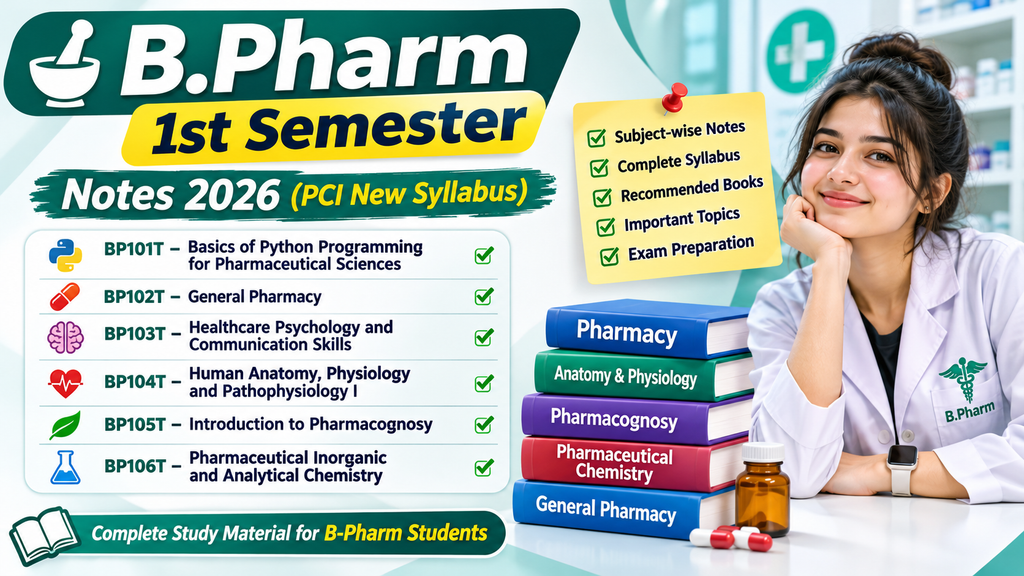
Basics of Python Programming for Pharmaceutical Sciences
General Pharmacy
Healthcare Psychology and Communication Skills
Human Anatomy, Physiology and Pathophysiology I
Introduction to Pharmacognosy
Introduction to Pharmaceutical Inorganic and Analytical Chemistry
B.Pharm 1st Semester Notes 2026 PDF: Subjects, Syllabus, Books & Exam Preparation
B.Pharm 1st Semester Study Guide
Confused about what to study first? Don't worry! Yahan har subject ke units, important topics aur exam preparation tips simple language mein diye gaye hain, so you can study smarter and save time.
Start with the High Priority topics, understand the basic concepts, then complete the remaining syllabus. Ye list revision aur study planning ke liye hai—kisi topic ko official examination prediction mat samajhna.
Basics of Python Programming for Pharmaceutical Sciences
5 Units · 30 Hours · Theory
Unit I – Introduction to Python ProgrammingHIGH PRIORITY
- Python installation and IDEs (Jupyter, PyCharm, VS Code)
- Variables, data types and type casting
- Arithmetic, comparison and logical operators
- Input and output operations
- Basic string manipulation
- Standard and third-party libraries
Start yahin se karo. Variables, data types, operators aur basic Python syntax clear nahi hoga toh aage programming difficult lagegi.
Unit II – Control Structures & FunctionsHIGH PRIORITY
- if, if-else and if-elif-else statements
- Nested conditional statements
- for and while loops
- break and continue
- Functions, arguments and return values
- Dosage calculation and BMI calculation programs
Programs ki practice zaroor karo. Sirf definitions padhne se programming nahi aayegi—code khud run karna.
Unit III – Data Structures & File HandlingHIGH PRIORITY
- Lists, tuples and dictionaries
- Indexing and slicing
- List and dictionary operations
- Introduction to NumPy arrays
- CSV file reading and writing
- Healthcare dataset handling
List, tuple aur dictionary ke differences examples ke saath samjho. NumPy arrays aur CSV file operations ko practically try karna.
Unit IV – Data Handling with PandasHIGH PRIORITY
- Introduction to Pandas
- Series and DataFrame
- Reading CSV and Excel files
- head(), tail(), info() and describe()
- Data cleaning and missing values
- Filtering, grouping and aggregation
Pandas ke functions ko examples ke saath padho. DataFrame, data filtering aur missing values ke concepts par special focus rakho.
Unit V – Data Visualization with MatplotlibHIGH PRIORITY
- Introduction to Matplotlib
- Line plots and histograms
- Scatter plots and box plots
- Labels, titles and legends
- Concentration-time curves
- ADR reporting and dissolution profiles
- Interpretation of scientific graphs
Graphs ke types, uses aur differences samjho. Pharmaceutical examples ke saath graph interpretation ki practice karna.
General Pharmacy
5 Units · 45 Hours · Theory
Unit I – Introduction to the Profession of PharmacyHIGH PRIORITY
- History and evolution of Pharmacy in India
- Pharmacy education and pharmaceutical industries
- Role of pharmacists in community, hospital and industry
- IP, BP, USP and other Pharmacopoeias
- Structure of Indian Pharmacopoeia
- Prescription: parts, handling and Latin terminology
Pharmacy history, pharmacist roles, pharmacopoeia comparisons aur prescription ke parts ko proper headings mein prepare karo.
Unit II – Pharmaceutical Calculations & Dosage FormsHIGH PRIORITY
- Metric system and pharmaceutical measurements
- Alligation and proof spirit
- Isotonic solutions and dilution calculations
- Percentage and ratio strength
- Geometric dilution and scientific notation
- Posology and dose calculations
- Routes of administration and dosage form classification
- APIs and excipients: definition and characteristics
Numericals ko ignore mat karna! Formulas likho, solved examples dekho aur daily calculations practice karo.
Unit III – Solid Dosage FormsHIGH PRIORITY
- Powders: types, advantages and disadvantages
- Dusting, effervescent and hygroscopic powders
- Eutectic mixtures and efflorescent powders
- Tablets: types, advantages and preparation
- Capsules: types, sizes and preparation
- Excipients used in solid dosage forms
Powders, tablets aur capsules ko definition, classification, advantages, disadvantages, excipients aur preparation ke format mein prepare karo.
Unit IV – Monophasic & Biphasic LiquidsHIGH PRIORITY
- Aromatic waters, syrups, elixirs and linctus
- Liniments, lotions and throat paints
- Gargles, mouthwashes and applications
- Enemas, eye drops, ear drops and nasal drops
- Tinctures and official preparations
- Suspensions: types, excipients and preparation
- Emulsions: types, emulsifying agents and identification tests
Liquid dosage forms ke differences, definitions, preparation methods aur examples ko tables mein revise karna.
Unit V – Semisolid Dosage FormsHIGH PRIORITY
- Semisolid dosage forms: definition and classification
- Advantages and disadvantages
- Ointment bases and excipients
- Preparation of ointments, pastes, creams and gels
- Suppositories and pessaries
- Types of suppository bases
- Displacement value and preparation methods
Ointments, creams, gels, pastes aur suppositories ke differences clear rakho. Suppository bases aur displacement value ko achhe se revise karo.
Healthcare Psychology and Communication Skills
5 Units · 15 Hours · Theory
Unit I – Introduction to Psychology in HealthcareHIGH PRIORITY
- Definition, scope and relevance of psychology
- Branches of psychology: clinical, health, behavioural and developmental
- Sensation, perception and attention
- Learning and memory
- Emotion, motivation and healthcare behaviour
Basic definitions, branches of psychology aur learning, memory, emotion and motivation ke concepts ko examples ke saath samjho.
Unit II – Developmental & Behavioural PsychologyHIGH PRIORITY
- Human developmental stages
- Personality theories
- Illness perception and recovery
- Anxiety, depression and somatization
- Coping strategies and resilience
- Stress management techniques
Development, personality aur psychological disorders ko short notes ke format mein prepare karo. Stress management aur coping strategies bhi important concepts hain.
Unit III – Foundations of Health CommunicationHIGH PRIORITY
- Elements and models of communication
- Interpersonal, group, mass and telehealth communication
- Communication barriers in healthcare
- Active listening and questioning
- Empathy and inclusive communication
Communication models, types, barriers aur ways to improve communication ko examples ke saath prepare karna.
Unit IV – Professional Communication in HealthcareIMPORTANT
- Communication with patients and caregivers
- Interdisciplinary healthcare communication
- Breaking bad news and difficult conversations
- Confidentiality and consent
- Patient records and discharge summaries
- Digital healthcare communication
Professional communication, ethical issues aur patient documentation ko practical healthcare examples ke through samjho.
Unit V – Health Psychology & Behavioural InterventionsHIGH PRIORITY
- Health Belief Model
- Illness behaviour and mind-body connection
- Psychosomatic illnesses
- CBT and Transtheoretical Model (TTM)
- Treatment adherence and behaviour change
- Psychological first aid and crisis communication
- Mental health awareness and stigma reduction
Models, behaviour change, psychosomatic illness aur stigma reduction ke concepts ko simple examples ke saath prepare karo.
Human Anatomy, Physiology and Pathophysiology I
5 Units · 60 Hours · Theory
Unit I – Introduction to Human BodyVERY IMPORTANT
- Cellular and tissue organization
- Levels of structural organization
- Body systems and homeostasis
- Cell structure, membrane transport and cell division
- Cell junctions and cell communication
- Epithelial, connective, muscular and nervous tissues
- Cell injury and adaptation
- Atrophy, hypertrophy, hyperplasia, metaplasia and dysplasia
- Cell swelling, intracellular accumulation and cell death
Cell, tissues, homeostasis aur cell injury/adaptation ko priority do. Differences aur labelled diagrams se concepts revise karna.
Unit II – Integumentary System, Skeletal System & JointsVERY IMPORTANT
- Structure and functions of skin
- Psoriasis, dermatitis and leprosy
- Wound healing
- Axial and appendicular skeletal system
- Types of bones and their functions
- Skeletal muscle organization and contraction
- Neuromuscular junction
- Classification of joints
- Rheumatoid arthritis, osteoporosis and gout
Bones, joints aur skin ke labelled diagrams practice karo. Disease topics mein definition, causes, mechanism aur symptoms ko organised format mein padho.
Unit III – Blood, Body Fluids & InflammationVERY IMPORTANT
- Composition and functions of blood
- Haemopoiesis and haemoglobin formation
- Blood coagulation and blood grouping
- Rh factor and transfusion
- Lymphatic organs, lymph vessels and lymph
- Inflammation, mediators and tissue repair
- Iron deficiency and megaloblastic anaemia
- Sickle cell anaemia and thalassemia
- Haemophilia
Blood formation, coagulation, blood grouping aur anaemia ke types ko proper tables and flowcharts ke saath revise karo.
Unit IV – Peripheral Nervous System & Special SensesVERY IMPORTANT
- Peripheral nervous system classification
- Sympathetic and parasympathetic nervous system
- Spinal and cranial nerves
- Eye, ear, nose and tongue
- Glaucoma and cataract
- Myopia and vertigo
- Otitis externa and otitis media
- Anosmia
Sympathetic vs parasympathetic comparison aur special senses ke diagrams prepare karo. Disorders mein causes, symptoms aur pathophysiology cover karna.
Unit V – Cardiovascular SystemVERY IMPORTANT
- Anatomy of heart
- Blood circulation and blood vessels
- Arteries, veins and capillaries
- Conducting system of heart
- Cardiac cycle and cardiac output
- Blood pressure and pulse regulation
- Electrocardiogram (ECG)
- Hypertension and cardiac arrhythmias
- Congestive heart failure and ischemic heart disease
- Angina, myocardial infarction and atherosclerosis
Heart diagram, cardiac cycle, ECG aur blood pressure regulation ko thoroughly samjho. Cardiovascular diseases ke mechanism ko flowcharts mein revise karna.
Introduction to Pharmacognosy
5 Units · 45 Hours · Theory
Unit I – Fundamentals of PharmacognosyHIGH PRIORITY
- Definition, history, scope and development
- Sources of natural drugs
- Plant, animal, microbial, marine and mineral sources
- Important milestones in drug discovery
- Herbal and traditional pharmacopoeias
- Official and unofficial drugs
- Crude drug classification and its merits and limitations
Definitions, sources, drug discovery milestones aur classifications ko tables mein prepare karna. Classification ke advantages/disadvantages bhi padho.
Unit II – Cultivation, Collection, Processing & StorageIMPORTANT
- Medicinal plant cultivation
- Good Agricultural and Collection Practices (GACP)
- Factors affecting cultivation and collection
- Storage of medicinal plants
- Plant hormones and their applications
- Polyploidy, mutation and hybridization
- Ex-situ and in-situ conservation
- Eco-pharmacognosy and endangered plants
Cultivation factors, GACP, conservation techniques aur plant improvement methods ko point-wise prepare karo.
Unit III – Quality Control of Natural DrugsHIGH PRIORITY
- Adulteration of crude drugs
- Organoleptic and microscopic evaluation
- Physical, chemical and biological evaluation
- Extractive values and moisture content
- Ash values and foreign organic matter
- Swelling index and foaming index
- Bitterness value and haemolytic potential
- Optical rotation, refractive index and viscosity
- DNA barcoding
Evaluation methods aur physicochemical parameters ke definitions, purposes aur differences ko table format mein revise karna.
Unit IV – Plant Metabolites & Traditional SystemsHIGH PRIORITY
- Primary and secondary metabolites
- Carbohydrates, proteins and lipids
- Alkaloids and glycosides
- Flavonoids and tannins
- Terpenoids, volatile oils and resins
- AYUSH and Traditional Chinese Medicine (TCM)
- Traditional systems and dosage forms
Primary vs secondary metabolites ka comparison prepare karo. Metabolites ke examples aur medicinal importance samajhna.
Unit V – Phytotherapeutic AgentsHIGH PRIORITY
- Adaptogens and immunomodulators
- Hepatoprotectives
- Cardiovascular herbal drugs
- Antidiabetic medicinal plants
- Anti-inflammatory and analgesic drugs
- CNS herbal drugs
- Antimicrobial and antiviral drugs
- Gastrointestinal and dermatological agents
- Drugs used in women's health and respiratory conditions
Har medicinal plant ke liye biological source, major constituents aur uses ka 3-column table banao. Ye revision ke liye bahut useful rahega.
Pharmaceutical Inorganic and Analytical Chemistry
5 Units · 45 Hours · Theory
Unit I – Pharmaceutical Analysis, Errors & ImpuritiesHIGH PRIORITY
- Analytical techniques and solution strength
- Primary and secondary standards
- Sources and types of errors
- Accuracy, precision and significant figures
- Pharmaceutical impurities and their sources
- Limit tests for chloride, sulphate, iron, arsenic and lead
- Heavy metal testing and modified limit tests
Accuracy vs precision, errors and limit tests ko priority do. Limit tests ke principle, procedure aur observation revise karo.
Unit II – Acid-Base Chemistry & Buffer SystemsHIGH PRIORITY
- Acids, bases and buffers
- pH scale and pharmaceutical importance
- Buffer equation and pH calculations
- Isotonicity and its importance
- IV fluids and ophthalmic solutions
- Major intracellular and extracellular electrolytes
- NaCl, KCl and Calcium chloride
- Oral Rehydration Salts (ORS)
- Physiological acid-base balance
Buffer equations aur pH numericals practice karo. Electrolytes ke functions aur ORS composition/importance revise karna.
Unit III – Titrimetric & Analytical MethodsVERY IMPORTANT
- Acid-base titrations and indicators
- Preparation and standardization of HCl and NaOH
- Strong, weak and very weak acid-base titrations
- Non-aqueous titrations
- Acidimetry and alkalimetry
- Precipitation titrations: Mohr's, Volhard's and Fajans' methods
- Gravimetric analysis
- Complexometric titrations and EDTA
- Redox titrations: Permanganometry, Cerimetry, Iodimetry and Iodometry
Ye unit extensive hai. Har titration ka principle, indicator, reaction, endpoint aur application separately prepare karo. Comparison tables aur equations ka practice karo.
Unit IV – Gastrointestinal Agents & RadiopharmaceuticalsHIGH PRIORITY
- Acidifiers
- Antacids and ideal properties
- Agents promoting bowel movements
- Pharmaceutical antimicrobials
- Potassium permanganate, boric acid and hydrogen peroxide
- Iodine and its preparations
- Basics of radioactivity
- Na-I-131, Tc-99m, Co-60 and P-32
- Radiopharmaceutical safety, storage and disposal
Drug groups ke examples, uses aur properties revise karo. Radioisotopes ke applications aur safety precautions ko point-wise prepare karna.
Unit V – Miscellaneous Pharmaceutical CompoundsIMPORTANT
- Expectorants
- Potassium iodide and ammonium chloride
- Emetics
- Copper sulphate and sodium potassium tartrate
- Haematinics: ferrous sulphate and ferrous gluconate
- Poisons and antidotes
- Sodium thiosulphate
Har compound ke category, uses aur important properties ko short notes mein prepare karo. Drug examples ko group-wise yaad karna.
B.Pharm 1st Semester Practical Guide
Theory ke saath practicals bhi equally important hain. Experiments, observations, calculations aur viva questions ko regular revise karo.
General Pharmacy Practical
Pharmaceutical Calculations & Compounding
What to Prepare?PRACTICAL
- Alligation and dilution calculations
- Strong solution of ammonium acetate
- Cresol with soap solution and Lugol's solution
- Simple syrup
- ORS powder and effervescent granules
- Dusting powder and divided powders
- Glycerogelatin and cocoa butter suppositories
- Ointments, gargles and mouthwashes
Har experiment ka aim, ingredients, method, calculations, label aur precautions prepare karo. Practical record regularly complete rakhna.
Healthcare Psychology & Communication Skills Practical
Role Plays · Case Studies · Communication Exercises
What to Prepare?PRACTICAL
- Patient counselling role plays
- Breaking bad news simulations
- Empathetic listening and crisis response
- Mental health case studies
- Reflective listening and paraphrasing
- Team communication and decision-making
- Health education and IEC material preparation
- Self-reflection and journaling
Communication activities mein confidence, empathy, listening aur professional behaviour par focus karo. Journal/reflective logs time par complete karna.
Human Anatomy, Physiology & Pathophysiology I Practical
Microscopy · Haematology · Physiology
What to Prepare?PRACTICAL
- Compound microscope
- Identification of tissues
- Axial and appendicular bones
- RBC and WBC count
- Differential WBC count
- Haemoglobin estimation and blood grouping
- Bleeding time, clotting time and ESR
- Pulse, heart rate and blood pressure
- ECG and cardiovascular system
- Case studies of common diseases
Practical procedures, normal values (as taught in your lab), calculations, observations aur interpretations ko record book se revise karo.
Introduction to Pharmacognosy Practical
Medicinal Plant Identification & Drug Evaluation
What to Prepare?PRACTICAL
- Morphological identification of medicinal plants
- Tulsi and Ashwagandha
- Amla and Arjuna
- Turmeric and Psyllium
- Brahmi and Fenugreek
- Moisture content and swelling index
- Foaming index and ash values
- Extractive values and foreign organic matter
- Stomatal index and vein parameters
- Lycopodium spore method and voucher specimens
Crude drugs ke common names, biological sources, identification characters, uses aur practical evaluation methods ko charts mein prepare karna.
Pharmaceutical Inorganic & Analytical Chemistry Practical
Limit Tests · Preparation · Assays
What to Prepare?PRACTICAL
- Limit tests for chloride and sulphate
- Limit tests for iron, lead and arsenic
- Preparation of aluminium hydroxide and potash alum
- Preparation of ferrous sulphate and magnesium sulphate
- Purity tests of inorganic substances
- Acid-base titrations
- Cerimetry and iodometry
- Complexometric titration
- Permanganometry and precipitation titration
- Standardization of titrants and pharmaceutical assays
Limit tests ka principle, chemical reaction, procedure aur observation yaad karo. Titrations ke calculations aur endpoint identification ki lab mein practice karna.
How to Prepare for B.Pharm 1st Semester Exams?
Bhai, syllabus dekhkar ek saath sab padhne ki tension mat lena. Smart planning ke saath daily thoda-thoda complete karna zyada effective rahega.
Start by reading the unit topics and understanding what you need to study. Pehle basic concepts clear karo.
Definitions, classifications, diagrams, differences and mechanisms ko exam-oriented format mein prepare karo.
Python, Pharmaceutical Calculations, Analytical Chemistry aur HAP mein practical understanding develop karo.
Jo units complete ho chuki hain, unka weekly revision karo. Last moment ke liye sab kuch mat chhodo.
Practical records, experiments, viva questions and calculations ko theory ke saath prepare karte raho.
Also Read- B.Pharm 1st Semester General Pharmacy Notes PDF, Updated Syllabus & Books
B.Pharm 1st Semester Notes According To Updated PCI Syllabus
FAQs About B.Pharm 1st Semester Notes
Frequently Asked Questions
Got questions about B.Pharm 1st Semester notes, syllabus or exam preparation? Find your answers below.
Where can I download B.Pharm 1st Semester notes PDF for 2026?
How many subjects are there in B.Pharm 1st Semester under the new PCI syllabus?
Is the B.Pharm 1st Semester syllabus updated for the new PCI curriculum?
Which subjects are included in B.Pharm 1st Semester?
- Basics of Python Programming for Pharmaceutical Sciences
- General Pharmacy
- Healthcare Psychology and Communication Skills
- Human Anatomy, Physiology and Pathophysiology I
- Introduction to Pharmacognosy
- Pharmaceutical Inorganic and Analytical Chemistry
1 thought on “B.Pharm 1st Semester Notes 2026 – All Subjects, New PCI Syllabus”