Radhe Radhe, B.Pharm Students! In this post, you will find complete notes for the B.Pharm 2nd Semester – Applied Biostatistics and Data Analytics for Pharmaceutical Sciences (BP201T) subject, based on the updated PCI-approved syllabus. Here, you can explore unit-wise notes, important questions and answers, statistical formulas, Python practicals, previous year questions (PYQs), and exam-oriented study material to help you prepare effectively. You will also find useful pharmacy updates, GPAT-related updates, and other important academic resources. Follow our Telegram channel to access semester-wise notes, study materials, and book PDFs.
As you may have already understood, pursuing a B.Pharm degree is not as easy as it looks. Many students choose this course as an option after 12th, but later realize how much in-depth study, analytical thinking, and practical knowledge it actually requires.
B.Pharm is a 4-year professional course divided into 8 semesters. In the 2nd semester, students are introduced to subjects that strengthen their pharmaceutical knowledge, including Applied Biostatistics and Data Analytics for Pharmaceutical Sciences, an important subject in the updated syllabus.
This subject focuses on statistical analysis, probability, data interpretation, correlation, regression, and Python programming. It helps pharmacy students understand how healthcare and pharmaceutical research increasingly depend on data-driven analysis, from clinical trials and drug development to patient outcomes and scientific research.
Why B.Pharm is Important in Healthcare
B.Pharm is not only about medicines — it is one of the most important courses in the healthcare sector. This course helps students understand how medicines are prepared, tested, distributed, and used safely for patients.
A pharmacist plays a major role in the medical field. They help doctors and patients by providing the correct medicines and proper guidance related to drug usage. A pharmacist also explains:
- How to take medicines properly
- Benefits of medicines
- Possible side effects
- Safe dosage and precautions
Today, the pharmacy profession is growing rapidly because healthcare industries, hospitals, research labs, and pharmaceutical companies all require skilled pharmacy professionals.
If you study B.Pharm seriously, you can build a strong career in:
- Pharmaceutical industries
- Hospitals and clinics
- Drug research centers
- Medical coding & pharmacovigilance
- Government healthcare sectors
At Pulse by Anubhav, we always try to provide updated B.Pharm notes, syllabus PDFs, PYQs, and study materials to help pharmacy students in their academic journey.
Updated Subjects in B.Pharm 2nd Semester (As per New PCI Syllabus)
Here is the latest subject list for B.Pharm 2nd Semester, including theory and practical subjects, as per the updated PCI syllabus.
Theory Subjects
- BP201T – Applied Biostatistics and Data Analytics for Pharmaceutical Sciences
- BP202T – Biochemistry
- BP203T – Human Anatomy, Physiology and Pathophysiology II
- BP204T – Pharmaceutical Organic Chemistry
- BP205T – Pharmacognosy and Phytochemistry
- BP206T – Physical Pharmaceutics
Practical Subjects
- BP207P – Biochemistry Practical
- BP208P – Human Anatomy, Physiology and Pathophysiology II Practical
- BP209P – Pharmaceutical Organic Chemistry Practical
- BP210P – Pharmacognosy and Phytochemistry Practical
- BP211P – Physical Pharmaceutics Practical
- BP212P – SEC Elective Practical (Any One):
- Communication Skills
- Mental Well-Being, Stress & Conflict Management
- Fundamentals of Computer Operations
These subjects are based on the revised B.Pharm curriculum introduced under the updated PCI syllabus.
Prepare for your B.Pharm Pharmaceutical Inorganic & Analytical Chemistry exam with easy, unit-wise and exam-focused quick notes. Revise important concepts, definitions, reactions, analytical methods, inorganic compounds and important pharmaceutical topics in less time.
Quickly revise pharmaceutical analysis, acid-base chemistry, titrations, gastrointestinal agents, antimicrobials, radiopharmaceuticals, miscellaneous compounds, haematinics, poisons and antidotes without going through lengthy material again.
Source: New PCI B.Pharm Syllabus – PharmacoLearn · B.Pharm Semester-wise Subjects & Syllabus
Special Highlight: Python in Pharmacy 📊
One of the biggest updates in the new B.Pharm syllabus is:
👉 Basics of Python Programming for Pharmaceutical Sciences
This modern subject introduces pharmacy students to the digital and technical side of healthcare. It helps students understand how technology is used in pharmaceutical research and data handling.
With this subject, students can learn to:
- Analyze pharmaceutical data
- Create graphs and concentration-time curves
- Work with research datasets
- Understand digital healthcare systems
- Improve research and analytical skills
This change shows how pharmacy education is becoming more technology-oriented and future-ready for modern healthcare industries.
Also Read- B.Pharm 1st Semester Introduction to Pharmacognosy Notes PDF, Updated Syllabus & Books
Basics of Python Programming for Pharmaceutical Sciences Notes Link
B.Pharm 2nd Semester Applied Biostatistics and Data Analytics for Pharmaceutical Sciences Science Syllabus
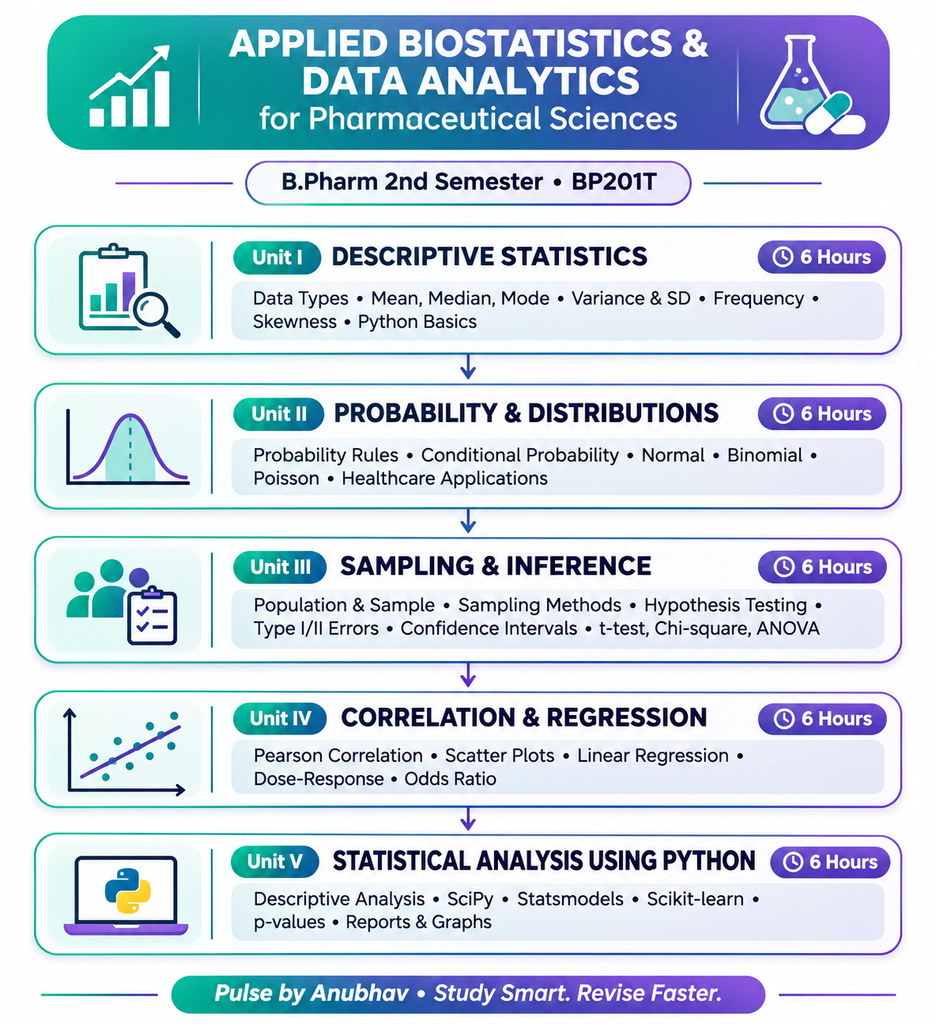
Applied Biostatistics and Data Analytics for Pharmaceutical Sciences – B.Pharm 2nd Semester Syllabus
Before downloading the notes, take a look at the Applied Biostatistics and Data Analytics for Pharmaceutical Sciences syllabus to understand the topics covered in this subject. This subject introduces pharmacy students to statistical methods, data analysis, probability, research interpretation and Python-based statistical tools used in pharmaceutical sciences. Below is the unit-wise syllabus to help you prepare for your semester examinations.
B.Pharm 2nd Semester – Unit-wise Syllabus
Unit I – Descriptive Statistics
Data Organization, Summary and InterpretationIntroduction to Pharmaceutical Data
- Introduction to statistics and biostatistics
- Importance of statistical analysis in pharmaceutical sciences
- Types of data: Nominal, Ordinal, Interval and Ratio
- Sources of pharmaceutical data
- Clinical trials, pharmacovigilance, quality control and pharmacokinetic studies
Measures of Central Tendency
- Mean
- Median
- Mode
- Applications and interpretation
Measures of Dispersion
- Range
- Variance
- Standard deviation
- Interpretation of data variability
Distribution of Data
- Frequency distribution
- Skewness
- Introduction to distribution shape
- Interpretation of descriptive statistics
Introduction to Data Analysis Using Python
- Basic use of NumPy and Pandas
- Calculation of descriptive statistics
- Summarizing and interpreting pharmaceutical datasets
Unit II – Probability and Statistical Distributions in Healthcare
Probability Concepts and Pharmaceutical ApplicationsBasics of Probability
- Introduction to probability
- Basic probability rules
- Conditional probability
- Independent and dependent events
Probability Distributions
- Introduction to probability distributions
- Discrete and continuous distributions
- Normal distribution
- Binomial distribution
- Poisson distribution
Applications in Pharmaceutical Sciences
- Probability in clinical research
- Healthcare risk analysis
- Interpretation of patient-related data
- Applications in drug safety and pharmaceutical research
Unit III – Sampling and Statistical Inference
Sampling Methods, Hypothesis Testing and Decision-MakingSampling Concepts
- Population and sample
- Importance of sampling in pharmaceutical research
- Random sampling
- Simple random sampling
- Stratified sampling
- Systematic sampling
Statistical Inference
- Introduction to statistical inference
- Null and alternative hypotheses
- Hypothesis testing
- Significance level
- Type I and Type II errors
- Confidence intervals
Statistical Tests
- Introduction to t-test
- Introduction to chi-square test
- Introduction to analysis of variance (ANOVA)
- Interpretation of statistical test results
Unit IV – Basics of Correlation and Regression
Relationship Between Pharmaceutical VariablesCorrelation Analysis
- Introduction to correlation
- Pearson correlation coefficient
- Positive and negative correlation
- Interpretation of correlation coefficient
- Scatter plots and trend visualization using pharmaceutical data
Regression Analysis
- Introduction to simple linear regression
- Regression equation
- Interpretation of regression coefficients
- Prediction using regression models
Clinical and Pharmaceutical Applications
- Odds ratio
- Application in clinical risk analysis
- Understanding relationships between dose and response
- Interpretation of pharmaceutical research data
Unit V – Statistical Analysis Using Python: Case-Based Learning
Practical Data Analysis and Statistical InterpretationStatistical Analysis Using Python
- Demonstration of descriptive statistics using Python
- Correlation analysis using SciPy and Statsmodels
- Linear regression using SciPy, Statsmodels and Scikit-learn
Interpretation of Statistical Outputs
- Interpretation of output summaries
- Understanding p-values
- Statistical significance
- Interpretation of correlation and regression results
Preparation of Statistical Reports
- Presentation of statistical findings
- Preparation of tables and graphs
- Interpretation of pharmaceutical datasets
- Preparation of scientific statistical reports
About Applied Biostatistics and Data Analytics
Applied Biostatistics and Data Analytics for Pharmaceutical Sciences helps B.Pharm students understand how numerical data can be collected, analysed and interpreted in healthcare and pharmaceutical research. From descriptive statistics and probability to correlation, regression and Python-based analysis, this subject builds the foundation for evidence-based research and modern pharmaceutical data analytics.
Topics Covered in This Subject
Biostatistics, Pharmaceutical Data Analytics, Descriptive Statistics, Probability, Statistical Distributions, Sampling, Hypothesis Testing, Confidence Intervals, Correlation, Regression Analysis, Odds Ratio, Python for Pharmacy, SciPy, Pandas, NumPy, Statsmodels, Scikit-learn and Statistical Report Preparation.
Also Read- B.Pharm 1st Semester Introduction to Pharmacognosy Notes PDF, Updated Syllabus & Books
B.Pharm 2nd Semester Applied Biostatistics and Data Analytics for Pharmaceutical Sciences Notes PDF
B.Pharm 2nd Semester Applied Biostatistics and Data Analytics for Pharmaceutical Sciences Book PDF
Books are very important; you should definitely check out the books according to your syllabus. During your pharmacy studies, books from Nirali Prakashan and PV Sindhu are very helpful. You can download the PDFs from the link below.
- Applied Biostatistics and Data Analytics for Pharmaceutical Sciences Nirali Prakashan Full Book PDF:- PDF
- Applied Biostatistics and Data Analytics for Pharmaceutical Sciences PV Sindhu Full Book PDF:- PDF
- Applied Biostatistics and Data Analytics for Pharmaceutical Sciences Thakur Publication Full Book PDF:- PDF
FAQs About Applied Biostatistics and Data Analytics for Pharmaceutical Sciences
❓ Frequently Asked Questions
Common questions about B.Pharm Pharmaceutical Inorganic & Analytical Chemistry notes, syllabus, units and exam preparation.
What is Pharmaceutical Inorganic & Analytical Chemistry in B.Pharm?
Pharmaceutical Inorganic & Analytical Chemistry deals with inorganic pharmaceutical substances, their properties, uses, identification, purity testing and analytical methods used in pharmacy.
Where can I download Pharmaceutical Inorganic & Analytical Chemistry notes PDF?
You can access unit-wise Pharmaceutical Inorganic & Analytical Chemistry notes, revision material and study resources through the Pulse by Anubhav Telegram channel. Click here to access the notes.
Are these Pharmaceutical Inorganic & Analytical Chemistry notes free?
Yes, the notes and study material shared through Pulse by Anubhav are available for students to access for their B.Pharm exam preparation.
Are these notes available unit-wise?
Yes, the notes are organised unit-wise to help students study topics systematically, revise important concepts and prepare for examinations more efficiently.
Which topics are covered in Pharmaceutical Inorganic & Analytical Chemistry?
The subject includes pharmaceutical analysis, errors and impurities, limit tests, acid-base chemistry, buffer systems, titrations, quantitative analysis, gastrointestinal agents, antimicrobials, radiopharmaceuticals, haematinics, poisons and antidotes.
Are these notes useful for last-minute exam revision?
Yes. These notes are designed to help students revise important definitions, reactions, classifications, pharmaceutical uses and exam-relevant concepts quickly before their examinations.
Can I study Pharmaceutical Inorganic & Analytical Chemistry using these notes alone?
These notes can be helpful for revision and understanding important topics, but students should also refer to their prescribed syllabus, textbooks, classroom material and previous year questions for complete exam preparation.
Where can I find more B.Pharm semester notes?
You can find more B.Pharm notes, study materials, important questions, PDFs and academic updates on the Pulse by Anubhav Telegram channel.
1 thought on “B.Pharm 2nd Semester Applied Biostatistics and Data Analytics for Pharmaceutical Sciences Notes PDF, Updated Syllabus & Books”