You will get here Chemistry Class 12 CBSE Notes and MCQs Chapter 1: Solutions . You can connect with us for every important update related to class 12.
Chemistry is a very important subject for your board exam because it will help you increase your percentage and give big support in your entrance exam like JEE and NEET. You can score high marks in this subject by studying notes and practicing MCQs. In this post, we will cover Chapter 1: Solutions.
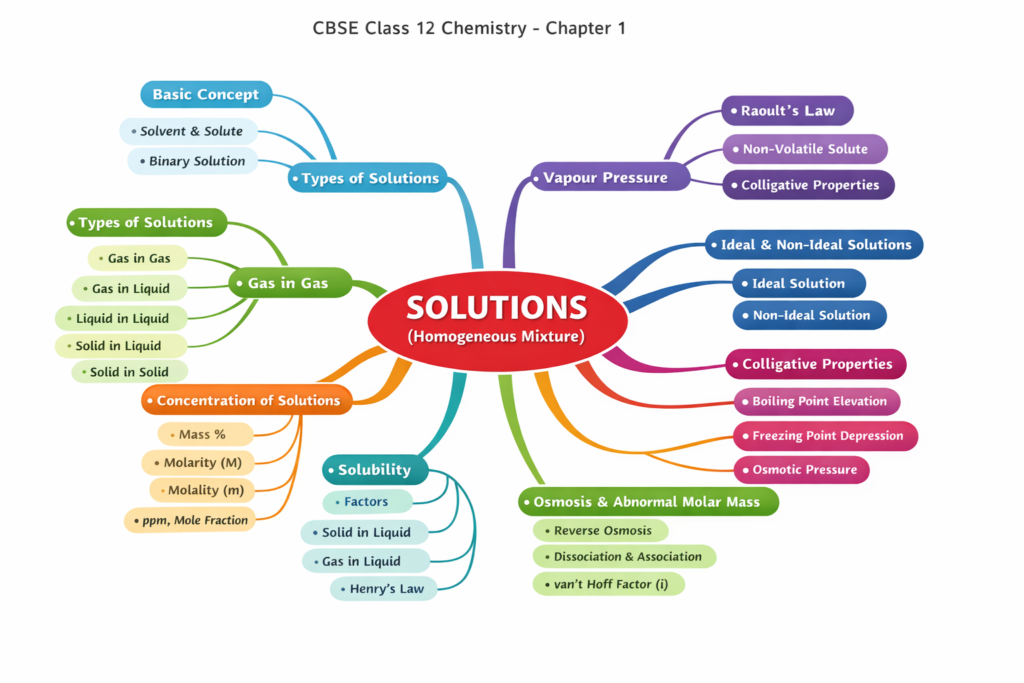
🔹 Basic Idea (Real Life + Concept) 🔹 Solution (Definition) 🔹 Concentration of Solution 🔹 Solubility 🔹 Solubility of Solids in Liquids 🔹 Solubility of Gases in Liquids 🔹 Vapour Pressure of Solutions 🔹 Ideal vs Non-Ideal Solutions 🔹 Azeotropes 🔹 Colligative Properties 🔹 Elevation of Boiling Point 🔹 Depression of Freezing Point 🔹 Osmosis & Osmotic Pressure 🔹 Abnormal Molar Mass
Class 12 Chemistry Chapter 1: Solutions Notes
CBSE Class 12 Chemistry – Unit 1
Solutions (Types of Solutions, Raoult’s Law, Colligative Properties)
Complete Class 12 Chemistry Unit 1 (Solutions) notes, syllabus,
NCERT book PDF aur official Telegram channel ka direct access yahan se milega.
Isme types of solutions, concentration methods, solubility, Raoult’s law,
colligative properties, osmotic pressure aur van’t Hoff factor cover hai.
✅ Correct Answer: Homogeneous mixture of two or more substances
Q2. The component present in largest amount in a solution is called:
A. Solvent
B. Solute
C. Mixture
D. Compound
✅ Correct Answer: Solvent
Q3. Which unit of concentration is temperature independent?
A. Molarity
B. Molality
C. Volume percentage
D. ppm
✅ Correct Answer: Molality
Q4. Solubility of gases in liquids increases with:
A. Increase in pressure
B. Increase in temperature
C. Decrease in pressure
D. No change
✅ Correct Answer: Increase in pressure
Q5. Henry’s law relates solubility of gas with:
A. Partial pressure of gas
B. Density
C. Volume
D. Temperature only
✅ Correct Answer: Partial pressure of gas
Q6. According to Raoult’s law, vapour pressure of solution depends on:
A. Mole fraction of solvent
B. Colour of solution
C. Nature of container
D. Density
✅ Correct Answer: Mole fraction of solvent
Q7. Which of the following is NOT a colligative property?
A. Elevation of boiling point
B. Osmotic pressure
C. Surface tension
D. Depression of freezing point
✅ Correct Answer: Surface tension
Q8. Boiling point of a solution compared to pure solvent is:
A. Higher
B. Lower
C. Same
D. Zero
✅ Correct Answer: Higher
Q9. van’t Hoff factor is used to explain:
A. Abnormal molar mass
B. Surface tension
C. Density
D. Viscosity
✅ Correct Answer: Abnormal molar mass
Q10. Osmotic pressure depends on:
A. Number of solute particles
B. Colour of solution
C. Nature of container
D. Smell of solute
✅ Correct Answer: Number of solute particles
Chemistry Chapter 1 Solutions Quick Revision
🔹 Basic Idea (Real Life + Concept) Zyada tar substances mixtures hote hain aur unki properties composition par depend karti hain.
🔹 Solution (Definition) Solution ek homogeneous mixture hota hai jisme solute solvent me uniformly dissolve hota hai.
🔹 Concentration of Solution Concentration batata hai solution me solute kitni quantity me present hai (M, m, %, x etc.).
🔹 Solubility Given temperature par solvent me dissolve hone wali maximum solute quantity.
🔹 Solubility of Solids in Liquids Generally temperature badhne par solids ki solubility badhti hai.
🔹 Solubility of Gases in Liquids Gas ki solubility pressure se badhti aur temperature se ghat ti hai (Henry’s Law).
🔹 Vapour Pressure of Solutions Non-volatile solute add karne se solvent ka vapour pressure kam ho jata hai (Raoult’s Law).
🔹 Ideal vs Non-Ideal Solutions Ideal Raoult’s law follow karte hain, non-ideal deviation show karte hain.
🔹 Azeotropes Aise mixtures jo constant boiling point par liquid aur vapour same composition dete hain.
🔹 Colligative Properties Ye properties sirf solute particles ki number par depend karti hain, nature par nahi.
🔹 Elevation of Boiling Point Solute add karne se solvent ka boiling point badh jata hai (ΔTb = Kb m).
🔹 Depression of Freezing Point Solute add karne se solvent ka freezing point kam ho jata hai (ΔTf = Kf m).
🔹 Osmosis & Osmotic Pressure Solvent semipermeable membrane se dilute se concentrated side flow karta hai; is flow ko rokne wala pressure osmotic pressure hai.
🔹 Abnormal Molar Mass Dissociation se molar mass kam aur association se zyada calculate hota hai (van’t Hoff factor i).
A solution is a homogeneous mixture of two or more substances in which solute is uniformly dissolved in solvent.
What are the different types of solutions?
Solutions can be gaseous, liquid, or solid depending on the physical state of solvent. Example: oxygen in water (gas in liquid), alloy (solid solution).
What is Raoult’s Law?
Raoult’s law states that the partial vapour pressure of each component in a solution is proportional to its mole fraction.
What are colligative properties?
Colligative properties depend only on number of solute particles, not their nature. Examples: boiling point elevation, freezing point depression, osmotic pressure.
What is osmotic pressure?
Osmotic pressure is the pressure required to stop the flow of solvent through a semipermeable membrane.
What is abnormal molar mass?
Abnormal molar mass occurs due to association or dissociation of solute particles in solution.
What is van’t Hoff factor?
Van’t Hoff factor represents the ratio of actual number of particles in solution to expected number of particles.
2 thoughts on “CBSE Class 12 Chemistry Chapter 1: Solutions – Notes + MCQs | Quick Revision”