CBSE Class 12 Chemistry Chapter 3: Chemical Kinetics – Notes + MCQs | Quick Revision - Pulse By Anubhav

CBSE Class 12 Chemistry Chapter 3: Chemical Kinetics – Notes + MCQs | Quick Revision

You will get here Chemistry Class 12 CBSE Notes and MCQs Chapter 3: Chemical Kinetics . You can connect with us for every important update related to class 12.

Class 12 Chemistry CH 3 Chemical Kinetics NCERT Solutions
Class 12 Chemistry Chapter 3 PDF
Class 12 Chemistry ch 3 Chemical Kinetics notes
Handwritten notes of Chemical Kinetics Class 12 PDF
NCERT Class 12 Chemistry chemical Kinetics intext solutions
3.11 chemistry class 12 chemical kinetics
Class 12 Chemistry Chemical Kinetics NCERT Solutions PDF
Class 12 Chemistry Chemical Kinetics NCERT PDF
Multiple Choice questions on Chemical Kinetics with answers PDF
Notes of chemical Kinetics Class 12 PDF
Class 12 Chemistry Chapter 3 PDF
Class 12 Chemistry CH 3 Chemical Kinetics NCERT Solutions
Handwritten notes of Chemical Kinetics Class 12 PDF
Notes of chemical Kinetics Class 12 PDF free download
Class 12 Chemistry ch 3 Chemical Kinetics notes
Chemical Kinetics MCQs toppr
Chapter 3 chemical kinetics notes pdf
Chapter 3 chemical kinetics notes class 12
Chapter 3 chemical kinetics notes pdf free download
Chapter 3 chemical kinetics notes pdf download
Chapter 3 chemical kinetics notes class 11
Notes of chemical Kinetics Class 12 PDF
Handwritten notes of Chemical Kinetics Class 12 PDF
Notes of chemical Kinetics Class 12 PDF free download

Chemistry is a very important subject for your board exam because it will help you increase your percentage and give big support in your entrance exam like JEE and NEET. You can score high marks in this subject by studying notes and practicing MCQs. In this post, we will cover Chapter 3: Chemical Kinetics .

Also Read- Sophie Shine Wedding, Biography, Career & Personal Life

Key Content Of Chapter 3 Chemical Kinetics

Class 12 Chemistry CH 3 Chemical Kinetics NCERT Solutions
Class 12 Chemistry Chapter 3 PDF
Class 12 Chemistry ch 3 Chemical Kinetics notes
Handwritten notes of Chemical Kinetics Class 12 PDF
NCERT Class 12 Chemistry chemical Kinetics intext solutions
3.11 chemistry class 12 chemical kinetics
Class 12 Chemistry Chemical Kinetics NCERT Solutions PDF
Class 12 Chemistry Chemical Kinetics NCERT PDF
Multiple Choice questions on Chemical Kinetics with answers PDF
Notes of chemical Kinetics Class 12 PDF
Class 12 Chemistry Chapter 3 PDF
Class 12 Chemistry CH 3 Chemical Kinetics NCERT Solutions
Handwritten notes of Chemical Kinetics Class 12 PDF
Notes of chemical Kinetics Class 12 PDF free download
Class 12 Chemistry ch 3 Chemical Kinetics notes
Chemical Kinetics MCQs toppr
Chapter 3 chemical kinetics notes pdf
Chapter 3 chemical kinetics notes class 12
Chapter 3 chemical kinetics notes pdf free download
Chapter 3 chemical kinetics notes pdf download
Chapter 3 chemical kinetics notes class 11
Notes of chemical Kinetics Class 12 PDF
Handwritten notes of Chemical Kinetics Class 12 PDF
Notes of chemical Kinetics Class 12 PDF free download

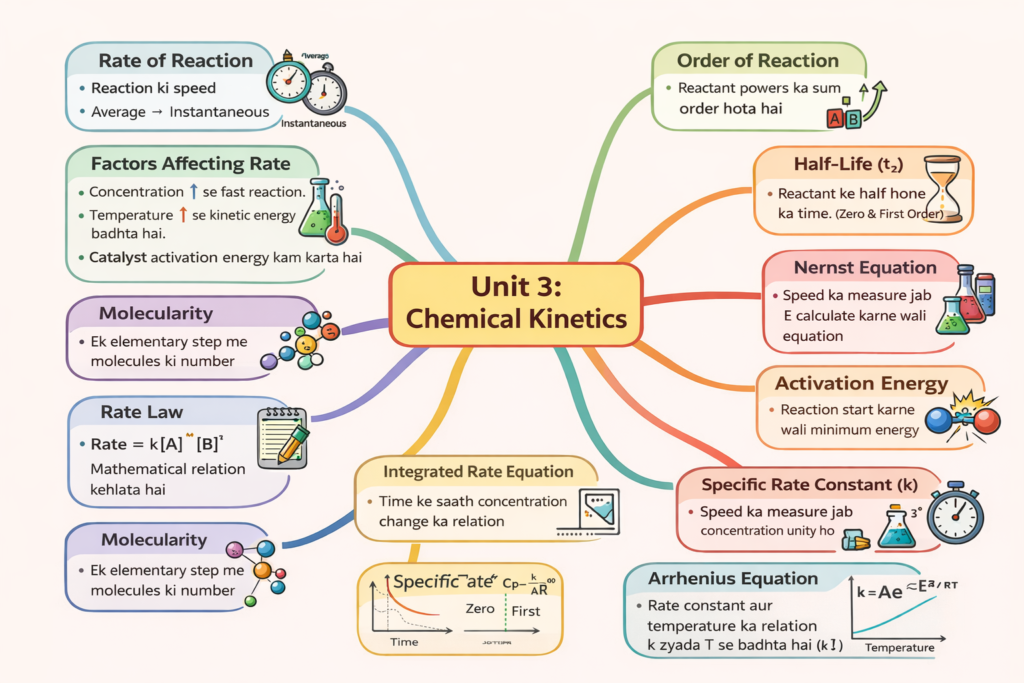
🔹 Rate of Reaction (Average & Instantaneous)
🔹 Factors Affecting Rate of Reaction
🔹 Order of Reaction
🔹 Molecularity of Reaction
🔹 Rate Law
🔹 Specific Rate Constant (k)
🔹 Integrated Rate Equation
🔹 Half-Life (t½)
🔹 Collision Theory (Basic Idea)
🔹 Activation Energy (Ea)

Class 12 Chemistry Chapter 3: Chemical Kinetics Notes

CBSE Class 12 Chemistry – Unit 3
Chemical Kinetics (Rate of Reaction, Order, Arrhenius Equation)
Complete Class 12 Chemistry Unit 3 (Chemical Kinetics) notes, syllabus, NCERT book PDF aur official Telegram channel ka direct access yahan se milega. Isme rate of reaction, factors affecting rate, order & molecularity, rate law, integrated rate equation, half-life, collision theory, activation energy aur Arrhenius equation cover hai.

Also Read- Jemimah Rodrigues: Why She’s Trending, Biography, Net Worth, Age, Lifestyle & Career 2026

Chemistry Chapter 3 Chemical Kinetics MCQs

Q1. Rate of reaction is defined as:
A. Change in concentration per unit time
B. Change in temperature
C. Change in pressure only
D. Mass of product formed
✅ Correct Answer: Change in concentration per unit time
Q2. Instantaneous rate of reaction is obtained from:
A. Slope of tangent to concentration-time curve
B. Total time of reaction
C. Mass of reactant
D. Pressure change
✅ Correct Answer: Slope of tangent to concentration-time curve
Q3. Which factor does NOT affect rate of reaction?
A. Concentration
B. Temperature
C. Colour of reactant
D. Catalyst
✅ Correct Answer: Colour of reactant
Q4. Rate law is determined by:
A. Experiment
B. Balanced equation
C. Molecular mass
D. Temperature only
✅ Correct Answer: Experiment
Q5. Order of reaction is:
A. Sum of powers of concentration terms
B. Number of products
C. Temperature of reaction
D. Reaction time
✅ Correct Answer: Sum of powers of concentration terms
Q6. Molecularity of a reaction can never be:
A. One
B. Two
C. Fractional
D. Three
✅ Correct Answer: Fractional
Q7. Unit of rate constant for first order reaction is:
A. s⁻¹
B. mol L⁻¹ s⁻¹
C. L mol⁻¹ s⁻¹
D. atm
✅ Correct Answer: s⁻¹
Q8. Half-life of first order reaction depends on:
A. Rate constant only
B. Initial concentration
C. Pressure
D. Volume
✅ Correct Answer: Rate constant only
Q9. Catalyst increases rate of reaction by:
A. Lowering activation energy
B. Increasing equilibrium constant
C. Increasing temperature
D. Changing products
✅ Correct Answer: Lowering activation energy
Q10. Arrhenius equation relates rate constant with:
A. Temperature
B. Pressure
C. Volume
D. Density
✅ Correct Answer: Temperature

Chemistry Chapter 3 Chemical Kinetics Quick Revision

🔹 Rate of Reaction (Average & Instantaneous)
Reaction ki speed ko rate kehte hain — average rate time interval me change batata hai, instantaneous rate kisi specific moment par exact speed batata hai.


🔹 Factors Affecting Rate of Reaction
Reaction rate concentration, temperature aur catalyst par depend karti hai — zyada collisions → faster reaction.


🔹 Order of Reaction
Rate law me reactant concentration ke powers ka sum reaction ka order hota hai.


🔹 Molecularity of Reaction
Elementary step me react karne wale molecules ki number molecularity kehlati hai (always whole number).


🔹 Rate Law
Reaction rate aur reactant concentration ka mathematical relation rate law hota hai.
👉 Rate = k[A]ᵐ[B]ⁿ


🔹 Specific Rate Constant (k)
Rate constant reaction ki speed ka measure hai jab reactant concentration unity ho.


🔹 Integrated Rate Equation
Time ke saath reactant concentration ka change batane wali equation (zero aur first order reactions ke liye).


🔹 Half-Life (t½)
Reactant ki initial quantity ka half hone me lagne wala time.


🔹 Collision Theory (Basic Idea)
Reaction tab hoti hai jab molecules sufficient energy aur proper orientation ke saath collide karein.


🔹 Activation Energy (Ea)
Reaction start karne ke liye minimum required energy barrier.

Also Read- CBSE Class 12 Chemistry Chapter 2: Electrochemistry – Notes + MCQs | Quick Revision

FAQs About Chapter Chemical Kinetics

FAQs About Chemical Kinetics (Class 12 Chemistry)
1. What is rate of reaction?
Rate of reaction is the change in concentration of reactants or products per unit time.
2. What is the difference between average and instantaneous rate?
Average rate is calculated over a time interval, while instantaneous rate is the rate at a particular instant and is obtained from the slope of the tangent to the concentration-time curve.
3. What factors affect the rate of reaction?
The main factors affecting rate are concentration, temperature and catalyst.
4. What is order of reaction?
Order of reaction is the sum of powers of concentration terms in the rate law expression.
5. What is molecularity of reaction?
Molecularity is the number of reacting species that collide simultaneously in an elementary reaction.
6. What is activation energy?
Activation energy is the minimum energy required for reactant molecules to form an activated complex and start the reaction.
7. What is Arrhenius equation?
Arrhenius equation relates rate constant with temperature: k = A e-Ea/RT, where Ea is activation energy.
8. What is half-life of a reaction?
Half-life is the time required for the concentration of a reactant to become half of its initial value.
📘 CBSE Class 12 Chemistry – All Units

Unit 10: Biomolecules
View Post
Unit 9: Amines
View Post
Unit 8: Aldehydes, Ketones and Carboxylic Acids
View Post
Unit 7: Alcohols, Phenols and Ethers
View Post
Unit 6: Haloalkanes and Haloarenes
View Post
Unit 5: Coordination Compounds
View Post
Unit 4: d and f Block Elements
View Post
Unit 3: Chemical Kinetics
View Post
Unit 2: Electrochemistry
View Post
Unit 1: Solutions
View Post

1 thought on “CBSE Class 12 Chemistry Chapter 3: Chemical Kinetics – Notes + MCQs | Quick Revision”

Leave a Comment