CBSE Class 12 Chemistry Chapter 5: Coordination Compounds – Notes + MCQs | Quick Revision - Pulse By Anubhav

CBSE Class 12 Chemistry Chapter 5: Coordination Compounds – Notes + MCQs | Quick Revision

You will get here Chemistry Class 12 CBSE Notes and MCQs Chapter 5: Coordination Compounds . You can connect with us for every important update related to class 12.

Previous Year questions on Coordination Compounds Class 12 with answers
Class 12 Chemistry Chapter 5 Notes coordination compounds
Class 12 Chemistry CH 5 coordination compounds NCERT Solutions
Coordination Compounds Previous Year questions PDF download Class 12
Class 12 Chemistry Chapter 5 notes PDF
Class 12 Chemistry CH 5 Coordination Compounds NCERT PDF
Class 12 Chemistry chapter 5 Intext Questions Solutions
Class 12 Chemistry coordination compounds Important Topics
Class 12 Chemistry coordination compounds Notes PDF
Coordination compounds Class 12 notes PW PDF
Coordination compounds Class 12 Notes Handwritten
Notes of Coordination Compounds Class 12 PDF download Handwritten
Coordination compounds Class 12 NCERT
Class 12 Chemistry Coordination Compounds NCERT PDF
Previous Year questions on Coordination Compounds Class 12 with answers
Coordination Compounds Class 12 PPT
Coordination compounds notes learn CBSE
Coordination compounds notes pdf
Class 12 Chemistry coordination compounds Notes PDF
Coordination compounds Class 12 Notes
Class 12 Chemistry co-ordination compounds Notes hsslive
Coordination compounds notes pdf B sc 2nd year
Coordination Compounds notes HSC
Class 12 Chemistry Coordination Compounds Notes Handwritten

Chemistry is a very important subject for your board exam because it will help you increase your percentage and give big support in your entrance exam like JEE and NEET. You can score high marks in this subject by studying notes and practicing MCQs. In this post, we will cover Chapter 5: Coordination Compounds .

Also Read- Sophie Shine Wedding, Biography, Career & Personal Life

Key Content Of Chapter 5 Coordination Compounds

Previous Year questions on Coordination Compounds Class 12 with answers
Class 12 Chemistry Chapter 5 Notes coordination compounds
Class 12 Chemistry CH 5 coordination compounds NCERT Solutions
Coordination Compounds Previous Year questions PDF download Class 12
Class 12 Chemistry Chapter 5 notes PDF
Class 12 Chemistry CH 5 Coordination Compounds NCERT PDF
Class 12 Chemistry chapter 5 Intext Questions Solutions
Class 12 Chemistry coordination compounds Important Topics
Class 12 Chemistry coordination compounds Notes PDF
Coordination compounds Class 12 notes PW PDF
Coordination compounds Class 12 Notes Handwritten
Notes of Coordination Compounds Class 12 PDF download Handwritten
Coordination compounds Class 12 NCERT
Class 12 Chemistry Coordination Compounds NCERT PDF
Previous Year questions on Coordination Compounds Class 12 with answers
Coordination Compounds Class 12 PPT
Coordination compounds notes learn CBSE
Coordination compounds notes pdf
Class 12 Chemistry coordination compounds Notes PDF
Coordination compounds Class 12 Notes
Class 12 Chemistry co-ordination compounds Notes hsslive
Coordination compounds notes pdf B sc 2nd year
Coordination Compounds notes HSC
Class 12 Chemistry Coordination Compounds Notes Handwritten

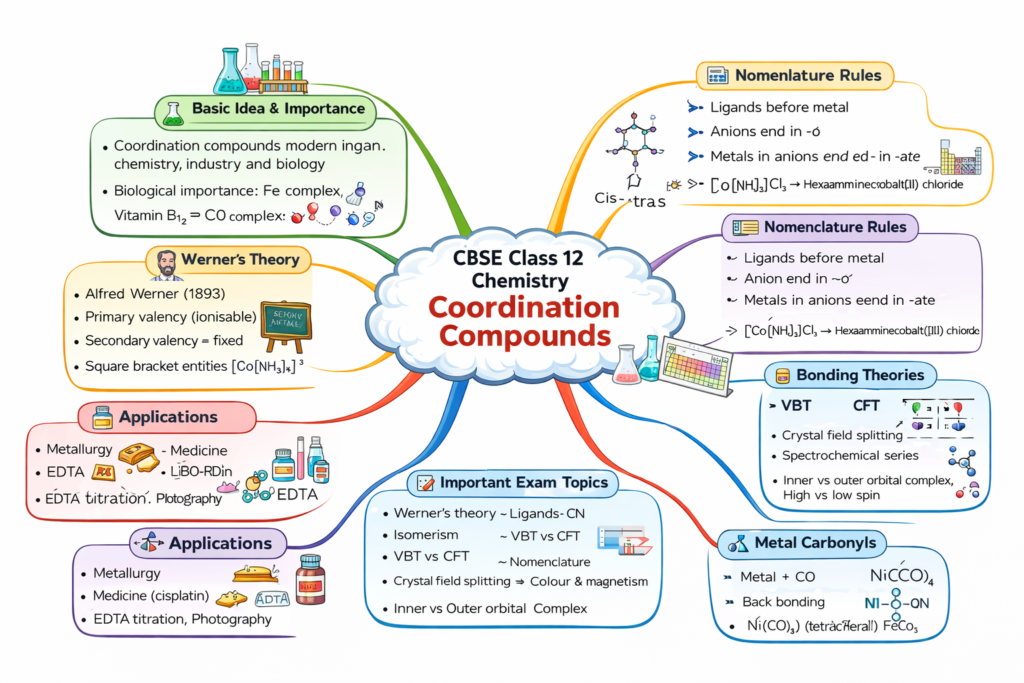
🔷 1. Basic Idea (Concept & Importance)
🔷 2. Werner’s Theory of Coordinatiion Compounds
🔷 3. Important Terms (Definitions)
🔷 4. Nomenclature of Coordiination Compounds (IUPAC Rules)
🔷 5. Isomerism in Coordination Compounds
🔷 6. Bonding in Coordination Compounds
🔷 7. Color in Coordiination Compounds
🔷 8. Magnetic Properties
🔷 9. Metal Carbonyls
🔷 10. Applications of Coordinatiion Compounds

Class 12 Chemistry Chapter 5: Coordination Compounds Notes

CBSE Class 12 Chemistry – Unit 5
Coordination Compounds (Werner’s Theory, Bonding, Isomerism, Applications)
Complete Class 12 Chemistry Unit 5 (Coordination Compounds) notes, syllabus, NCERT book PDF aur official Telegram channel ka direct access yahan se milega. Isme Werner’s theory, ligands, nomenclature, isomerism, bonding theories, crystal field theory, colour, magnetic properties aur applications cover hai.

Also Read- Jemimah Rodrigues: Why She’s Trending, Biography, Net Worth, Age, Lifestyle & Career 2026

Chemistry Chapter 5 Coordination Compounds MCQs

Q1. In coordination compounds, ligands act as:
A. Electron pair donors
B. Proton donors
C. Electron acceptors
D. Oxidising agents
✅ Correct Answer: Electron pair donors
Q2. According to Werner’s theory, secondary valency represents:
A. Coordination number
B. Oxidation state
C. Atomic number
D. Mass number
✅ Correct Answer: Coordination number
Q3. The coordination number of [Co(NH₃)₆]³⁺ is:
A. 6
B. 4
C. 3
D. 2
✅ Correct Answer: 6
Q4. Which of the following is a bidentate ligand?
A. Ethylenediamine (en)
B. NH₃
C. Cl⁻
D. H₂O
✅ Correct Answer: Ethylenediamine (en)
Q5. Complexes having only one type of ligand are called:
A. Homoleptic complexes
B. Heteroleptic complexes
C. Chelates
D. Double salts
✅ Correct Answer: Homoleptic complexes
Q6. Geometrical isomerism in coordination compounds is also called:
A. Cis–trans isomerism
B. Linkage isomerism
C. Ionisation isomerism
D. Solvate isomerism
✅ Correct Answer: Cis–trans isomerism
Q7. Colour of coordination compounds is mainly due to:
A. d–d electronic transitions
B. Nuclear reactions
C. Proton transfer
D. Ionic bonding
✅ Correct Answer: d–d electronic transitions
Q8. Which theory explains splitting of d-orbitals in coordination compounds?
A. Crystal Field Theory
B. Molecular Orbital Theory
C. Dalton’s Theory
D. Kinetic Theory
✅ Correct Answer: Crystal Field Theory
Q9. Paramagnetism in coordination compounds is due to:
A. Presence of unpaired electrons
B. Paired electrons
C. High density
D. Low temperature
✅ Correct Answer: Presence of unpaired electrons
Q10. EDTA is an example of:
A. Hexadentate ligand
B. Unidentate ligand
C. Ambidentate ligand
D. Neutral metal
✅ Correct Answer: Hexadentate ligand

Chemistry Chapter 5 Coordiination Compounds Quick Revision

🔹 Basic Idea (Real Life + Concept)
Coordinatiion compounds central metal ion aur ligands se milkar bante hain aur biological systems, medicine, metallurgy aur industry me important role play karte hain.


🔹 Werner’s Theory of Coordiination Compounds
Metal do valency show karta hai — primary valency (ionisable) aur secondary valency (non-ionisable). Secondary valency coordination number ke equal hoti hai aur definite geometry deti hai.


🔹 Important Terms (Definitions)
Central metal, ligand, coordiination number, coordiination sphere, oxidation number etc. cordination compounds ke basic concepts define karte hain jo complex structure samajhne me help karte hain.


🔹 Nomenclature of Coordinatiion Compounds (IUPAC Rules)
Coordination compouunds ko systematic rules se name kiya jata hai jisme pehle ligands aur phir metal ka naam likhte hain aur oxidation state Roman number me show karte hain.


🔹 Isomerism in Coordinaton Compunds
Same formula wale coordinaton compounds different arrangement ki wajah se different properties show karte hain — jaise geometrical, optical aur structural isomerism.


🔹 Bonding in Coordination Compunds
Metal aur ligand ke beech coordinate bond banta hai jise Valence Bond Theory (VBT) aur Crystal Field Theory (CFT) se explain kiya jata hai.


🔹 Colour in Coordinatiion Compounds
Transition metal complexes coloured hote hain kyunki d-orbitals me electron transition hota hai jo specific wavelength absorb karta hai.


🔹 Magnetic Properties
Coordination compouunds ki magnetic nature unpaired electrons ki number par depend karti hai — paramagnetic (unpaired) ya diamagnetic (paired).


🔹 Metal Carbonyls
Metal carbonyls me metal CO ligand se bond karta hai aur σ-donation aur π-back bonding show karta hai.


🔹 Applications of Coordination Commpounds
Coordination compouunds ka use medicine (cisplatin), metallurgy, electroplating, analytical chemistry aur biological systems me hota hai.

Also Read- CBSE Class 12 Chemistry Chapter 4: The d – and f – Block Elements – Notes + MCQs | Quick Revision

FAQs About Chapter Coordination Compound

CBSE Class 12 Chemistry – Chapter 5 FAQs
1. What are coordination compounds?
Coordination compounds are compounds in which a central metal atom or ion is bonded to a fixed number of ligands through coordinate bonds.
2. What is Werner’s theory in simple terms?
Werner proposed that metals show two valencies – primary (ionisable, oxidation state) and secondary (non-ionisable, coordination number). Secondary valency determines geometry.
3. What is a ligand?
A ligand is an ion or molecule that donates a pair of electrons to the central metal atom. Example: NH₃, Cl⁻, H₂O, en, EDTA.
4. What is coordination number?
Coordination number is the number of donor atoms directly bonded to the central metal ion. Example: In [Co(NH₃)₆]³⁺, coordination number = 6.
5. What types of isomerism are shown by coordination compounds?
They show structural isomerism (linkage, ionisation, coordination, solvate) and stereoisomerism (geometrical and optical isomerism).
6. Why are coordination compounds coloured?
Due to d–d electronic transitions. Electrons absorb visible light and get excited to higher energy levels, producing colour.
7. What is Crystal Field Theory?
Crystal Field Theory explains the splitting of d-orbitals in presence of ligands and helps explain colour and magnetic properties.
8. What is the difference between strong field and weak field ligands?
Strong field ligands cause large d-orbital splitting (low spin complexes) while weak field ligands cause small splitting (high spin complexes).
9. What are metal carbonyls?
Metal carbonyls are coordination compounds containing CO as ligand. Example: Ni(CO)₄, Fe(CO)₅.
10. What are the applications of coordination compounds?
Used in metallurgy, medicine (cisplatin), analytical chemistry (EDTA titration), electroplating, photography and biological systems like haemoglobin.
📘 CBSE Class 12 Chemistry – All Units

Unit 10: Biomolecules
View Post
Unit 9: Amines
View Post
Unit 8: Aldehydes, Ketones and Carboxylic Acids
View Post
Unit 7: Alcohols, Phenols and Ethers
View Post
Unit 6: Haloalkanes and Haloarenes
View Post
Unit 5: Coordination Compounds
View Post
Unit 4: d and f Block Elements
View Post
Unit 3: Chemical Kinetics
View Post
Unit 2: Electrochemistry
View Post
Unit 1: Solutions
View Post

1 thought on “CBSE Class 12 Chemistry Chapter 5: Coordination Compounds – Notes + MCQs | Quick Revision”

Leave a Comment