You will get here Chemistry Class 12 CBSE Notes and MCQs Chapter 7: Alcohols, Phenols and Ethers . You can connect with us for every important update related to class 12.
Chemistry is a very important subject for your board exam because it will help you increase your percentage and give big support in your entrance exam like JEE and NEET. You can score high marks in this subject by studying notes and practicing MCQs. In this post, we will cover Chapter 7: Alcohols, Phenols and Ethers .
Key Content Of Chapter 7 Alcohols, Phenols and Ethers
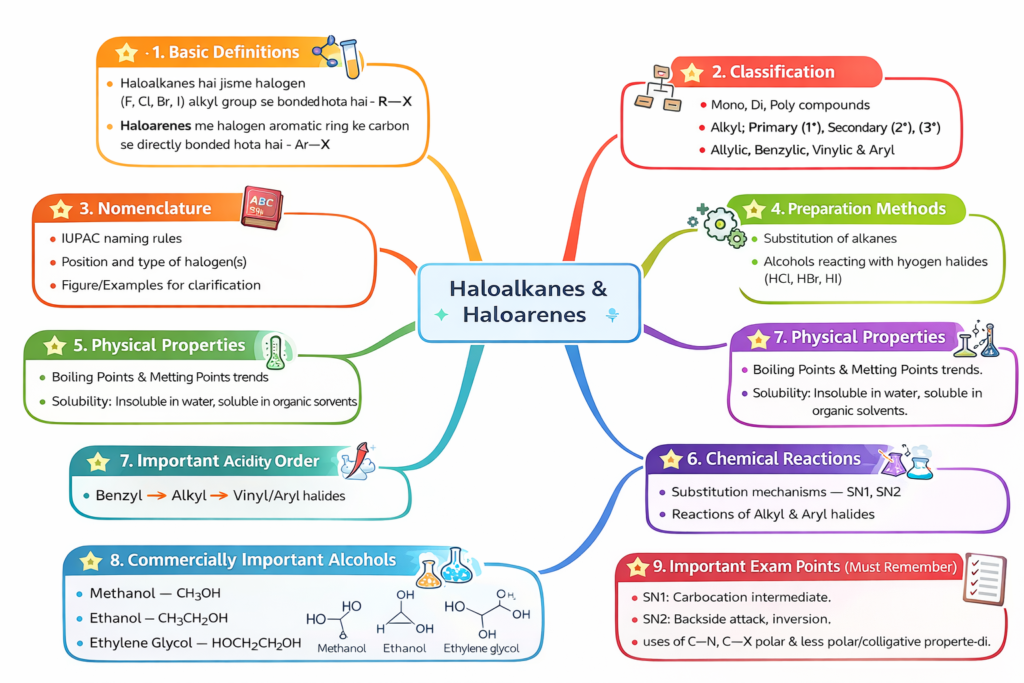
⭐ 1. Basic Definitions ⭐ 2. Classification ⭐ 3. Nomenclature (Very Important for Exams) ⭐ 4. Preparation Methods ⭐ 5. Physical Properties ⭐ 6. Chemical Reactions ⭐ 7. Important Acidity Order ⭐ 8. Commercially Important Alcohols ⭐ 9. Important Exam Points (Must Remember)
Class 12 Chemistry Chapter 7: Alcohols, Phenols and Ethers Notes
CBSE Class 12 Chemistry – Unit 7
Alcohols, Phenols and Ethers
Complete Class 12 Chemistry Unit 7 (Alcohols, Phenols and Ethers) notes, syllabus,
NCERT book PDF aur official Telegram channel ka direct access yahan se milega.
Isme alcohols, phenols aur ethers ki nomenclature, classification, preparation methods,
physical & chemical properties, acidity of phenols, electrophilic substitution reactions,
dehydration mechanism, identification of alcohols aur uses of methanol, ethanol aur phenols cover hai.
Chemistry Chapter 7 Alcohols, Phenols and Ethers MCQs
Q1. Alcohols are compounds in which –OH group is attached to:
A. sp³ hybridised carbon of aliphatic system
B. Aromatic nitrogen
C. Double bonded carbon only
D. Oxygen atom
✅ Correct Answer: sp³ hybridised carbon of aliphatic system
Q2. Phenols differ from alcohols because –OH group is attached to:
A. Alkyl group
B. Aromatic ring
C. Hydrogen atom
D. Ether linkage
✅ Correct Answer: Aromatic ring
Q3. General formula of ethers is:
A. R–OH
B. R–O–R′
C. R–CHO
D. R–COOH
✅ Correct Answer: R–O–R′
Q4. Which alcohol gives immediate turbidity in Lucas test?
A. Primary alcohol
B. Secondary alcohol
C. Tertiary alcohol
D. Phenol
✅ Correct Answer: Tertiary alcohol
Q5. Which method is most important for preparation of ethers?
A. Williamson ether synthesis
B. Hydrolysis
C. Oxidation
D. Reduction
✅ Correct Answer: Williamson ether synthesis
Q6. Phenol is more acidic than alcohol due to:
A. Resonance stabilisation of phenoxide ion
B. Hydrogen bonding
C. Low molecular mass
D. Weak O–H bond
✅ Correct Answer: Resonance stabilisation of phenoxide ion
Q7. Dehydration of alcohols produces:
A. Alkene
B. Ketone
C. Ether only
D. Aldehyde
✅ Correct Answer: Alkene
Q8. Order of ease of dehydration of alcohols is:
A. 1° > 2° > 3°
B. 3° > 2° > 1°
C. 2° > 1° > 3°
D. All equal
✅ Correct Answer: 3° > 2° > 1°
Q9. Which alcohol is highly poisonous and causes blindness?
A. Methanol
B. Ethanol
C. Propanol
D. Butanol
✅ Correct Answer: Methanol
Q10. Which reaction introduces –CHO group in phenol?
A. Kolbe reaction
B. Reimer–Tiemann reaction
C. Nitration
D. Oxidation
✅ Correct Answer: Reimer–Tiemann reaction
Chemistry Chapter 7 Alcohols, Phenols and Ethers Quick Revision
🔹 Basic Idea (Real Life + Concept) Hydrocarbons me hydrogen replace hone se alcohols, phenols aur ethers bante hain. Inka use daily life me solvents, medicines, fuels aur industry me hota hai.
🔹 Alcohols (Definition) –OH group agar aliphatic carbon se attached ho → alcohol (R–OH).
🔹 Phenols (Definition) –OH group agar benzene ring se directly attached ho → phenol.
🔹 Ethers (Definition) Oxygen do alkyl/aryl groups ko join karta hai → R–O–R′ structure.
🔹 Classification of Alcohols
Primary (1°) → –OH on 1° carbon
Secondary (2°) → –OH on 2° carbon
Tertiary (3°) → –OH on 3° carbon
Mono, di, tri, polyhydric based on number of –OH.
🔹 Classification of Phenols Mono, di, trihydric phenols based on number of –OH groups.
🔹 Classification of Ethers
Symmetrical ether → same groups
Unsymmetrical ether → different groups
🔹 Nomenclature (Very Important for Exams)
Alcohol → alkane + “ol” (propanol).
Phenol → base name phenol, ortho/meta/para positions.
Alcohols are organic compounds in which hydroxyl group (–OH) is attached to an sp³ hybridised carbon of an aliphatic system. Example: Methanol, Ethanol.
What is the difference between alcohol and phenol?
In alcohols, –OH group is attached to an aliphatic carbon atom, whereas in phenols –OH group is directly attached to an aromatic benzene ring.
Why is phenol more acidic than alcohol?
Phenol is more acidic because phenoxide ion formed after losing H⁺ is stabilised by resonance, while alkoxide ion of alcohol does not have resonance stabilisation.
What is Williamson ether synthesis?
Williamson ether synthesis is a method for preparation of ethers by reaction of alkyl halide with sodium alkoxide.
R–X + R′ONa → R–O–R′
How are primary, secondary and tertiary alcohols identified?
They are identified by Lucas test. Tertiary alcohol gives immediate turbidity, secondary gives turbidity after some time, and primary alcohol shows no turbidity at room temperature.
What is dehydration of alcohol?
Dehydration of alcohol is removal of water from alcohol in presence of acid to form alkene. Ease of dehydration: 3° > 2° > 1°.
What are the uses of methanol and ethanol?
Methanol is used as solvent and in manufacture of formaldehyde but is highly poisonous. Ethanol is used as fuel, solvent, antiseptic and in alcoholic beverages.
What are ethers?
Ethers are organic compounds in which oxygen atom is bonded to two alkyl or aryl groups (R–O–R′). They are commonly used as solvents and anaesthetics.
1 thought on “CBSE Class 12 Chemistry Chapter 7: Alcohols, Phenols and Ethers – Notes + MCQs | Quick Revision”