
Nepal floods LIVE: Flash floods leave hundreds dead and nearly 3,000 missing as rescue teams intensify operations across affected regions.
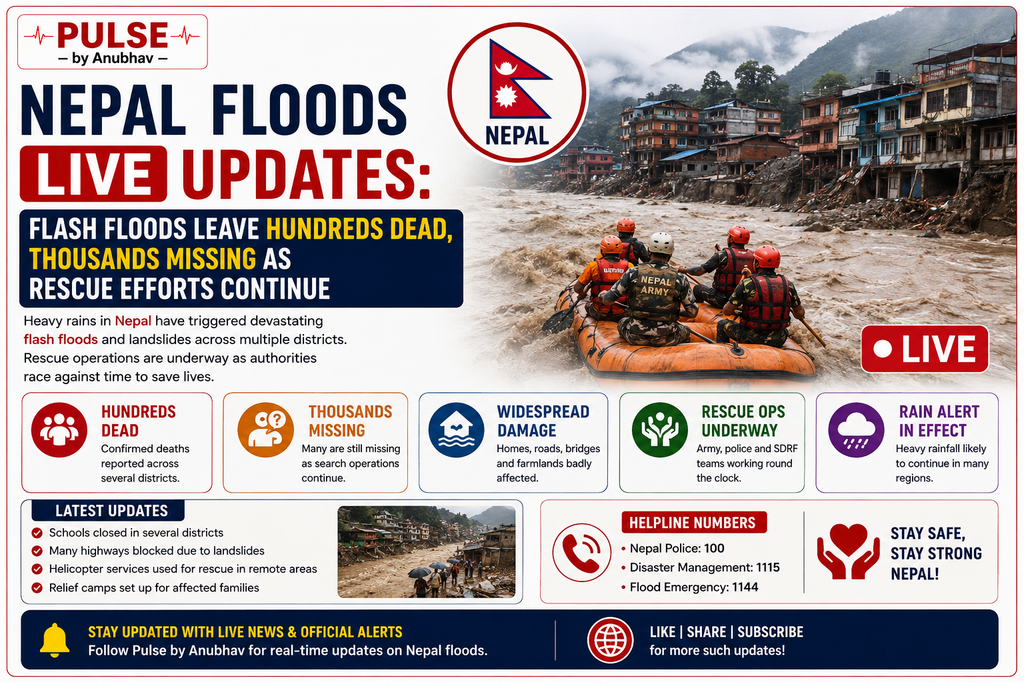
Nepal floods have caused widespread devastation after powerful flash floods swept through areas near the Nepal-Tibet border. Hundreds of people have died and nearly 3,000 remain missing as rescue teams search through mud, debris and damaged hydropower tunnels. India and China have sent specialised assistance, while Nepal estimates rebuilding could cost up to $5 billion. Fresh rainfall remains a concern as authorities continue rescue, relief and evacuation operations.
Also Read- CTET Exam 2026 Postponed: Application Reopened Till September 1, New Exam Date Soon
Nepal Floods LIVE Updates: Flash Floods Leave Hundreds Dead, Nearly 3,000 Missing as Rescue Operations Intensify

The Nepal floods crisis has entered a critical phase as rescue teams continue their search for thousands of people still missing after a devastating wall of water, mud and debris swept through areas near the Nepal-Tibet border. The disaster, which struck on August 26, has killed hundreds of people in Nepal and Tibet, while several victims are believed to have been carried downstream into India.
The latest figures released on Saturday, August 29, put the death toll in Nepal at 675, while seven deaths have been confirmed on the Tibetan side. With hundreds of people still unaccounted for, the combined number of missing in Nepal and Tibet has climbed to nearly 3,000.
The disaster is believed to have been triggered by a glacial collapse and an ice-rock avalanche, which sent a massive surge of water and debris into the Bhote Koshi River system. The sudden flooding devastated villages, roads, bridges and hydropower infrastructure across the region.
For Pulse by Anubhav, here is a detailed look at the latest developments from Nepal, Tibet and India as rescue and relief operations continue.
Nepal Floods: Death Toll Rises to 675
Nepal’s disaster authorities have reported that at least 675 people have died in the floods. The toll has continued to rise as rescue teams recover bodies from affected districts and downstream rivers.
Seven more deaths have been confirmed in Tibet, taking the known death toll linked to the disaster across Nepal and Tibet to 682. Several bodies have also been recovered in India’s Uttar Pradesh after apparently being swept downstream from Nepal.
The scale of the disaster remains difficult to assess fully because many remote areas are still inaccessible and communication links have been damaged.
Nearly 3,000 People Still Missing
One of the biggest concerns remains the growing number of missing people.
Authorities in Nepal have listed 2,426 people as missing, while Chinese authorities have reported 554 missing in Tibet. Together, the figure is close to 3,000.
The missing include local residents, hydropower workers, trekkers, pilgrims and foreign nationals. Nepal’s disaster agency has also listed 933 hydropower workers among those unaccounted for.
Rescue officials are facing a particularly difficult challenge at hydropower projects, where thick layers of mud and debris have blocked tunnels.
More Than 100 Workers Trapped Inside Hydropower Tunnel
Rescue operations have intensified at the Trishuli 3A Hydropower Project in Rasuwa, where more than 100 workers are believed to be trapped inside a mud-filled tunnel.
Nepal Army and police personnel have been working continuously to clear the tunnel entrance. Heavy mud, unstable conditions and poor weather have made the operation extremely dangerous.
Rescuers have already managed to pull some survivors from the mud, but authorities remain concerned about those still inside.
India Sends Specialised Tunnel Rescue Team
At Nepal’s request, India has sent an 11-member specialised team consisting of tunnel rescue experts and medical personnel.
The team reached the Trishuli area after carrying out an aerial reconnaissance of the Chilime and Langtang regions. Its focus is expected to include assessing the safest way to reach people trapped inside damaged hydropower tunnels.
China has also sent tunnel rescue specialists from Tibet to assist with the operation.
Nepal Requests Specialised International Assistance
Nepal has clarified that it needs international assistance in several specialised areas as the disaster response expands.
The government has sought technical help for tunnel rescue operations, locating survivors, forensic and DNA identification, transportation and communication restoration, and the preservation of recovered bodies.
Nepal’s Foreign Minister Shisir Khanal has also rejected reports that the country refused international assistance. He said support would be essential not only for immediate relief but also for reconstruction.
Nepal Floods Reconstruction Bill Could Reach $5 Billion
The economic damage from the disaster could be enormous.
Nepal’s Finance Minister Swarnim Wagle has estimated that rebuilding the flood-hit areas could cost between $4 billion and $5 billion. He stressed that the figure is only an initial estimate because the government is still assessing the full extent of the loss and damage.
Foreign Minister Khanal separately said reconstruction and rehabilitation could require billions of dollars and appealed to the international community for support.
The floods have damaged roads, bridges, homes, schools and major infrastructure, meaning recovery could take a considerable amount of time.
Fresh Rain Threatens Rescue Operations
Rescuers are also keeping a close watch on the weather.
Nepal’s meteorological authorities have warned of fresh rainfall and thunderstorms in several flood-affected areas. Moderate to heavy rainfall is possible across parts of the country’s hilly and mountainous regions.
This could further complicate helicopter operations and ground searches, particularly in areas already affected by landslides and unstable terrain.
Authorities have therefore urged caution as rescue teams continue working in extremely difficult conditions.
Risk of Another Lake Burst Declines
A major concern after the original disaster was the possibility of another sudden flood from a lake formed by the glacial collapse near the Nepal-Tibet border.
Chinese authorities have now said the immediate risk appears to have decreased as water has been gradually flowing out of the lake.
Satellite observations showed that the lake had reduced in size by Saturday morning. However, officials continue to monitor the area because another body of water formed closer to the site of the glacial collapse remains under observation.
Any sudden release of water could put rescue teams and downstream communities at additional risk.
Also Read- Toxic Review & Release Date: Yash’s Film Faces CBFC Cuts, Earns ₹41 Crore in Pre-Sales
Bodies Recovered From Gandak River in Uttar Pradesh
The impact of the Nepal floods has also been felt across the border in India.
Three more bodies were recovered from the Gandak River in Uttar Pradesh’s Kushinagar district on Saturday. Authorities suspect they may have been swept downstream from Nepal during the floods.
With the latest recoveries, the number of bodies found in the Gandak river system across Kushinagar and Maharajganj has increased further.
Officials are working to identify the victims and have remained in contact with Nepalese authorities to determine whether the deceased were among those reported missing.
India Steps Up Assistance to Nepal
India has continued to provide humanitarian assistance to flood-hit Nepal.
Relief supplies, medical assistance and specialised personnel have been sent through multiple consignments. An Indian tunnel rescue team has also reached Nepal following Kathmandu’s request for technical assistance.
Indian authorities are simultaneously monitoring the situation along the border, particularly because rivers originating in Nepal can affect downstream areas of Uttar Pradesh and Bihar.
India has also increased surveillance of glaciers and glacial lakes in its Himalayan regions following the disaster.
Indians Among Those Missing and Stranded
A significant number of Indian nationals were caught in the disaster zone, particularly pilgrims, tourists and workers associated with hydropower projects.
The Ministry of External Affairs has been coordinating rescue and evacuation efforts, while state governments have been working to trace residents reported missing in Nepal and Tibet.
Several groups of stranded Indians have already returned home, including pilgrims from Maharashtra, Tamil Nadu and Andhra Pradesh.
However, hundreds of Indians and people of Indian origin were still reported to be missing or uncontactable in the wider disaster zone in the latest updates.
Foreign Tourists and Pilgrims Also Unaccounted For
The disaster has affected people from several countries who were travelling through Nepal and Tibet.
Among those reported missing are pilgrims travelling towards Mount Kailash, tourists and workers from different nationalities. Nepal’s authorities have listed hundreds of foreign nationals among those whose whereabouts remain unknown.
Families in several countries are now waiting for information as rescue teams try to reach remote areas where roads, bridges and communication networks have been destroyed.
Roads and Communication Networks Severely Damaged
The flash floods have caused extensive damage to Nepal’s transport infrastructure.
Several roads and bridges were washed away, leaving remote communities isolated. Some routes have now reopened gradually, but major stretches remain blocked by flood debris and landslides.
Helicopters are being used to evacuate stranded people and deliver essential supplies to places that remain inaccessible by road.
Restoring connectivity has become a major priority because rescue teams cannot reach several of the worst-hit locations without first clearing damaged roads.
More Than 3,700 People Rescued So Far
Despite the enormous challenges, thousands of people have already been brought to safety.
Rescue teams involving the Nepal Army, police and other agencies have evacuated people from badly affected communities, hydropower sites and remote areas.
The Nepal Army has also been using helicopters to reach stranded residents and transport relief supplies.
However, authorities warn that the rescue operation remains far from over, particularly with thousands still missing and bad weather threatening to slow aerial operations.
What Caused the Nepal Floods?
The disaster is believed to have begun after a glacial collapse and ice-rock avalanche in the Himalayan region near the Nepal-Tibet border.
The collapse generated a sudden and powerful surge of water, mud and debris that moved rapidly through river systems.
The torrent then struck settlements and infrastructure downstream, causing widespread destruction in a matter of minutes.
The event has once again highlighted the vulnerability of Himalayan communities to sudden glacial and hydrological disasters.
Nepal Floods LIVE: Rescue Efforts Continue
For now, the priority remains clear — find survivors, rescue those trapped and provide relief to communities cut off by the disaster.
Search teams are continuing operations despite unstable terrain, heavy mud, damaged roads and the possibility of additional rainfall. Authorities in Nepal, India and China are also monitoring conditions around the border and nearby glacial lakes.
With the death toll continuing to rise and nearly 3,000 people still missing, the Nepal floods have become one of the region’s most devastating disasters in recent years.
Pulse by Anubhav will continue to track the latest developments, rescue operations, evacuation efforts and official updates from Nepal, Tibet and India.
Also Read- RRB NTPC UG Result 2026 Out: CBT 1 Merit List PDF, Scorecard & Zone-Wise Result (CEN 07/2025)
FAQs About Nepal Floods Flash Floods
Nepal Floods: Frequently Asked Questions
Everything you need to know about the Nepal floods, flash floods, casualties, rescue operations and the latest situation.
What is the latest update on the Nepal floods?
The Nepal floods have caused widespread destruction near the Nepal-Tibet border. Hundreds of people have died and nearly 3,000 people remain missing across Nepal and Tibet, while rescue and relief operations continue.
How many people have died in the Nepal floods?
At least 675 people have been reported dead in Nepal, while seven deaths have also been confirmed on the Tibetan side in the latest updates.
How many people are missing after the Nepal flash floods?
Nearly 3,000 people are reported missing across Nepal and Tibet. Nepal has reported thousands of missing people, while hundreds are also unaccounted for on the Tibetan side.
What caused the Nepal flash floods?
The devastating flash floods were linked to a glacial collapse and an ice-rock avalanche near the Nepal-Tibet border, sending a powerful surge of water, mud and debris downstream.
How much could Nepal need to rebuild after the floods?
Nepal’s Finance Minister has estimated that rebuilding could cost around $4 billion to $5 billion. The figure remains an initial estimate as authorities continue assessing the damage.
Is India helping Nepal with flood rescue operations?
Yes. India has sent relief supplies, medical assistance and an 11-member specialised team, including tunnel rescue experts, to support Nepal’s ongoing rescue operations.
Are more flash floods possible in Nepal?
Authorities have warned of fresh rainfall and thunderstorms in several affected areas. Further rain could make rescue operations more difficult and increase the risk of additional flooding.
Are Indians missing in the Nepal floods?
Yes. Indian nationals and people of Indian origin are among those reported missing or uncontactable following the Nepal flash floods. Authorities are continuing tracing, rescue and evacuation efforts.
Latest updates, explained simply.
1 thought on “Nepal Floods LIVE Updates: Flash Floods Leave Hundreds Dead, Thousands Missing as Rescue Efforts Continue”