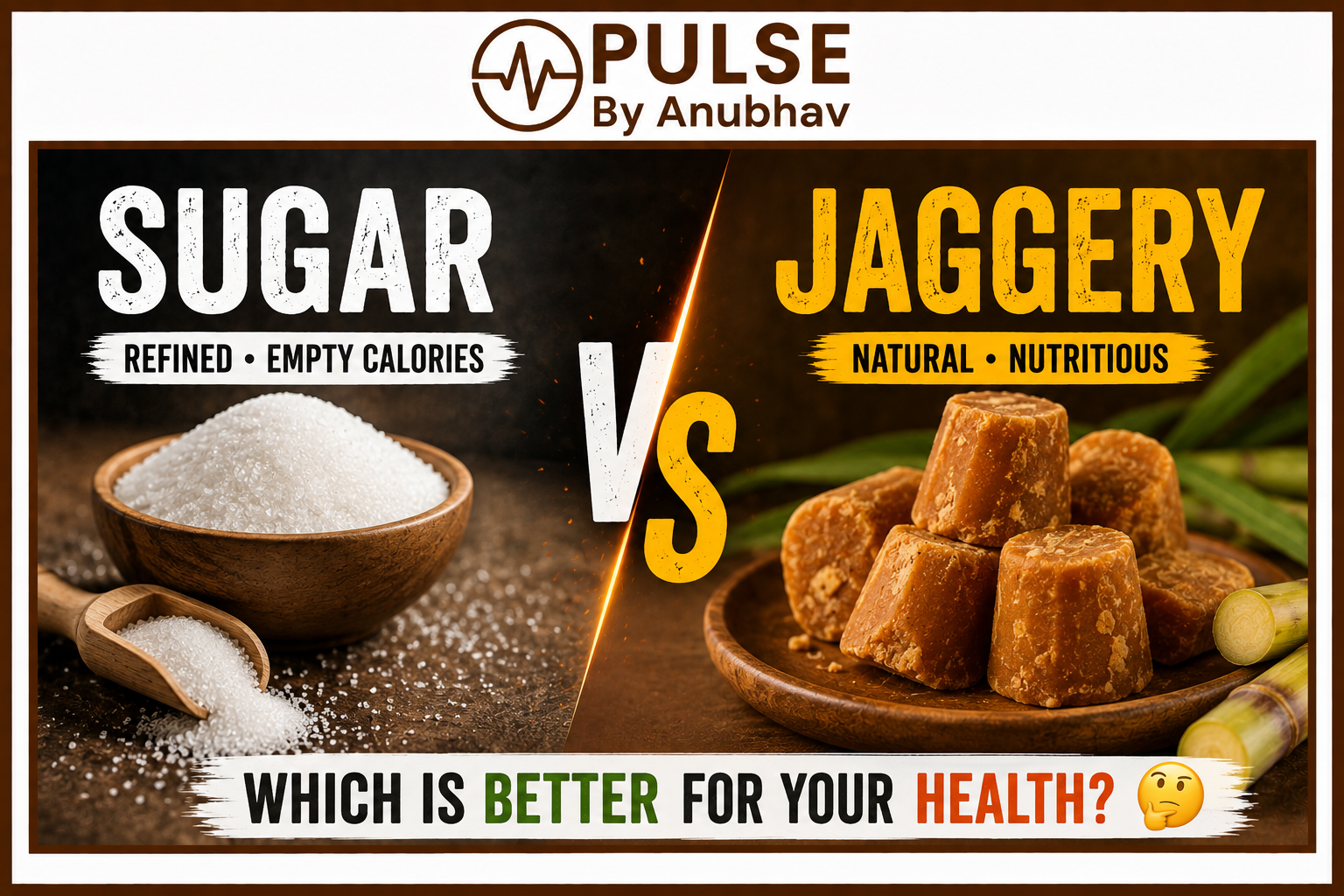
Sugar vs Jaggery: Discover which is healthier, their nutrition, glycemic impact, benefits, side effects, and the better choice for your diet.
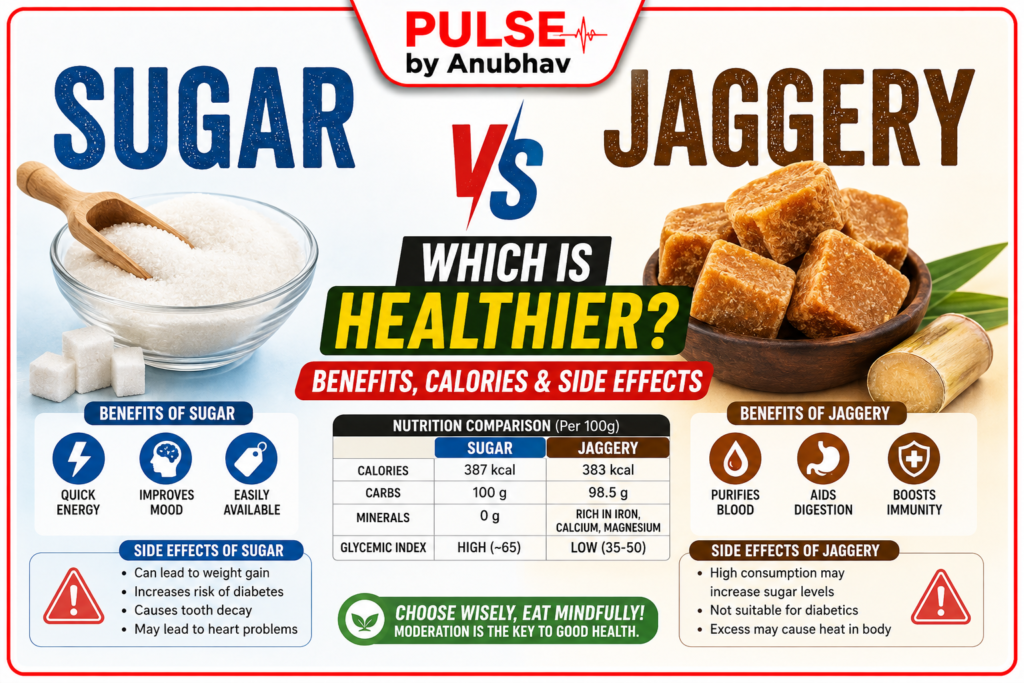
Sugar vs Jaggery is a common debate among people looking for a healthier sweetener. Refined sugar mainly provides calories and carbohydrates with negligible micronutrients, while jaggery is less processed and may retain small amounts of minerals. However, jaggery is still rich in sugar and can raise blood glucose, so it should not be considered a free alternative for people with diabetes. Overall, jaggery has a slight nutritional edge, but moderation matters most. Read more health explainers on Pulse by Anubhav.
Also Read- Tea Addiction: Benefits, Side Effects & How Much Tea Is Safe Daily?
🍬 Sugar vs 🟤 Jaggery: Which Is Better for Your Health? 🤔
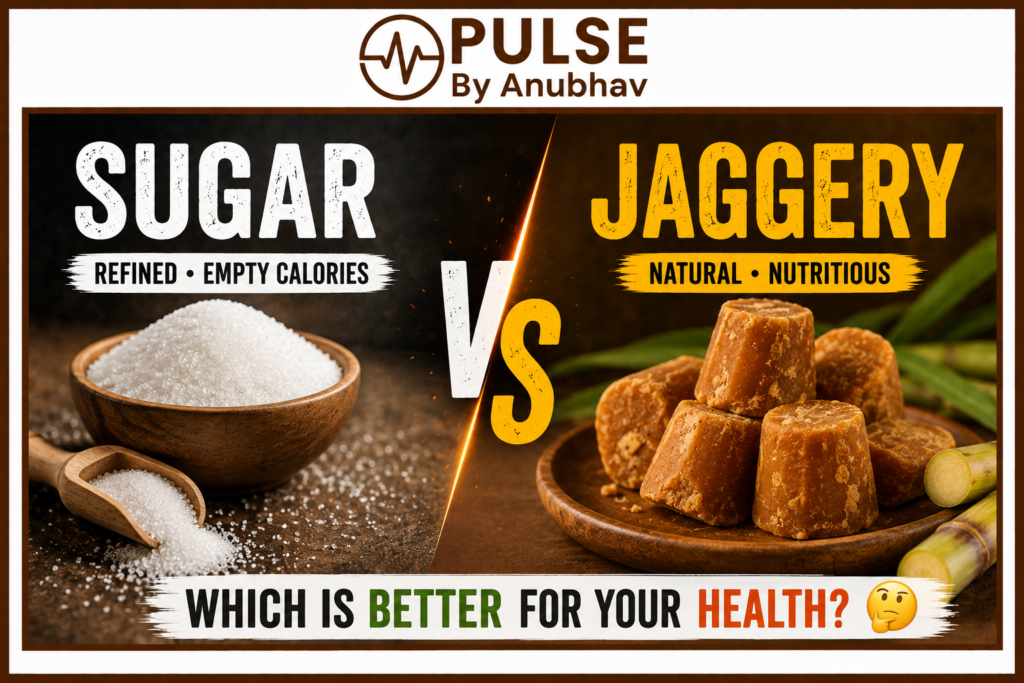
Many people believe that jaggery is completely healthy while refined sugar is always bad. But the reality is a little more complicated. Both are sweeteners, both provide calories, and both can affect blood sugar levels.
The main difference in the Sugar vs Jaggery debate comes down to processing and nutritional content. Jaggery is less refined and retains small amounts of certain minerals, while refined sugar mainly provides carbohydrates and calories.
So, is switching from sugar to jaggery really a healthier choice? Let’s understand the facts.
🥊 What Is Sugar?
Sugar is a refined sweetener commonly produced from sugarcane or sugar beet. During processing, impurities and most naturally occurring micronutrients are removed, leaving a product made primarily of sucrose.
Because refined sugar provides calories with very few vitamins or minerals, it is often described as a source of “empty calories.”
✅ Advantages of Sugar
1. ⚡ Quick Source of Energy:
Sugar is rapidly broken down into glucose, which the body can use as a quick source of energy.
2. 🧁 Improves Taste:
It adds sweetness and enhances the flavor of desserts, beverages, bakery products, and many packaged foods.
3. 📦 Long Shelf Life:
Refined sugar can be stored for a long period when kept properly in a dry environment.
4. 💰 Affordable and Easily Available:
Sugar is inexpensive and widely available, making it one of the most commonly used sweeteners.
Also Read- Sheet Masks: Are They Really Good for Your Skin? Benefits, Risks & Hidden Ingredients
❌ Disadvantages of Excess Sugar
1. 📈 Can Raise Blood Sugar Quickly:
Foods and drinks containing large amounts of added sugar can cause a rapid rise in blood glucose levels.
2. 💉 Excess Intake Is Linked With Type 2 Diabetes Risk:
Frequently consuming high amounts of added sugars—particularly through sugary beverages—may contribute to weight gain and metabolic problems associated with type 2 diabetes.
3. ❤️ May Affect Heart and Metabolic Health:
A diet consistently high in added sugar can contribute to excess calorie intake, obesity, and other cardiovascular risk factors.
4. 🦷 Increases the Risk of Tooth Decay:
Frequent sugar consumption encourages oral bacteria to produce acids that can damage tooth enamel and contribute to cavities.
5. 🍔 Excess Intake May Affect Liver Health:
Regularly consuming excessive amounts of added sugars can contribute to metabolic problems, including fat accumulation in the liver.
6. 😴 Energy Fluctuations:
Highly sugary foods may provide quick energy but can be followed by hunger or a noticeable drop in energy for some people.
7. ❌ Very Few Micronutrients:
Refined white sugar contains negligible amounts of vitamins, minerals, or other beneficial micronutrients.
🟤 What Is Jaggery?
Jaggery, commonly known as Gur in India, is a traditional unrefined sweetener usually prepared by concentrating sugarcane juice. Some varieties can also be made from palm sap.
Unlike refined white sugar, jaggery undergoes less processing. As a result, it can retain small amounts of minerals and other compounds naturally present in its source.
However, this does not make jaggery a low-sugar food. It is still predominantly sugar and should be consumed in moderation.
✅ Advantages of Jaggery
1. 🩸 Contains Some Iron:
Jaggery can contain small amounts of iron, although the amount varies considerably depending on its source and manufacturing process. It should not be relied upon as the primary way to treat or prevent iron deficiency.
2. 🦴 Contains Trace Minerals:
Compared with refined sugar, jaggery may provide small amounts of minerals such as potassium, magnesium, calcium, and phosphorus.
3. 🛡️ Contains Some Antioxidant Compounds:
Because jaggery is less refined, it may retain certain plant compounds that are largely removed during sugar refining.
4. 🌱 Less Processed:
Jaggery typically undergoes fewer refining steps than conventional white sugar.
5. 😋 Distinct Natural Flavor:
Its rich, caramel-like flavor makes jaggery particularly popular in Indian sweets, beverages, and traditional recipes.
Also Read- Egg vs Paneer: Which Is the Best Protein Source for Muscle Gain?
❌ Disadvantages of Jaggery
1. 📈 It Still Raises Blood Sugar:
One of the biggest misconceptions about jaggery is that it does not affect glucose levels. Jaggery remains rich in sugars and can increase blood glucose.
2. 🔥 High in Calories:
Replacing sugar with large quantities of jaggery does not automatically make a diet healthier. Excess consumption can still add significant calories and contribute to weight gain.
3. 🚫 Diabetes Requires Extra Caution:
Jaggery is not a “free food” for people with diabetes. Anyone managing diabetes should consider its carbohydrate content, portion size, overall diet, and advice from their healthcare professional.
4. 🦠 Quality Can Vary:
Jaggery produced or stored under poor hygienic conditions may contain unwanted impurities or contamination. Choosing a reliable source is important.
5. 🦷 Can Still Contribute to Cavities:
Because jaggery contains fermentable sugars, frequent consumption can also contribute to tooth decay.
🚨 Sugar vs Jaggery: Myth vs Fact
❌ Myth: “Jaggery is sugar-free.”
✅ Fact: Jaggery itself is predominantly sugar. It may contain some minerals, but it can still raise blood glucose levels.
❌ Myth: “People with diabetes can eat unlimited jaggery.”
✅ Fact: Jaggery still contributes carbohydrates and calories. People with diabetes should manage portions according to their individual dietary and medical plan.
❌ Myth: “Replacing sugar with jaggery makes sweets healthy.”
✅ Fact: Jaggery may offer a few nutritional advantages over refined sugar, but a sweet containing large quantities of jaggery can still be high in sugar and calories.
🥗 Sugar vs Jaggery: Which Is Better?
If you compare them purely on processing and micronutrient content, jaggery has a slight nutritional edge over refined white sugar because it is less processed and can retain small amounts of minerals.
But that difference should not be exaggerated.
Jaggery is not a health food that can be consumed without limits. Both sugar and jaggery are calorie-dense sweeteners, and excessive consumption of either can make it harder to maintain a balanced diet.
So instead of asking only “Sugar or jaggery—which is healthier?”, the more important question is “How much am I consuming?”
Also Read- Painkillers: Benefits, Side Effects & Hidden Dangers of Taking Them Too Often
Sugar vs Jaggery: Glycemic Index, Diabetes, Brown Sugar & Mishri Compared
Sugar vs Jaggery Glycemic Index
Both sugar and jaggery can raise blood glucose. Jaggery contains some minerals because it is less refined, but that does not make it a low-glycemic or sugar-free sweetener.
| Factor | Refined Sugar 🍬 | Jaggery 🟤 |
|---|---|---|
| Main carbohydrate | Mostly sucrose | Mostly sugars, including sucrose |
| Blood sugar impact | Can raise glucose quickly | Can also raise glucose significantly |
| Processing | Highly refined | Less refined |
| Micronutrients | Negligible | Small amounts may remain |
Is Jaggery Better Than Sugar for Diabetics?
Jaggery may look like the healthier option, but people with diabetes should remember one important fact: jaggery is still a sugar-rich sweetener and can increase blood glucose.
Although it may contain traces of minerals such as iron, potassium and magnesium, these small amounts do not cancel out its sugar content.
Brown Sugar vs Jaggery: Which Is Better?
Brown sugar and jaggery may look similar, but they are not the same. Brown sugar is generally refined sugar containing molasses, while traditional jaggery is made by concentrating sugarcane juice or, in some varieties, palm sap.
| Feature | Brown Sugar | Jaggery |
|---|---|---|
| Processing | Usually more refined | Generally less refined |
| Flavor | Mild molasses flavor | Deeper, earthy/caramel-like flavor |
| Minerals | Very small amounts | May contain slightly more trace minerals |
| Calories | High | High |
| Best choice? | Jaggery may have a small micronutrient advantage, but moderation matters more than choosing between the two. | |
Sugar vs Jaggery Taste: What’s the Difference?
White sugar gives a clean and straightforward sweetness without adding much extra flavor. This makes it easy to use in tea, coffee, cakes, desserts and beverages.
Jaggery has a stronger and more complex flavor that can taste earthy, caramel-like or slightly smoky depending on how it is made. This is why gur works particularly well in traditional Indian sweets, chikki, laddoo and certain drinks.
Mishri vs Sugar vs Jaggery: Which Is Better?
Mishri, refined sugar and jaggery are all used as sweeteners, but their processing and micronutrient content can differ. None should be treated as an unlimited healthy food simply because it is traditional or less processed.
| Feature | Mishri | Sugar | Jaggery |
|---|---|---|---|
| Sweetness | Sweet | Sweet | Sweet with richer flavor |
| Primary role | Sweetener | Sweetener | Sweetener |
| Micronutrients | Generally minimal | Negligible | Small amounts may be present |
| Blood glucose | Can raise it | Can raise it | Can raise it |
| Overall | Use moderately | Use moderately | Slight nutritional edge, but still limit intake |
💡 Healthy Tips for Using Sugar and Jaggery
✅ If you enjoy jaggery, you can use it as an alternative to refined sugar for its flavor and small amount of micronutrients.
✅ Keep your overall intake of added or free sugars low, regardless of whether they come from refined sugar or jaggery.
😱Check nutrition labels because packaged drinks, cereals, sauces, biscuits, and snacks can contain significant amounts of added sugars.
✅ Avoid assuming that products labelled “made with jaggery” are automatically healthy.
✅ Build most of your diet around fruits, vegetables, whole grains, legumes, nuts, and appropriate protein sources rather than relying on sweeteners for nutrition.
❤️ Bottom Line: Is Jaggery Better Than Sugar?
In the Sugar vs Jaggery comparison, jaggery has a small nutritional advantage because it is less refined and can contain trace amounts of minerals that refined white sugar lacks.
But the difference isn’t big enough to make unlimited jaggery consumption healthy.
🍬 Sugar: Highly refined and provides mainly calories and carbohydrates.
🟤 Jaggery: Less refined and contains some micronutrients, but is still high in sugar and calories.
🏆 Better approach: Whichever you choose, keep the quantity moderate.
For more simple, practical and evidence-aware health comparisons, stay connected with Pulse by Anubhav. 💊
💬 What do you use more often—🍬 Sugar or 🟤 Jaggery? Share your choice in the comments!
Also Read- Intermittent Fasting: Benefits, Risks, Methods & Is It Really Healthy?
🍬 Sugar vs Jaggery FAQs
Quick answers about jaggery, sugar, glycemic impact, diabetes, calories and other popular sweeteners.
2 thoughts on “Sugar vs Jaggery: Which Is Healthier? Benefits, Calories & Side Effects”