You will get here Chemistry Class 12 CBSE Notes and MCQs Chapter 10: Biomolecules . You can connect with us for every important update related to class 12.
Chemistry is a very important subject for your board exam because it will help you increase your percentage and give big support in your entrance exam like JEE and NEET. You can score high marks in this subject by studying notes and practicing MCQs. In this post, we will cover Chapter 10: Biomolecules.
✅ Correct Answer: Polyhydroxy aldehydes or ketones
Q2. Which of the following is a monosaccharide?
A. Glucose
B. Sucrose
C. Lactose
D. Starch
✅ Correct Answer: Glucose
Q3. Which of the following is a non-reducing sugar?
A. Sucrose
B. Maltose
C. Lactose
D. Glucose
✅ Correct Answer: Sucrose
Q4. Proteins are polymers of:
A. Amino acids
B. Fatty acids
C. Nucleotides
D. Monosaccharides
✅ Correct Answer: Amino acids
Q5. Peptide bond is formed between:
A. –COOH and –NH₂ groups
B. Two –OH groups
C. Two –COOH groups
D. Two –NH₂ groups
✅ Correct Answer: –COOH and –NH₂ groups
Q6. Denaturation of proteins involves:
A. Loss of biological activity
B. Breaking peptide bonds
C. Formation of amino acids
D. Increase in primary structure
✅ Correct Answer: Loss of biological activity
Q7. Enzymes are chemically:
A. Proteins
B. Lipids
C. Vitamins
D. Carbohydrates
✅ Correct Answer: Proteins
Q8. Which vitamin is fat soluble?
A. Vitamin A
B. Vitamin B
C. Vitamin C
D. Vitamin B12
✅ Correct Answer: Vitamin A
Q9. DNA contains which sugar?
A. Deoxyribose
B. Ribose
C. Glucose
D. Fructose
✅ Correct Answer: Deoxyribose
Q10. Which of the following is NOT present in DNA?
A. Adenine
B. Guanine
C. Uracil
D. Cytosine
✅ Correct Answer: Uracil
Chemistry Chapter 10 Biomolecules Quick Revision
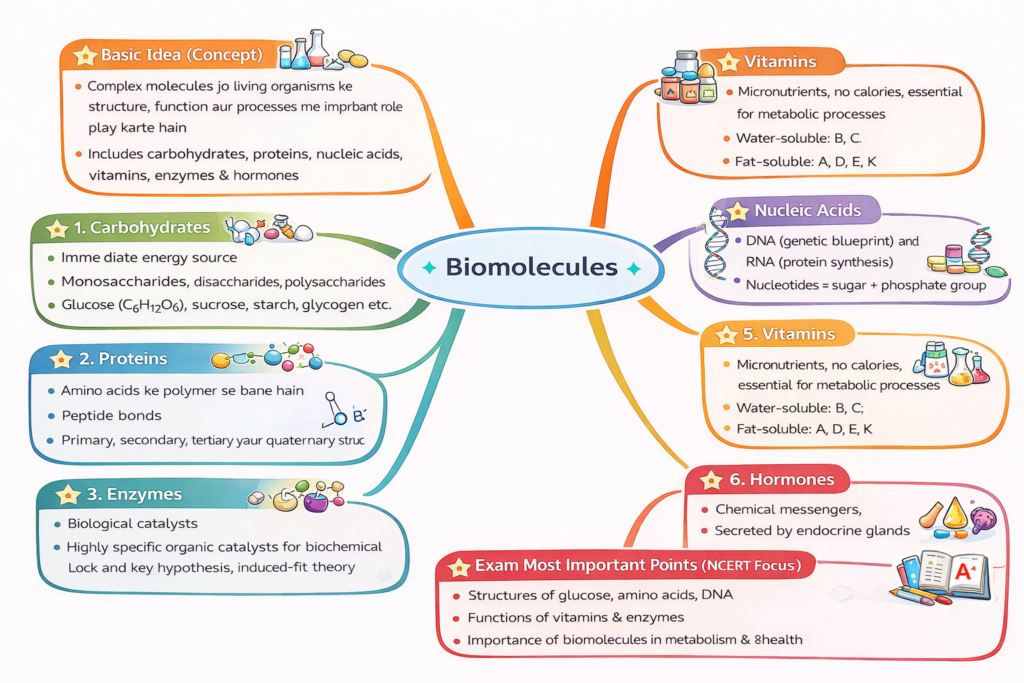
🔹 Basic Idea (Real Life + Concept) Biomolecules living organisms me naturally present organic compounds hote hain jo growth, energy production, metabolism aur body functions ko control karte hain. Main biomolecules carbohydrates, proteins, vitamins aur nucleic acids hote hain.
🔹 Carbohydrates (Definition) Carbohydrates polyhydroxy aldehydes ya ketones hote hain jo body ko energy provide karte hain (example: glucose, starch).
🔹 Classification of Carbohydrates Carbohydrates ko monosaccharides (glucose), oligosaccharides (sucrose) aur polysaccharides (starch, cellulose) me divide kiya jata hai.
🔹 Glucose Sabse important carbohydrate hai jo body ka main energy source hai aur aldohexose structure show karta hai.
🔹 Proteins (Definition) Proteins amino acids ke polymers hote hain jo body growth, repair aur enzyme formation me help karte hain.
🔹 Amino Acids Amino acids me –NH₂ aur –COOH group hota hai aur ye peptide bond se judkar proteins banate hain.
🔹 Structure of Proteins Proteins ki primary, secondary, tertiary aur quaternary structure hoti hai jo unki shape aur function decide karti hai.
🔹 Denaturation of Proteins Heat ya pH change se protein ka structure destroy ho jata hai aur biological activity khatam ho jati hai.
🔹 Enzymes (Definition) Enzymes biological catalysts hote hain jo biochemical reactions ki speed badhate hain bina khud change hue.
Carbohydrates are optically active polyhydroxy aldehydes or ketones that provide energy to living organisms. Examples include glucose, starch and sucrose.
What are proteins?
Proteins are polymers of amino acids linked by peptide bonds. They help in growth, repair of body tissues and perform structural and functional roles in living organisms.
What are enzymes?
Enzymes are biological catalysts made of proteins that speed up chemical reactions in living organisms without being consumed.
What are vitamins?
Vitamins are organic compounds required in small amounts for normal growth and health. They are classified as fat-soluble and water-soluble vitamins.
What are nucleic acids?
Nucleic acids are biomolecules responsible for heredity and protein synthesis. They include DNA and RNA.
What is the difference between DNA and RNA?
DNA contains deoxyribose sugar and thymine base and is double stranded, while RNA contains ribose sugar and uracil base and is single stranded.
What are hormones?
Hormones are chemical messengers produced by endocrine glands that regulate body functions like growth, metabolism and reproduction.
Why is Biomolecules chapter important for exams?
This chapter is important because it covers carbohydrates, proteins, vitamins, DNA, RNA and enzymes which are frequently asked in CBSE board exams.
4 thoughts on “CBSE Class 12 Chemistry Chapter 10: Biomolecules – Notes + MCQs | Quick Revision”