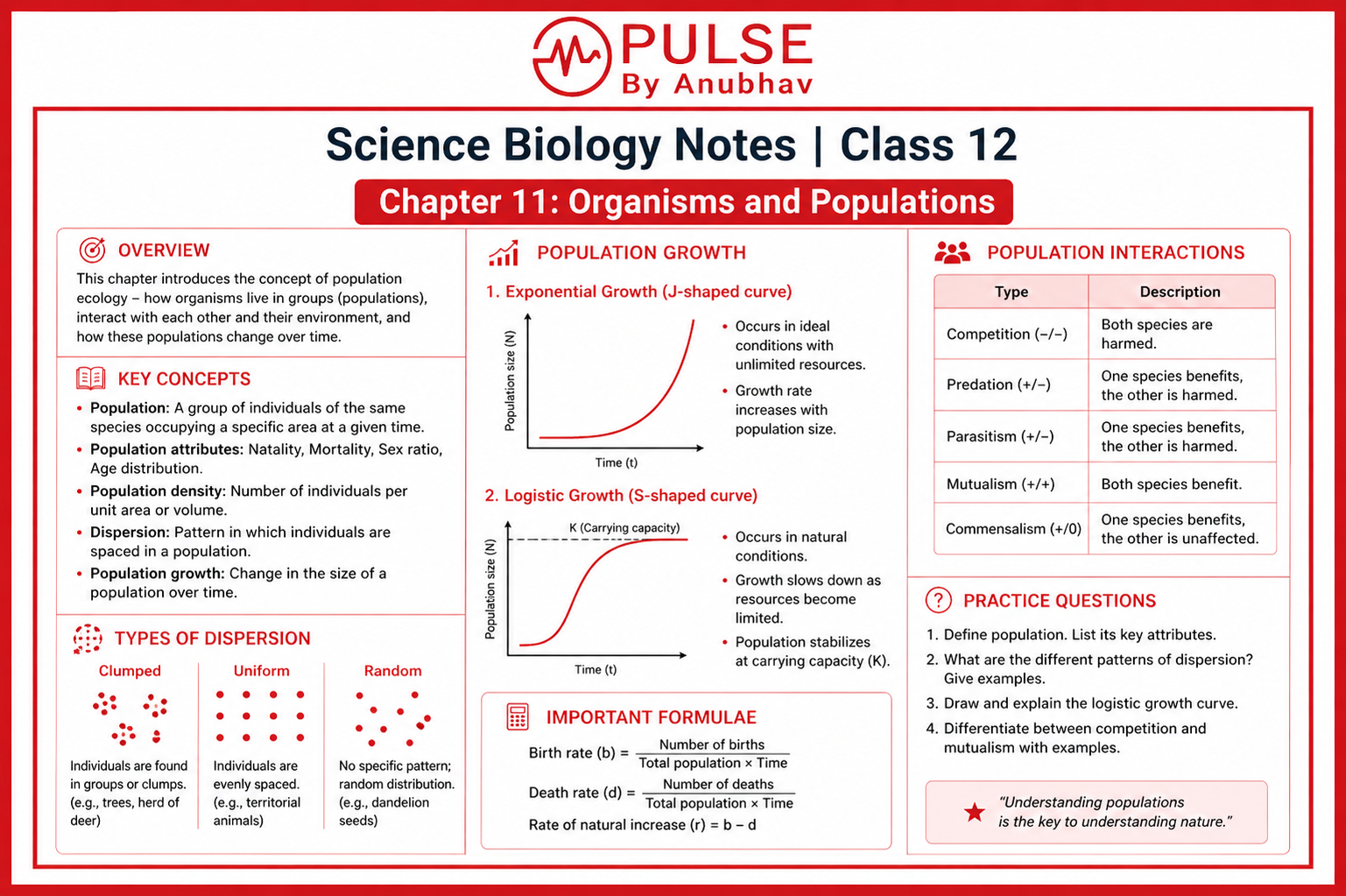
You will get here Science Biology class 12 CBSE notes Chapter 11: Organisms and Populations. You can connect with us for every important update related to class 12.
Science Biology is a very important subject for you because it will help you increase your percentage as well as it is an important subject for your medical entrance exam. You can score high marks in this subject by studying notes and practicing MCQs. In this post, we will cover Chapter 11: Organisms and Populations.
Also Read- Moushumi Chatterjee: Married at 15, Mother at 17 – The Actress Who Even Took On Raaj Kumar
Key Content Of Chapter 11 Organisms and Populations
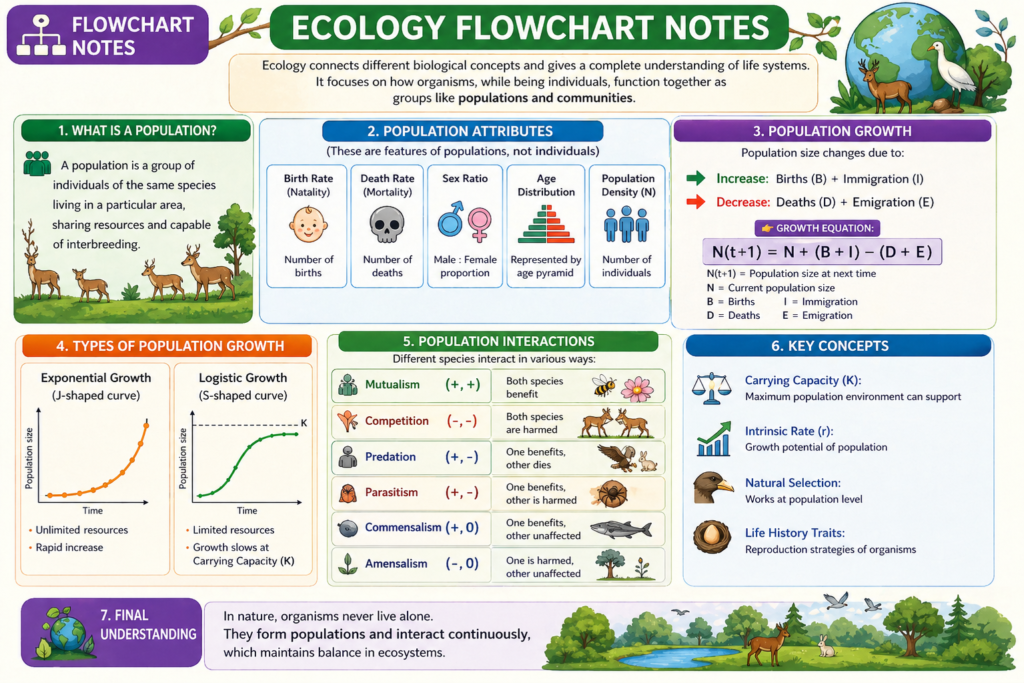
Ecology connects different biological concepts and gives a complete understanding of life systems. It focuses on how organisms, while being individuals, function together as groups like populations and communities.
🔹 What is a Population?
A population is a group of individuals of the same species living in a particular area, sharing resources and capable of interbreeding.
🔹 Population Attributes
(These are features of populations, not individuals)
- Birth Rate (Natality) → Number of births
- Death Rate (Mortality) → Number of deaths
- Sex Ratio → Male : Female proportion
- Age Distribution → Represented by age pyramid
- Population Density (N) → Number of individuals
🔹 Population Growth
Population size changes due to:
- Increase: Births (B) + Immigration (I)
- Decrease: Deaths (D) + Emigration (E)
👉 Growth Equation:
N(t+1) = N + (B + I) – (D + E)
🔹 Types of Population Growth
- Exponential Growth (J-shaped curve)
- Unlimited resources
- Rapid increase
- Logistic Growth (S-shaped curve)
- Limited resources
- Growth slows at Carrying Capacity (K)
🔹 Population Interactions
Different species interact in various ways:
- Mutualism (+,+) → Both benefit
- Competition (-,-) → Both harmed
- Predation (+,-) → One benefits, other dies
- Parasitism (+,-) → One benefits, other harmed
- Commensalism (+,0) → One benefits, other unaffected
- Amensalism (-,0) → One harmed, other unaffected
🔹 Key Concepts
- Carrying Capacity (K): Maximum population environment can support
- Intrinsic Rate (r): Growth potential of population
- Natural Selection: Works at population level
- Life History Traits: Reproduction strategies of organisms
🔹 Final Understanding
In nature, organisms never live alone. They form populations and interact continuously, which maintains balance in ecosystems.
Also Read- Class 12 Physical Education Notes (Chapter Wise) – CBSE Guide
Class 12 Science Biology Chapter 11: Organisms and Populations Notes
Class 12 Biology Chapter 11 Organisms and Populations MCQs
Also Read:- Shruti Haasan Profile: Age, Height, Facts & Big Update on Peddi Song with Ram Charan
FAQs About Organisms and Populations
Class 12 Biology Notes – All Chapters (Pulse by Anubhav)
| Chapter | Topic | Open |
|---|---|---|
| Chapter I | Sexual Reproduction in Flowering Plants | View → |
| Chapter II | Human Reproduction | View → |
| Chapter III | Reproductive Health | View → |
| Chapter IV | Principles of Inheritance and Variation | View → |
| Chapter V | Molecular Basis of Inheritance | View → |
| Chapter VI | Evolution | View → |
| Chapter VII | Human Health and Disease | View → |
| Chapter VIII | Microbes in Human Welfare | View → |
| Chapter IX | Biotechnology: Principles and Processes | View → |
| Chapter X | Biotechnology and its Applications | View → |
| Chapter XI | Organisms and Populations | View |
| Chapter XII | Ecosystem | View → |
| Chapter XIII | Biodiversity And Conservation | View → |
1 thought on “Science Biology Notes | Class 12 – Chapter 11: Organisms and Populations”