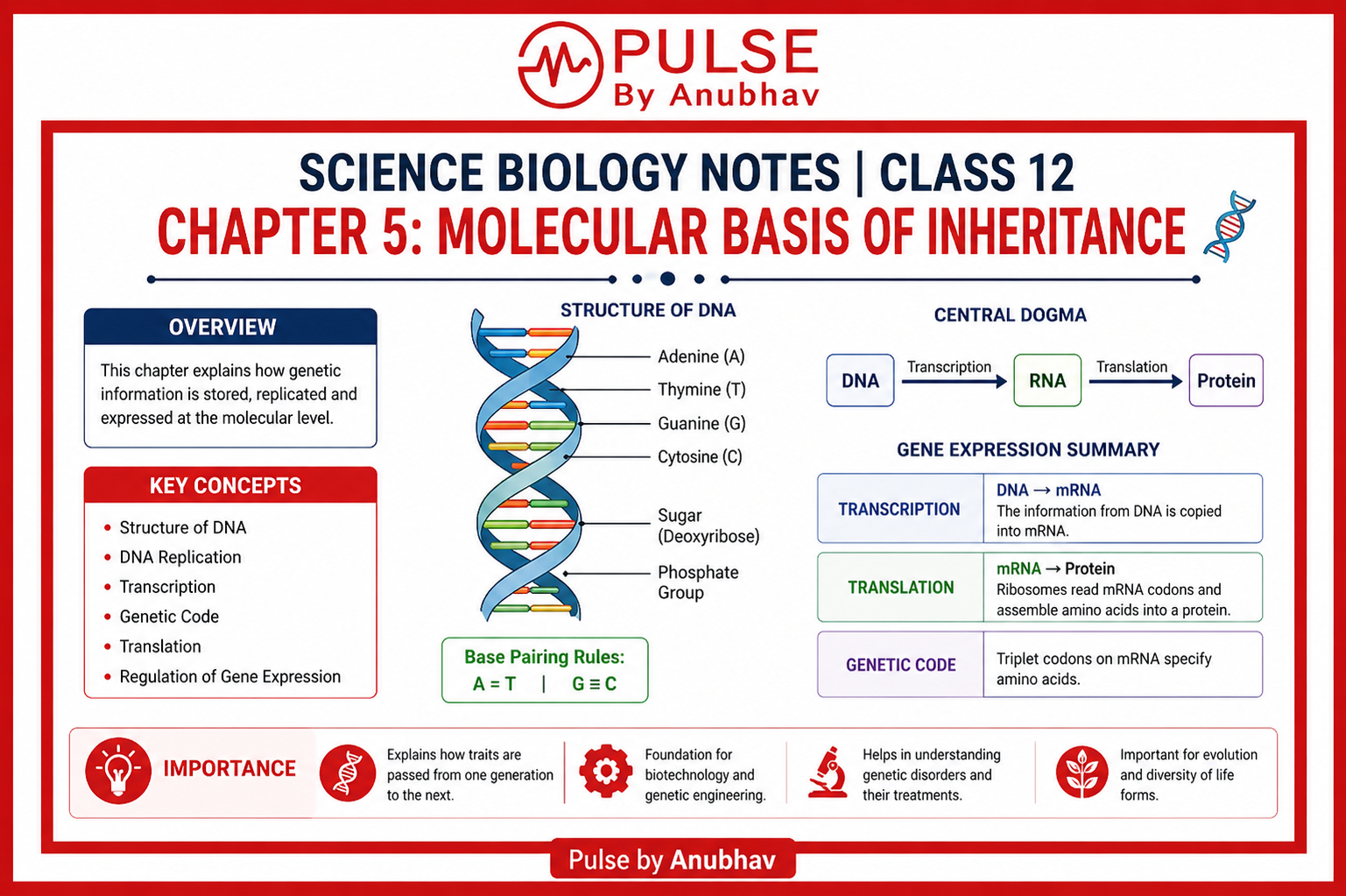
You will get here Science Biology class 12 CBSE notes Chapter 5: Molecular Basis Of Inheritance. You can connect with us for every important update related to class 12.
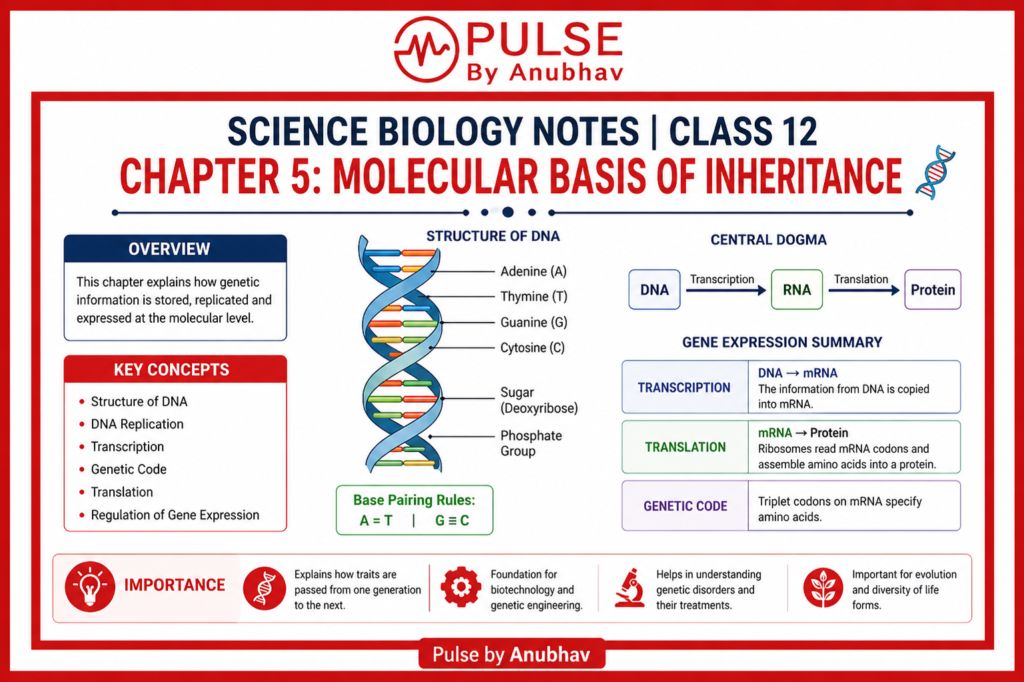
Science Biology is a very important subject for you because it will help you increase your percentage as well as it is an important subject for your medical entrance exam. You can score high marks in this subject by studying notes and practicing MCQs. In this post, we will cover Chapter 5: Molecular Basis Of Inheritance.
Also Read- Moushumi Chatterjee: Married at 15, Mother at 17 – The Actress Who Even Took On Raaj Kumar
Key Content Of Chapter 5 Molecular Basis Of Inheritance
Pulse by Anubhav 🚀
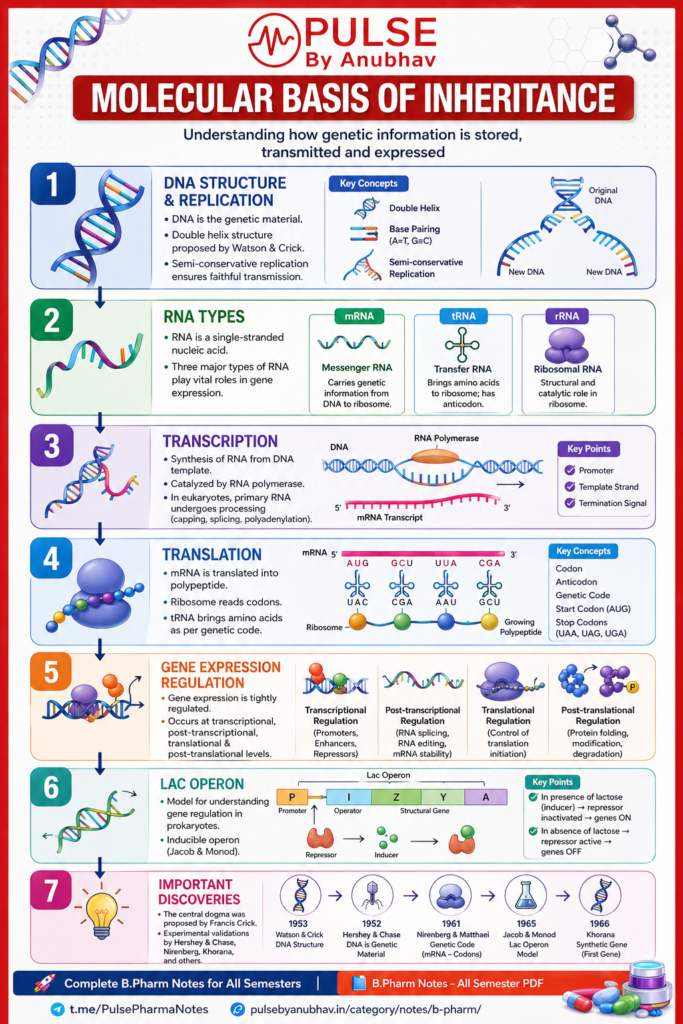
- Molecular Basis Of Inheritance explains how genetic information is stored, copied, and expressed in living organisms.
- DNA (Deoxyribonucleic Acid) is the primary genetic material in most organisms.
- DNA is made up of nucleotides, each containing:
- Nitrogenous base
- Deoxyribose sugar
- Phosphate group
Structure of DNA
- DNA has a double helix structure (Watson & Crick, 1953)
- Two strands are anti-parallel
- Base pairing rule:
- Adenine (A) = Thymine (T) → 2 H-bonds
- Guanine (G) = Cytosine (C) → 3 H-bonds
- Backbone = Sugar + Phosphate
RNA (Ribonucleic Acid)
- Acts mainly as messenger and functional molecule
- Types:
- mRNA → carries genetic message
- tRNA → brings amino acids
- rRNA → forms ribosomes
Search for Genetic Material
- Griffith → discovered transforming principle
- Avery, MacLeod, McCarty → proved DNA is genetic material
- Hershey & Chase → confirmed DNA (not protein) is genetic material
RNA World
- RNA was the first genetic material
- DNA evolved later because it is more stable
DNA Replication
- Occurs in semiconservative manner
- Each daughter DNA = 1 parental + 1 new strand
- Enzyme: DNA polymerase
- Takes place at replication fork
Transcription
- Formation of RNA from DNA
- Only one DNA strand acts as template
- Main parts:
- Promoter
- Structural gene
- Terminator
Genetic Code
- Code is triplet (codon)
- Total codons = 64
- 61 code for amino acids
- 3 are stop codons
- Features:
- Degenerate
- Universal
- AUG = Start codon
Translation
- Process of protein synthesis from mRNA
- Occurs in ribosomes
- tRNA helps in bringing amino acids
- Forms polypeptide chain
Regulation of Gene Expression
- Controls when genes are active or inactive
- Example: Lac Operon (E. coli)
- Lactose acts as inducer
- Regulates enzyme production
Human Genome Project (HGP)
- Aim: Sequence complete human DNA
- Key facts:
- ~3 billion base pairs
- ~20,000–25,000 genes
- Introduced Bioinformatics
DNA Fingerprinting
- Technique to identify individuals
- Based on DNA polymorphism
- Uses VNTR sequences
Applications:
- Crime investigation
- Paternity testing
- Genetic identification
👉 Flow: Flower → Pollination → Fertilisation → Seed → Fruit
Also Read- Class 12 Physical Education Notes (Chapter Wise) – CBSE Guide
Class 12 Science Biology Chapter 5: Molecular Basis Of Inheritance Notes
Class 12 Biology Chapter 5 Molecular Basis Of Inheritance MCQs
Also Read:- Shruti Haasan Profile: Age, Height, Facts & Big Update on Peddi Song with Ram Charan
FAQs About Molecular Basis Of Inheritance
Class 12 Biology Notes – All Chapters (Pulse by Anubhav)
| Chapter | Topic | Open |
|---|---|---|
| Chapter I | Sexual Reproduction in Flowering Plants | View → |
| Chapter II | Human Reproduction | View → |
| Chapter III | Reproductive Health | View → |
| Chapter IV | Principles of Inheritance and Variation | View → |
| Chapter V | Molecular Basis of Inheritance | View → |
| Chapter VI | Evolution | View → |
| Chapter VII | Human Health and Disease | View → |
| Chapter VIII | Microbes in Human Welfare | View → |
| Chapter IX | Biotechnology: Principles and Processes | View → |
| Chapter X | Biotechnology and its Applications | View → |
| Chapter XI | Organisms and Populations | View |
| Chapter XII | Ecosystem | View → |
| Chapter XIII | Biodiversity And Conservation | View → |
1 thought on “Science Biology Notes | Class 12 – Chapter 5: Molecular Basis Of Inheritance”